
The Digital Currency Battle Begins
The global financial system is on the brink of a transformation. Central banks are testing state-backed digital money, while decentralized networks continue to grow at record speed.


This conflict between CBDC vs Cryptocurrency represents more than technology, it is a struggle over trust, privacy, and the meaning of financial freedom.
Governments frame central bank digital currencies as modern solutions for payments and stability. Supporters of Bitcoin and Ethereum see them instead as tools for surveillance and control. The truth, as always, lies somewhere in the tension between innovation and power.
What Exactly Are CBDCs?
A central bank digital currency, or CBDC, is a digital form of a nation’s fiat money issued directly by its monetary authority. Unlike physical cash, it exists only electronically and is fully centralized.
According to the Bank for International Settlements, over 130 countries are exploring CBDCs, with more than a dozen already in pilot programs. Their goals vary: speeding up payments, improving cross-border transfers, and giving governments better oversight of monetary flows.
The idea is simple: if central banks already control physical currency, why not digitize it and provide the same trust through secure, government-backed ledgers?
Public Cryptocurrencies: Built on Open Networks
On the other side of the debate, public cryptocurrencies like Bitcoin and Ethereum operate without centralized control. These systems rely on blockchain technology, where transactions are validated by distributed participants rather than government institutions.
This decentralization is the defining difference in the CBDC vs Cryptocurrency debate. Public coins are borderless, resistant to censorship, and operate on transparent code.
No government can shut down Bitcoin or dictate its issuance schedule. That independence makes crypto appealing to those seeking protection from inflation, capital controls, or political instability.
Privacy vs Control: The Core Divide
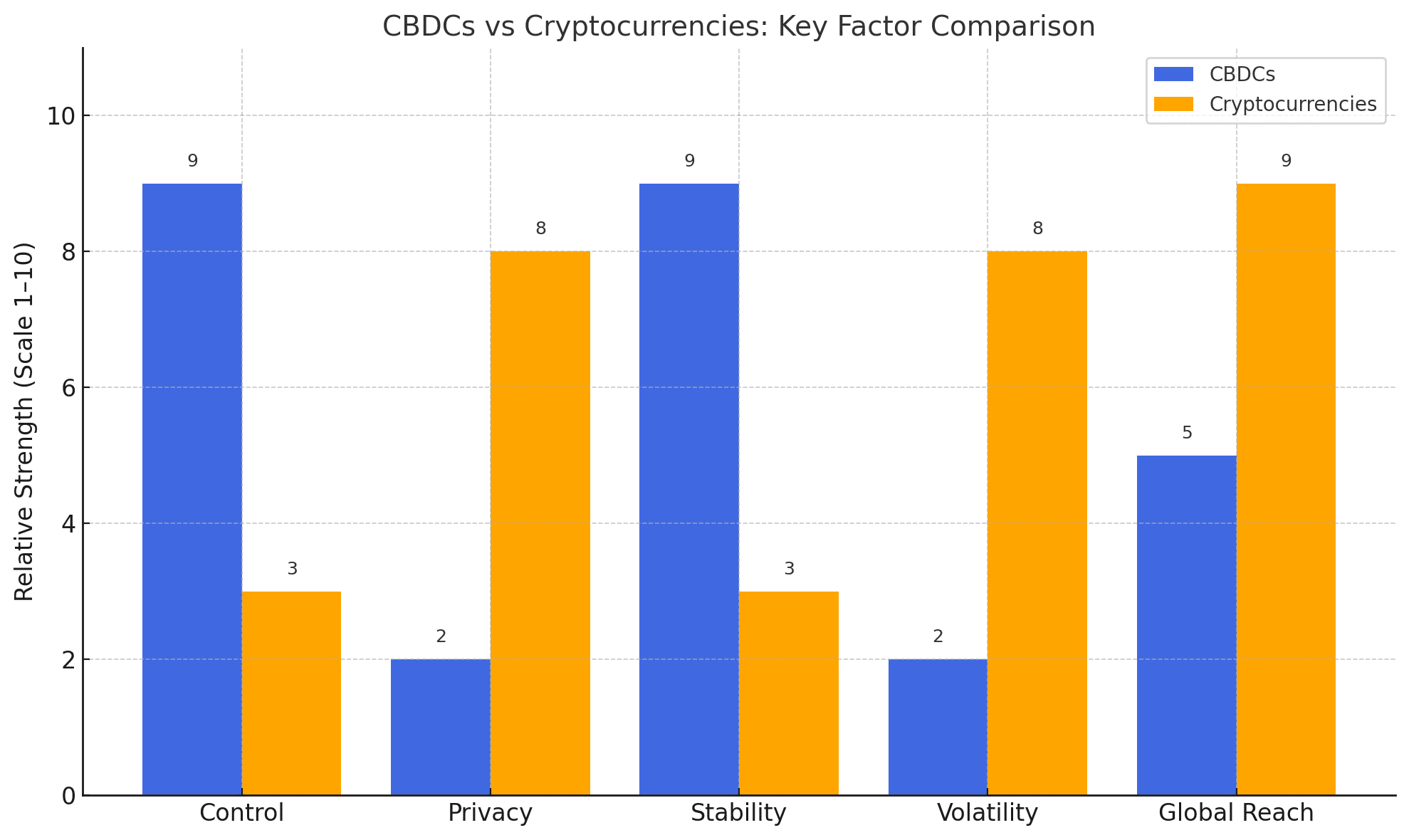
The most striking contrast between CBDC vs Cryptocurrency is privacy. With CBDCs, governments can theoretically monitor every transaction in real time. Proponents argue this helps combat money laundering and tax evasion. Critics warn it could lead to unprecedented financial surveillance.
Public cryptocurrencies lean toward transparency at the network level but still allow pseudonymity. A user’s wallet is visible on the blockchain, but their real identity often remains hidden. For those prioritizing financial privacy, this feature has made cryptocurrencies a haven against centralized oversight.
Stability vs Volatility
Central banks highlight stability as the biggest advantage in the CBDC vs Cryptocurrency divide. Since CBDCs are pegged to national currencies, they do not fluctuate like Bitcoin or Ethereum. This makes them attractive for everyday payments and settlements.
Cryptocurrencies, by contrast, often experience sharp price swings. Bitcoin’s price can move 10% in a single day, making it unreliable for short-term use as currency. However, many investors see this volatility as a feature rather than a flaw.
It provides opportunities for returns, and over the long run, Bitcoin has outperformed nearly every traditional asset class.
The Geopolitical Angle: Dollar vs Decentralization
The rise of CBDCs also ties into global power struggles. China has already launched its digital yuan, aiming to reduce reliance on the U.S. dollar in international trade. Other nations are racing to catch up, fearing that being left behind could weaken their economic influence.
For cryptocurrencies, this geopolitical dynamic works differently. They are not tied to any state, which makes them appealing for cross-border transactions. In countries with failing currencies, Bitcoin often acts as an escape valve. This global accessibility puts crypto at the center of debates about financial independence.
Risks That Cannot Be Ignored
Both CBDCs and cryptocurrencies carry risks. A CBDC system could become a target for cyberattacks or misuse by authoritarian regimes. Meanwhile, cryptocurrencies face concerns over regulatory crackdowns, environmental impact from mining, and use in illicit activities.
The Financial Stability Board has warned that large-scale adoption of unregulated crypto could create systemic risks. At the same time, watchdog groups worry that CBDCs might give governments excessive control over individual spending. These parallel risks make the CBDC vs Cryptocurrency question not just a matter of preference but of long-term societal impact.
Can They Coexist?
Some analysts believe CBDCs and cryptocurrencies will not cancel each other out but will serve different purposes. CBDCs may dominate in retail payments, government transfers, and regulated banking.
Public cryptocurrencies may remain the preferred option for decentralized finance (DeFi), long-term investment, and global remittances outside traditional systems.


In this blended future, consumers may use both: CBDCs for everyday shopping and crypto for hedging wealth or exploring financial independence. The competition is not necessarily zero-sum but will depend heavily on how governments regulate and how innovators respond.
Conclusion: The Future of Money is a Battle of Ideas
The clash of CBDC vs Cryptocurrency is about more than technology, it is a contest of ideologies. Central banks promise stability, while public blockchains promise freedom. Each has strengths, weaknesses, and risks that will shape the financial world for decades.
Ultimately, the future of money may not be about one side winning but about how societies balance control and liberty. For developers and analysts alike, this debate is not just academic; it is the blueprint for tomorrow’s economy.
Disclaimer
This article is for informational purposes only and does not constitute financial advice. Readers should conduct their own research before making any investment decisions.
Glossary of Terms
CBDC: Central bank digital currency, state-issued digital fiat money.
Cryptocurrency: Decentralized digital asset running on a blockchain network.
Blockchain: A distributed ledger technology that records transactions across multiple nodes.
Volatility: Rapid price changes over short periods, common in crypto assets.
DeFi (Decentralized Finance): Financial systems built on public blockchains without intermediaries.
Dollarization: The reliance on the U.S. dollar as a global settlement currency.
Financial Surveillance: Government monitoring of financial activities through centralized systems.
Frequently Asked Questions about CBDC vs Cryptocurrency
1. What is the difference between CBDC and Cryptocurrency?
CBDCs are centralized, state-backed digital money, while cryptocurrencies are decentralized and operate on public blockchains.
2. Are CBDCs safer than cryptocurrencies?
CBDCs are stable because they are pegged to national currencies, while cryptocurrencies face volatility but provide decentralization.
3. Can CBDCs replace Bitcoin?
Unlikely. CBDCs serve payments and state functions, while Bitcoin is viewed as a global store of value.
4. Do CBDCs threaten financial privacy?
Yes. CBDCs allow central banks to monitor transactions, raising surveillance concerns absent in decentralized systems.
5. Will CBDCs and cryptocurrencies coexist?
Yes. Analysts expect CBDCs for daily use and cryptocurrencies for investment, DeFi, and global transfers.