A Political Crisis With Global Financial Ripples
When the words U.S. Government Shutdown hit the headlines, markets brace for turbulence. These shutdowns, often triggered by budget deadlocks in Congress, halt non-essential federal operations.


While the impact on traditional sectors like public services is well-documented, the crypto community now faces a pressing question: what happens to Bitcoin and digital assets when Washington grinds to a halt?
Bitcoin as a Safe-Haven Narrative Put to the Test
Bitcoin has often been described as “digital gold.” During times of uncertainty, investors historically shift toward safe-haven assets. A U.S. Government Shutdown may rekindle that narrative. The logic is straightforward: when trust in government functions falters, decentralized money looks more appealing.
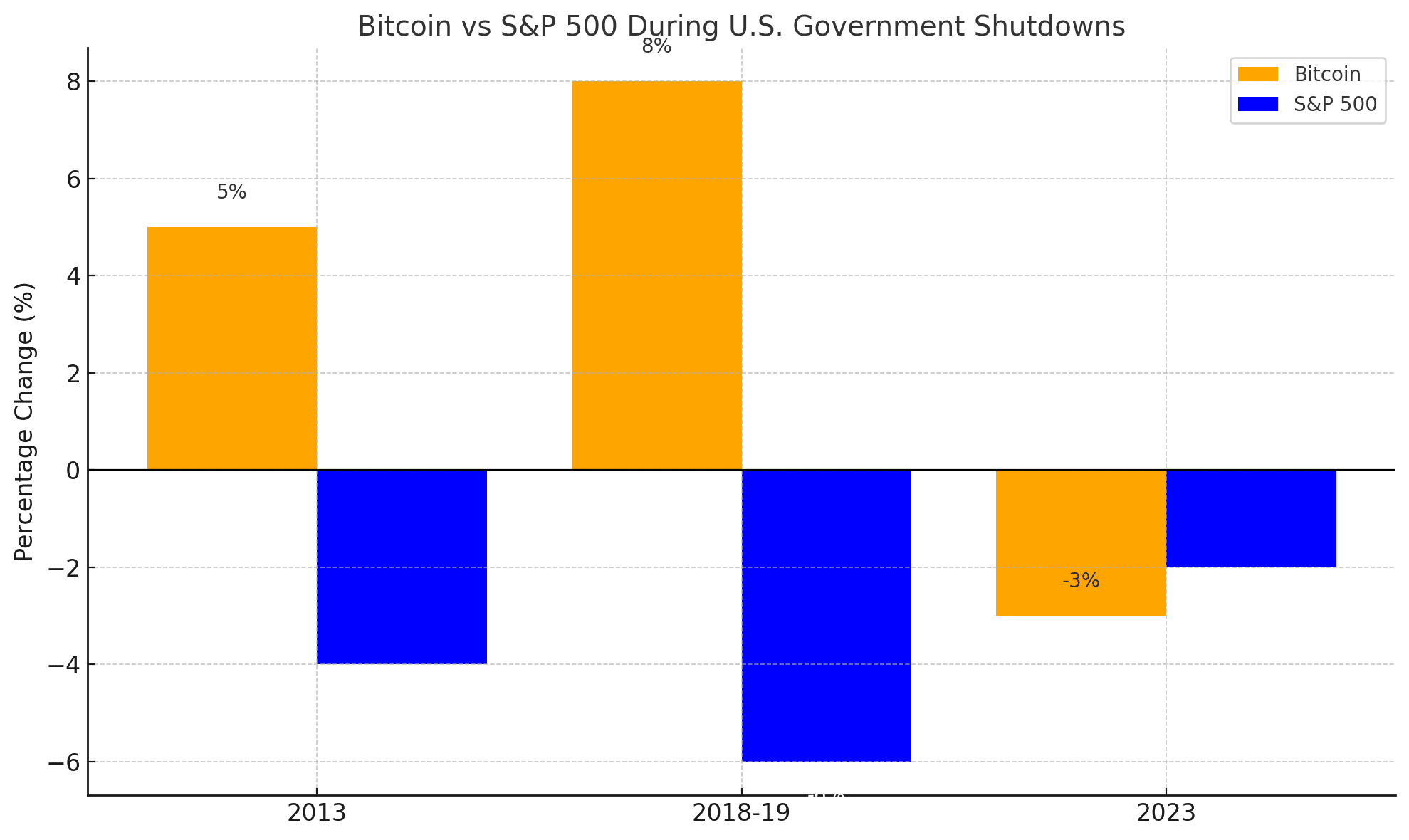
Data from CoinMarketCap shows that during the 2018–2019 shutdown, Bitcoin posted modest gains while equity markets struggled. Although correlation does not always equal causation, the case highlights how political dysfunction can spark renewed interest in alternative stores of value.
Delays in Crypto Regulation and ETF Approvals
One of the most significant side effects of a U.S. Government Shutdown is the freezing of regulatory processes. Agencies like the Securities and Exchange Commission (SEC) and the Commodity Futures Trading Commission (CFTC) operate with reduced staff. That means crypto ETF filings, enforcement actions, and policy updates are pushed aside.
For investors awaiting clarity on Bitcoin ETFs or Ethereum-related products, such delays can be frustrating. According to Reuters, shutdowns have historically delayed SEC decision-making on financial instruments, creating uncertainty that spills over into markets. For crypto, where regulatory clarity is already scarce, these delays can stall momentum and adoption.
Liquidity Pressures and Dollar Volatility
The U.S. Government Shutdown also rattles global perceptions of the U.S. dollar. If prolonged, it raises doubts about America’s fiscal stability. That pressure can weaken the dollar, which often has a direct impact on Bitcoin and crypto markets.
A weaker dollar historically drives investors toward assets seen as hedges. Bitcoin, with its capped supply, becomes attractive in such scenarios.
Analysts at Bloomberg note that during episodes of fiscal stress, dollar weakness coincides with capital flows into digital assets. This creates opportunities for price surges, though the reverse can also occur if panic triggers liquidity drains.
Federal Workers, Retail Investors, and Market Psychology
Beyond macroeconomic factors, shutdowns affect millions of workers. Furloughed federal employees and delayed paychecks can weigh on retail investors’ ability to participate in crypto markets. Reduced disposable income often leads to short-term sell-offs or lower trading volumes.
Yet psychology cuts both ways. A U.S. Government Shutdown sends a strong message about instability in traditional finance.
For some retail participants, that’s a compelling reason to double down on decentralized finance (DeFi) and cryptocurrencies as alternatives. The push-pull dynamic often results in volatile trading patterns.
Blockchain Developers and Startups Face Headwinds
While traders watch charts, builders face different problems. Government shutdowns delay grant programs, research initiatives, and even approvals for blockchain patents. Developers waiting for licenses or feedback from agencies like FinCEN could see critical projects stall.
Startups relying on government-linked partnerships or fintech sandboxes may also hit roadblocks. These delays stifle innovation and slow the industry’s ability to compete with global counterparts. In fast-moving sectors like blockchain, timing is everything.
Global Perception and the Dollar Dominance Debate
The U.S. Government Shutdown carries symbolic weight beyond domestic borders. For countries already exploring alternatives to the dollar, a shutdown signals weakness. This fuels debates about de-dollarization and enhances the narrative around Bitcoin and stablecoins as neutral, borderless financial instruments.
A 2023 report by the International Monetary Fund (IMF) noted that fiscal instability in major economies accelerates interest in non-sovereign assets. If shutdowns become recurring, Bitcoin’s global positioning as an alternative reserve asset could gain further traction.
Risk of Market Manipulation and Speculation
Volatility creates opportunities, but also risks. During a U.S. Government Shutdown, low liquidity and high uncertainty create fertile ground for speculative swings. Whales and institutional players may exploit the environment to push prices sharply up or down. Retail investors, driven by fear or hype, often get caught in the middle.
This dynamic is not unique to crypto but is amplified in markets where regulation is thin and sentiment drives significant moves. Caution becomes essential in navigating such conditions.
Conclusion: A Shutdown is More Than Politics, It’s a Crypto Catalyst
The next U.S. Government Shutdown will not only challenge lawmakers but also test the resilience of digital markets. From delays in regulation to swings in the dollar and shifts in global perception, the effects are wide-ranging. For Bitcoin and crypto, the event serves as both a threat and an opportunity.
The takeaway is clear: shutdowns are no longer just political stories; they are financial catalysts with global consequences. Whether Bitcoin benefits or suffers will depend on how investors interpret the dysfunction, and whether they see crypto as chaos insurance or just another volatile bet.
Disclaimer
This article is for informational purposes only and does not constitute financial advice. Readers should conduct their own research before making any investment decisions.
Glossary of Terms
Bitcoin ETF: An exchange-traded fund linked to Bitcoin’s price, pending approval by regulators.
DeFi (Decentralized Finance): Blockchain-based financial services without intermediaries.
Liquidity: The ease of buying or selling an asset without affecting its price.
Dollar Dominance: The U.S. dollar’s role as the world’s primary reserve currency.
Volatility: The degree of variation in trading prices over a given period.
Stablecoin: A cryptocurrency pegged to a stable asset, like the U.S. dollar.
Frequently Asked Questions
1. How does a U.S. Government Shutdown affect Bitcoin?
It can increase volatility, delay regulation, and shift investor sentiment toward Bitcoin as a safe haven.
2. Will shutdowns weaken the U.S. dollar?
Prolonged shutdowns can reduce confidence in fiscal stability, often leading to dollar weakness.
3. Do shutdowns impact crypto regulation?
Yes. Agencies like the SEC and CFTC pause or delay decisions, affecting ETFs and compliance.
4. Are shutdowns good or bad for crypto prices?
They can be both. Some investors see Bitcoin as protection, while others sell due to financial strain.
5. Do shutdowns influence global crypto adoption?
Yes. Repeated shutdowns reinforce interest in decentralized assets and stablecoins worldwide.