



Arthur Hayes Bitcoin prediction is once again stirring up debate across the crypto market. Known for his sharp macro insights, the BitMEX co-founder believes Bitcoin has outgrown its famous four-year halving rhythm.
In his latest analysis, Hayes claims the market is now dictated by one thing: global liquidity. “The cycle is dead,” he said, adding that monetary policy, not halvings, will decide Bitcoin’s next direction.


The End of the Halving Era
For years, traders built strategies around the four-year cycle tied to Bitcoin halvings, moments when mining rewards are cut in half. Historically, each halving sparked massive rallies followed by brutal corrections. Hayes now argues that this pattern is obsolete.
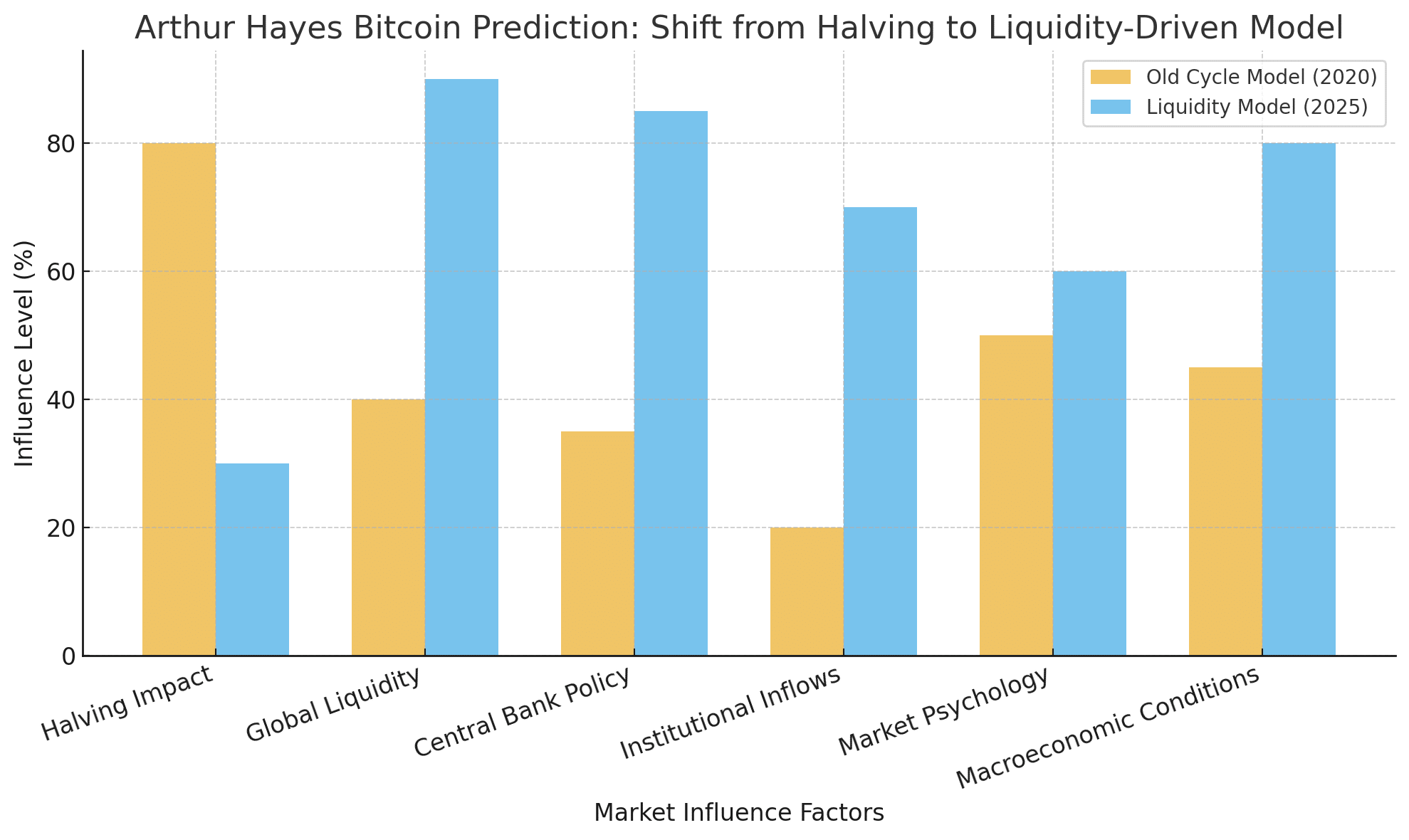
According to his perspective, the halving’s effect on scarcity is being overshadowed by central bank liquidity. The Arthur Hayes Bitcoin prediction emphasizes that “as long as liquidity is flowing, Bitcoin will rise, regardless of where we are in the cycle.”
He bases his view on the shifting macro landscape. The Federal Reserve and other central banks have been caught in a balancing act, fighting inflation while trying not to choke economic growth. Hayes believes this constant injection of liquidity into markets has blurred traditional crypto timing models.
Liquidity Becomes the New Compass
In the Arthur Hayes Bitcoin prediction, liquidity acts as the ultimate compass for price movement. He argues that Bitcoin’s price now mirrors capital expansion rather than issuance cuts. When governments print money or expand credit, assets like Bitcoin rise as investors seek protection from inflation and currency debasement.
In simple terms, he sees the halving as less relevant compared to global money flow. “Every time the Fed turns on the tap, Bitcoin surges,” Hayes said on social media. His statement aligns with market data showing strong correlations between Bitcoin rallies and central bank balance sheet growth.
Analysts who agree with the Arthur Hayes Bitcoin prediction note that the old rhythm of bull and bear cycles is giving way to a fluid, macro-driven era. As global liquidity increases, Bitcoin could see extended rallies that outlast historical expectations.
For Investors
For investors, the Arthur Hayes Bitcoin prediction signals a paradigm shift. Traditional models relying on fixed timeframes may no longer work. Instead, traders should watch liquidity metrics, interest rates, and global risk appetite. Bitcoin’s correlation with equity markets and gold is tightening, suggesting it now behaves more like a macro hedge than a cyclical asset.
Crypto economist Alex Krüger commented, “Liquidity is the new halving. Bitcoin will move when money moves.” His view aligns closely with Hayes’s thesis, showing a growing consensus among macro-focused analysts that liquidity has become the real driver behind digital assets.
What Could Come Next
If the Arthur Hayes Bitcoin prediction proves correct, Bitcoin’s current uptrend could extend deep into 2026, supported by rate cuts and renewed fiscal spending.
With the U.S., China, and Japan all expanding money supply, Bitcoin may continue to benefit from inflationary tailwinds. In this view, corrections will still occur, but without the deep 80 percent drawdowns of past cycles.
Still, critics argue that market psychology cannot be ignored. Even in a liquidity-rich world, overvaluation and speculative excess can lead to steep corrections. Technical analysts point to the 125,000–130,000 dollar resistance zone as a potential barrier in the near term.
The Bigger Picture
The Arthur Hayes Bitcoin prediction captures a broader shift in how investors perceive crypto. Bitcoin is evolving from a self-contained asset with predictable rhythms into a global macro barometer reflecting the pulse of central banks.
In a world flooded with debt and currency debasement, Bitcoin’s narrative as “digital gold” may strengthen, but its volatility will remain tied to liquidity flows.
Hayes’s statement reflects more than short-term forecasting. It challenges the entire analytical framework that traders have used for over a decade. If liquidity truly replaces the halving cycle, forecasting Bitcoin becomes less about blockchain mechanics and more about reading global finance.
Conclusion
The Arthur Hayes Bitcoin prediction that “the cycle is over” forces investors to rethink their playbook. Whether one agrees or not, his thesis holds weight in a world dominated by monetary intervention.
As liquidity continues to shape risk assets, Bitcoin’s price will likely mirror global financial tides more than its own issuance schedule. In the end, Hayes’s prediction is not just about Bitcoin, it is about the future of money itself.
Frequently Asked Questions
1. What is Arthur Hayes Bitcoin prediction?
Arthur Hayes Bitcoin prediction states that Bitcoin’s four-year halving cycle is obsolete and liquidity now drives market trends.
2. Why does Hayes think liquidity matters more than halvings?
He believes global money printing, rate cuts, and credit expansion have a stronger impact on Bitcoin than supply reduction events.


3. How could this affect Bitcoin’s price in 2026?
If liquidity remains high, Bitcoin could continue its rally into 2026, breaking away from traditional cyclical corrections.
4. What are the risks of Hayes’s outlook?
If central banks tighten liquidity again, Bitcoin could face sharp pullbacks despite strong fundamentals.
Glossary of Key Terms
Liquidity: The availability of cash or credit in markets that fuels asset growth.
Halving: A Bitcoin event every four years that cuts mining rewards by 50 percent, reducing new supply.
Macro Policy: Broad economic measures such as interest rate changes or money printing that affect all asset classes.
Bitcoin Cycle: A historical pattern of bull and bear markets tied to the halving timeline.