



This article was first published on TurkishNY Radio.
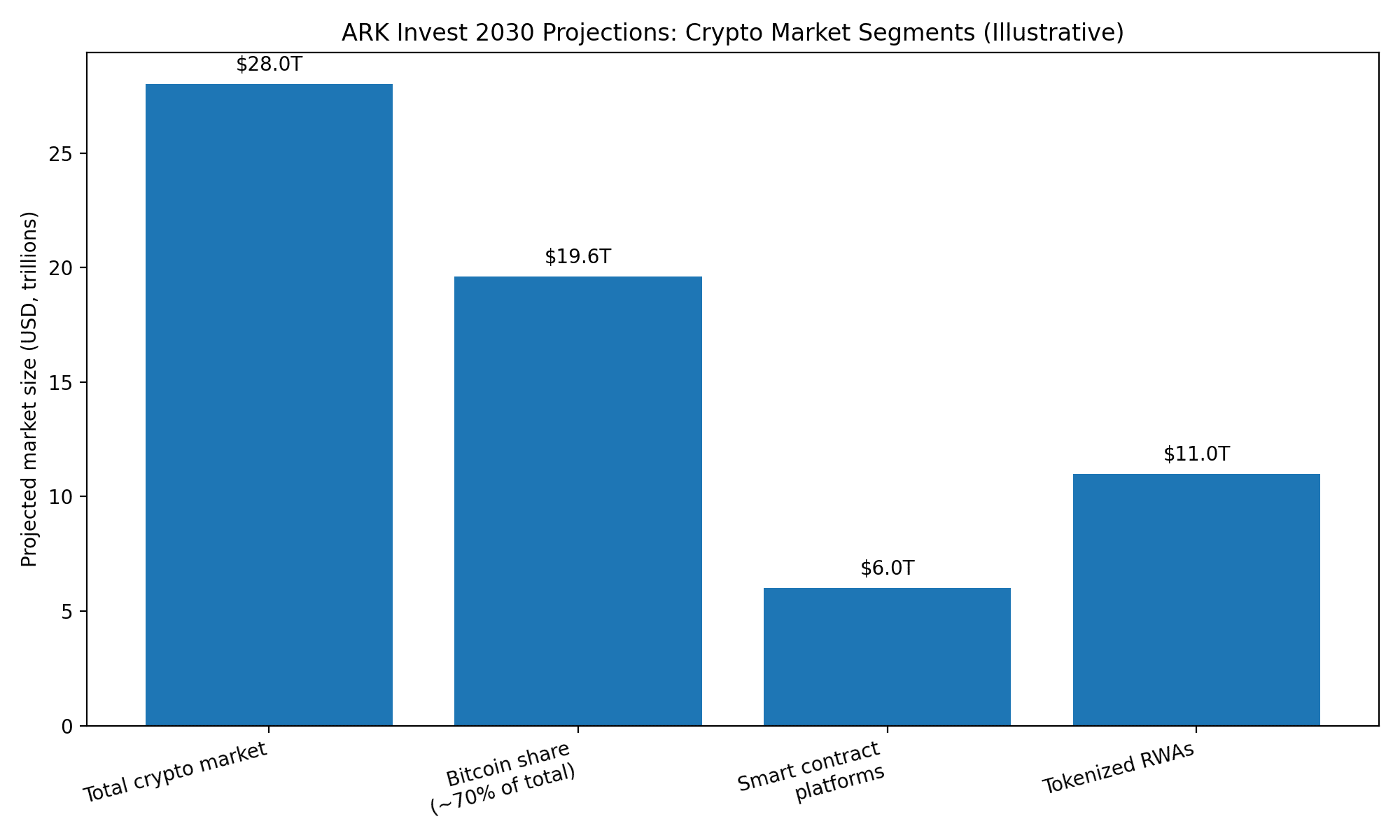
ARK Invest has put a long-term number on the digital asset space that is hard to ignore: a potential $28 trillion total crypto market by 2030. It is the kind of projection that instantly sparks debate, but the bigger story sits beneath the headline.


ARK is not only talking about price appreciation, as it is outlining what the industry could look like if adoption keeps stacking up year after year, but regulation also becomes more workable, and crypto starts behaving like infrastructure instead of a side bet.
This crypto market forecast is built around a familiar logic that traditional investors recognize. Markets do not grow into the trillions by accident. They expand when access improves, trust rises, liquidity deepens, and real use cases become routine. I
n ARK’s view, the next few years could deliver exactly that blend, with Bitcoin as the anchor, smart contract platforms as the rails, and tokenization as the bridge between on-chain finance and the real economy.
What ARK is really saying when it talks about $28T
ARK’s central idea is straightforward even if the number feels enormous. Digital assets could scale into a multi-trillion-dollar market by 2030 because several engines are running at the same time, not because one narrative suddenly wins.
Bitcoin adoption remains the foundation, but it is supported by expanding on-chain activity, rising stablecoin settlement, and tokenization pushing traditional finance closer to blockchain rails.
In this crypto market forecast, ARK highlights how crypto is slowly becoming easier to own and harder to dismiss. Institutional investors are no longer forced to navigate the market through awkward workarounds.
Better custody, more familiar product wrappers, and a maturing regulatory conversation have created pathways that did not exist in earlier cycles. That shift matters because the biggest pools of capital tend to arrive when the “plumbing” looks reliable enough to use.
Bitcoin’s role: not just a trade, but a benchmark asset
ARK’s outlook places Bitcoin at the center of the decade as the firm suggests Bitcoin could represent roughly 70% of the total crypto market value by 2030, which is a telling assumption. It implies the market becomes more top-heavy over time, with Bitcoin acting as the reference point in the same way gold often functions as a benchmark asset in traditional portfolios.
ARK’s model also points to a long-range Bitcoin price outcome near $950,000 to $1,000,000 by 2030. That range is not presented as a guarantee. It is the outcome of a supply-and-demand framework where scarcity meets broader demand. By then, roughly 20.5 million BTC may be mined, leaving limited incremental supply and a float that can tighten quickly when long-term holders and institutional allocators increase exposure.
This crypto market forecast treats Bitcoin’s “store-of-value” role as the gravitational force that stabilizes the ecosystem. If that happens, Bitcoin does not need daily hype to stay relevant. It becomes the asset that large investors hold through cycles because the thesis is built on long-term monetary characteristics, not short-term excitement.


The growth math behind the projection feels aggressive, but it is not random
One reason a $28 trillion number sounds unrealistic is that it is compared to the market today, then dismissed as fantasy. ARK instead frames it through compound annual growth, estimating roughly 61% CAGR through 2030. CAGR is simply a way to express what steady average growth would look like over time, even if the real path is choppy.
This crypto market forecast becomes easier to interpret when viewed as a scenario analysis rather than a prediction carved in stone. ARK is essentially saying: if crypto continues to earn credibility, participation, and utility at a fast pace, then the market size could compound into the tens of trillions. If the industry stalls on regulation, security, usability, and institutional trust, then the math breaks and the projection collapses under its own weight.
Stablecoins and DeFi: the quiet tools that build real usage
The most important shift in modern crypto is that the ecosystem is no longer powered only by speculation. Stablecoins and DeFi have introduced financial mechanics that people actually use, sometimes without even thinking about them as “crypto.” Stablecoins act as settlement instruments, trading collateral, and cross-border transfer tools. Their growth often signals that the on-chain economy is becoming more liquid and more functional.
ARK’s view assumes this trend continues and expands, and that stablecoins remain central to the market’s operating flow. In that sense, this crypto market forecast is not only about token prices. It is about transaction velocity, settlement demand, and the everyday utility that turns crypto from a theme into a tool.
DeFi plays a different role. It is the part of the ecosystem that tries to recreate lending, trading, liquidity provision, and yield markets with software instead of gatekeepers. What matters most here is not a single viral protocol. It is whether DeFi becomes safer and more intuitive, with better risk controls, clearer standards, and less reliance on fragile incentives.
When DeFi matures, it tends to show up in measurable indicators: more active users, more consistent liquidity, healthier collateral structures, and fee generation that holds up even when the market calms down.

Smart contract platforms and the infrastructure that carries the load
ARK also assigns major value to smart contract ecosystems, suggesting they could grow into a $6 trillion segment by 2030, implying around 54% CAGR. That is a big number, but the logic is rooted in what these networks enable. Smart contract platforms host applications, tokenization, stablecoins, and the settlement layers that keep DeFi running.
The deeper point is that smart contract platforms can become financial highways. If they remain reliable, scalable, and cheap enough to use without friction, they support activity that expands far beyond simple token transfers. In ARK’s framing, these platforms may ultimately be valued less like typical tech networks and more like foundational financial infrastructure, especially if on-chain assets begin to represent meaningful portions of real-world value.
In the real world, investors will look for a simple set of signals: consistent uptime, predictable fees, durable developer adoption, strong security track records, and applications that keep users coming back. If those pieces align, the infrastructure narrative becomes stronger than the meme cycle narrative.
Tokenization could become the trillion-dollar bridge between markets
ARK’s most ambitious segment is tokenized real-world assets, with a proposed market opportunity around $11 trillion by 2030. Tokenization is often misunderstood because it sounds abstract. The practical idea is simple: financial assets that already exist in traditional markets can be represented on-chain, allowing faster settlement and easier integration into programmable finance.
Tokenized government debt, credit products, and funds could become building blocks for modern markets in the same way ETFs became building blocks for traditional portfolios. The logic is not that tokenization replaces legacy finance overnight. It is that tokenization upgrades parts of the system that are slow, expensive, or restricted to limited operating hours.
This crypto market forecast assumes that regulatory clarity improves enough for large institutions to participate at scale, and that the infrastructure becomes robust enough to handle meaningful volumes without operational risk. That is a heavy lift, but it is also why tokenization continues to attract attention from serious players. The prize is not hype. It is efficiency and global reach.
Crypto market forecast: the signals that must keep improving
For a decade-long thesis, the best approach is to watch indicators, not slogans. A projection like ARK’s will only remain believable if the data keeps moving in the right direction.
Institutional participation is one signal. It shows up through regulated access, custody growth, and consistent allocation behavior that holds up across market downturns. Liquidity is another. Deeper liquidity reduces market fragility and lowers the odds that every shock turns into a cascade.
Network usage is also critical. Active wallets, transaction consistency, fee generation, and stablecoin settlement volumes all paint a picture of whether crypto is being used as a system rather than traded as a story. For tokenization, the indicators are even more specific: credible issuers, compliant structures, and real asset categories moving on-chain in a repeatable way.
This is the part of the conversation that often gets missed. The market does not need to “believe” in the forecast. It needs to watch whether the inputs that would justify it are strengthening over time.
The risks that can slow the roadmap, even if demand is real
No long-range projection should ignore friction. Regulation can evolve in ways that restrict growth or create uncertainty. Security failures can damage trust, especially when retail participants get hurt. User experience still needs improvement, because mass adoption does not happen when products feel confusing or risky.
There is also the reality of market cycles. Even if crypto expands over the decade, the path will likely include deep drawdowns, narrative shifts, and periods where interest fades. That does not invalidate the long-range trend, but it does shape how capital enters, exits, and re-enters the ecosystem.
ARK’s thesis implicitly assumes crypto keeps absorbing those shocks while continuing to build. That is a demanding standard, but it is also the difference between a market that stays speculative and one that grows into a lasting asset class.
Conclusion: ARK’s $28T view is a roadmap, not a promise
ARK Invest’s $28 trillion projection is bold, but it is not built on a single lucky guess. It is based on a framework where Bitcoin becomes a core institutional asset, stablecoins and DeFi expand real usage, smart contract platforms scale as financial infrastructure, and tokenization brings traditional assets onto programmable rails.
Whether the market reaches that exact number by 2030 is less important than whether the core indicators keep improving year after year. If adoption continues, liquidity deepens, and regulation becomes more workable, this crypto market forecast stops sounding like fantasy and starts looking like a plausible long-term scenario that serious investors cannot ignore.
Frequently Asked Questions FAQs
What is ARK Invest predicting for the crypto market by 2030?
ARK Invest expects the total digital asset market could reach around $28 trillion by 2030, with Bitcoin making up the majority of that value under its assumptions.
Why does Bitcoin dominate ARK’s long-term model?
ARK treats Bitcoin as the most established crypto asset with scarcity-driven economics and a clearer path to institutional adoption compared to smaller, more experimental tokens.
How do stablecoins support long-term crypto growth?
Stablecoins increase on-chain liquidity and make settlement simpler, especially for trading, transfers, and DeFi activity. Their growth often reflects stronger real-world usage.
What makes tokenized real-world assets so important in 2030 projections?
Tokenized assets can move traditional instruments like treasuries and funds onto blockchains, enabling faster settlement and integration into programmable finance systems.
Glossary of Key Terms
CAGR (Compound Annual Growth Rate): A metric that shows the average yearly growth rate of a market over time, assuming growth compounds each year.
DeFi (Decentralized Finance): Financial services such as lending, borrowing, and trading conducted through smart contracts instead of traditional intermediaries.
Stablecoin: A token designed to hold a stable price, often pegged to a fiat currency like the U.S. dollar, commonly used for settlement and liquidity.
Smart Contract Platform: A blockchain that supports programmable applications, enabling developers to build decentralized services that run on-chain.
Tokenized Real-World Assets (RWAs): Traditional assets such as treasuries or funds represented as blockchain tokens, allowing them to be transferred, settled, or used within on-chain systems.
Resource