

Updated on 29th October, 2025
This Article Was First Published on TurkishNY Radio.


The popular bankcard services provider, Visa, has announced a big expansion to its stablecoin backing program; it will add support for four more stablecoins spanning across four different blockchain networks.
Per CEO Ryan McInerney on the companies’ Q4 earnings call, through the new supported stablecoins, the company will soon “accept and convert to over 25 traditional fiat currencies,” solidifying the Visa stablecoin lineup.
This growth highlights how Visa stablecoins are becoming part of the global payments network, moving stablecoin payments out from the marginal into the mainstream merchant- and bank-settlement float.
Visa Stablecoins Drive Record Growth in Payments
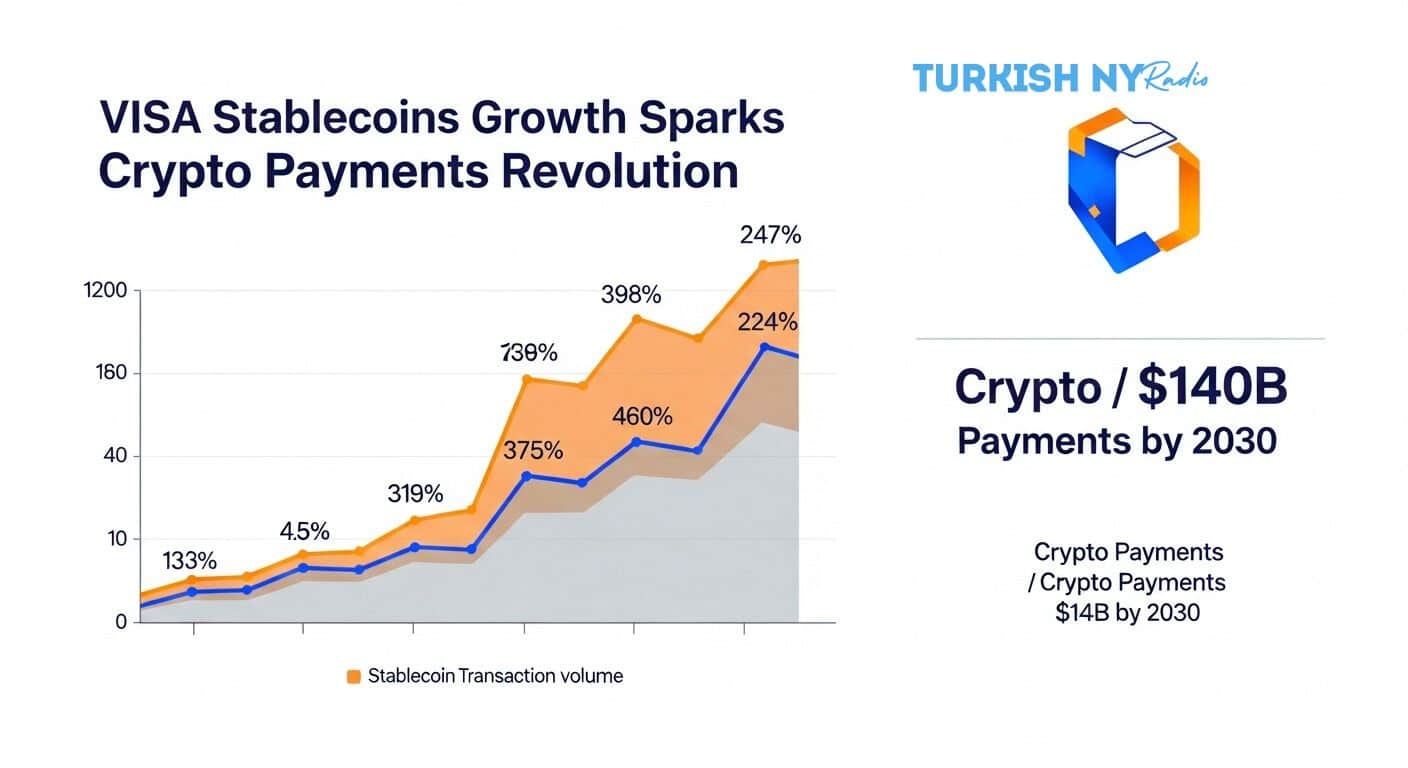
Visa also announced that over $140 billion in crypto and stablecoin flows has passed through its network since 2020. The company also noted that card spending associated with stablecoin payments quadrupled year-over-year in Q4.
In addition, the company claims its stablecoin support settlement volume has exceeded a $2.5 billion monthly run rate, annualized.
These numbers demonstrate how the stablecoin payments, at one time essentially niche experiments, are being integrated into the wider payments landscape through Visa’s rails.
What Banks Think Stablecoin Backing Should Look Like
Visa is allowing banks and institutions to work with Visa stablecoins in novel new ways.
The rollout includes:
Enabling banks to create and destroy their own stablecoins using the Visa Tokenized Asset Platform (VTAP)
Adding the new stablecoins to Visa Direct for high-speed and efficiency of global treasury operations, including international settlements
By providing powerful new payments capabilities for stablecoins at an issuer and settlement layer (rather than simply acceptance), Visa is shifting the role of Visa stablecoins from “crypto accessory” to core bank infrastructure.
The offering represents a new way banks now can use stablecoins for foreign exchange (FX), treasury, and payment settlement services.
The Macro Effects of Stablecoin Backing
These are three broader themes around Visa as it takes aim at stablecoin payments and the Visa stablecoins program:
Payment networks on cryptorails: Visa’s move to support an upgradeable stablecoin is a signal that, for traditional networks at least, tokenized assets are no longer just pilot projects; they’re deployment (i.e., production volume) ready.
Banks joining the tokenization game: The fact that banks can issue and burn stablecoins through the VTAP feature means Visa’s stablecoins aren’t only a thing for crypto wallets but also a bank instrument.
Competitive pressure and regulation: As networks blow out stablecoin payments, the winners will differentiate on issues like compliance, reserve transparency, and relations with fiat-backed issuers, all part of the Visa stablecoin equation.
Where Stablecoin Support Can Go Next
The following scenarios illustrate possible trajectories for stablecoin payments and Visa stablecoins over the next 12–24 months:


| Scenario | Payments volumes via Visa stablecoins | Bank issuance/mint-burn programs via VTAP |
| Base Case | $30–50 trillion in total stablecoin payments globally | 100–150 banks utilising Visa stablecoins infrastructure |
| Upside Case | $50–65 trillion or more | 200+ banks issuing their own tokens via Visa stablecoins platform |
| Cautious Case | $20–30 trillion | 50–75 banks slow to adopt stablecoin issuance/settlement features |
Next Steps for Stakeholders
Payment providers, banks, and fintechs will want to analyze how the rollout of Visa’s support for stablecoins jibes with their digital-asset roadmap.
Those building merchant products or cross-border flows should pay close attention to Visa’s integrations. Use of Visa stablecoins for merchant settlement, bank tokenization, and global FX could set the next wave in mainstreaming crypto infrastructure.
Simultaneously, companies that are building card-linked token programs also need to think through how stablecoin payments in Visa affect dynamics across fiat and crypto rails.
Summary
The payment giant Visa has inked deals with five more blockchain-based companies as part of its strategy to support stablecoins.
The move enhances Visa’s capabilities to settle payments with stablecoins, allowing banks to mint and burn tokens on its Tokenized Asset Platform.
Having processed over $140 billion in flows, and with card spending up 4× year-on-year, Visa’s leap into stablecoin payments is a big step towards integrating traditional banking with new blockchain finance, according to the company.
Glossary of Key Terms
Stablecoin
A cryptocurrency with a stable price, typically one that’s pegged to actual money, such as the U.S. dollar or euro. Call it “digital cash.”
Blockchain
An encrypted digital record book, or ledger, that is shared among a network of computers. It’s something like a digital ledger shared by computers all over the world.
Visa Stablecoins
Visa-backed digital currency enabling individuals anywhere in the world to send money over social networks, recording all transactions accurately, securely, and efficiently.
Minting and Burning
“Minting” is the term for creating new stablecoins, while “burning” refers to taking them out of circulation akin to printing or shredding real money.
Tokenized Asset Platform (VTAP)
Visa’s technology will enable banks to offer safe and easy issuance, management, and settlement of stablecoins on their payment networks.
Cross-Border Payments
Transferring money across borders with stablecoins for faster, cheaper, and more reliable transfer times than wires.
USDC
One of several popular digital tokens known as a stablecoin, backed by dollars. Each token is supposed to be the equivalent of one U.S. dollar, and it is frequently used in digital payments.
Fiat Currency
Traditional government-issued money, such as the dollar, euro, or yen, held up as a standard against which stablecoins are pegged.
Frequently Asked Questions (FAQs) About Visa stablecoins
1. What are Visa stablecoins?
These fiat-backed digital currencies provide near real-time settlement using the world’s leading networks to facilitate fund movement around the globe, 24/7.
2. How would Visa stablecoins help consumers and banks?
They enable banks to mint and burn tokens, ensuring liquidity, enhancing the speed of cross-border transactions, and enabling real-time settlements in 25+ fiat currencies.
3. Is the Visa stablecoin transaction secure and compliant?
Yes. In other words, Visa upholds very high encryption and information security credentials rather than maintaining a permissionless blockchain.
4. What’s next on Visa’s stablecoin roadmap?
Visa is looking to support more stablecoins and add more blockchains and innovations in payment in its global network of over 60 million merchants with its Tokenized Asset Platform for financial institutions.