
The Securities and Exchange Commission has approved NYSE Arca’s petition to shift Grayscale’s Ethereum Trust ETF and its Mini Trust into generic listing territory.
That change allows the funds to trade continuously without submitting individual approval requests for each renewal. At the same time, the SEC preserves a 60-day window to suspend the change if necessary in order to protect investors or markets.


This regulatory pivot signals a move toward crypto ETF expansion and lowers friction for future product launches. Under the generic standard, the investments fall under the same commodity-based rules used by established exchange-traded trusts, rather than bespoke non-generic treatment.
The SEC justified its immediate effective date decision by noting that the rule change introduces no novel issues and remains consistent with investor protection and the public interest.
Why Crypto ETF Rules Bring Faster Approvals & Adoption
The new generic listing regime could potentially reduce the structural impediments to spot crypto ETFs. The rule, in practice, strips away unnecessary filing requirements and accelerates the approval track for Ether-type funds and alternative token ETFs.
Analysts say the reform could fuel filings for multi-asset or altcoin ETFs, thereby adding to competition in the crypto ETF space. Yet the S.E.C. is asking for public feedback on the rule change to be sure that it doesn’t run afoul of the Exchange Act. In the meantime, exchanges and issuers can start lining up applications for new funds that use these more relaxed standards.
Also Read: SEC Streamlines Crypto ETF Listings: Is Bitcoin on the Road to $150K?
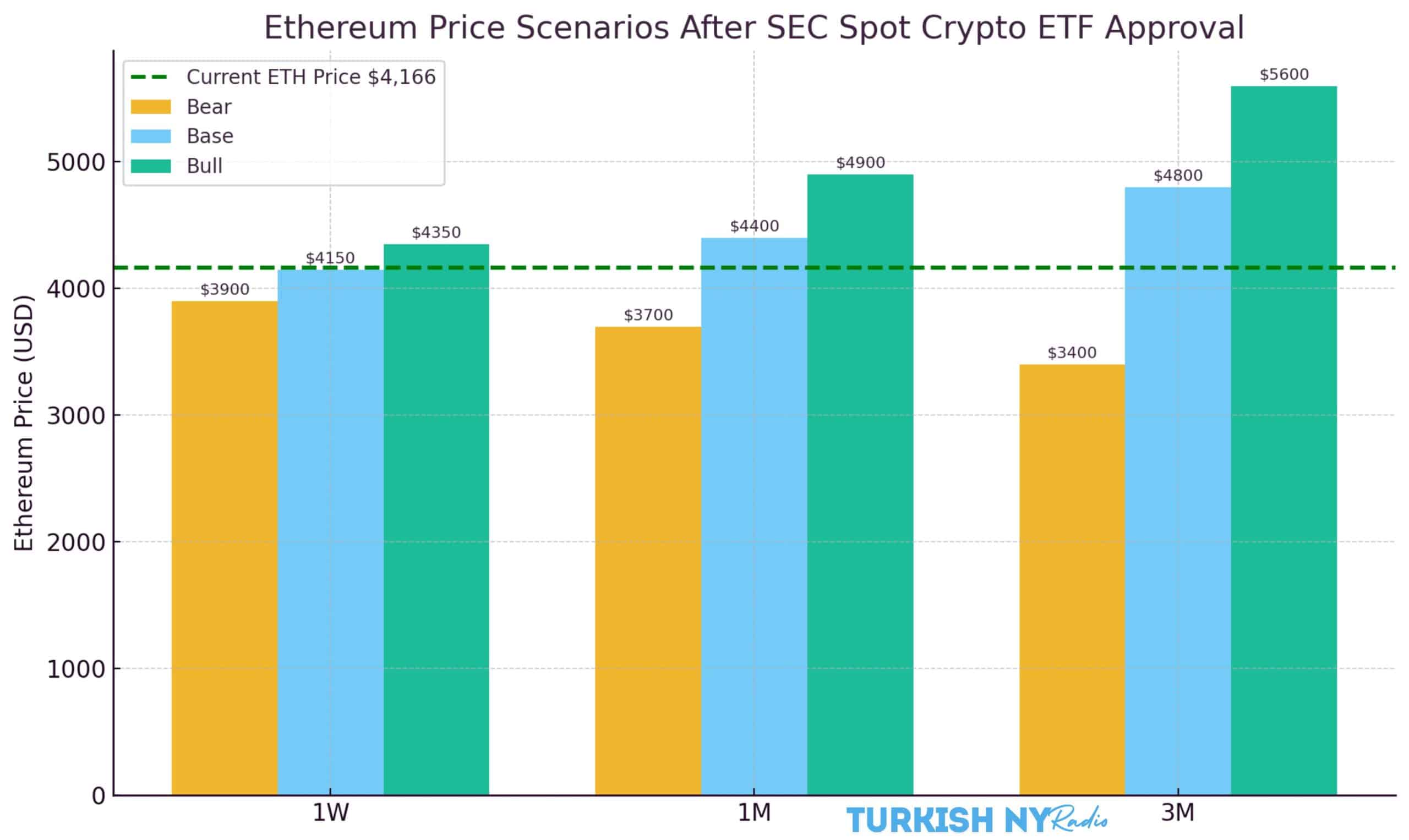
ETH Price Projection Scenarios
| Timeframe | Bear Scenario | Base Case | Bull Scenario | Dominant Drivers |
| 1 week | 3,900 | 4,150 | 4,350 | Short-term sentiment, ETF momentum |
| 1 month | 3,700 | 4,400 | 4,900 | New ETF filings, capital flows |
| 3 months | 3,400 | 4,800 | 5,600 | Institutional adoption, staking demand |
These projections remain speculative and do not constitute financial advice.
Why Spot Crypto ETFs Mean Faster Approvals & Adoption
James Seyffart of Bloomberg Intelligence sees the generic listing maneuver as an accelerant for crypto ETF growth, in particular for Ether and altcoins. History of ETF Reforms And a simplified structure seems to send issuances skyrocketing. On X, that attitude has found support in ETF and blockchain quarters.
On Reddit, community reaction reflects excitement and wariness both. Some conversations laud the reduced regulatory friction for crypto ETFs; others caution that a remaining requirement of continued eligibility under older standards will still restrict which token trades can take advantage of new treatment.
Also Read: Crypto ETF Filings Flood SEC: Avalanche, Sui, Bonk, and LTC in Spotlight
From Regulation to Capital Flows
This regulation change will probably change the dynamics of crypto ETFs. The baseline standard could allow more diversity in products, more aggressive filings, and speedier approval times. For Ethereum dapps, this shift could increase institutional confidence by providing a compliant way to gain exposure.
Meanwhile, staking proposals for Grayscale’s funds are in limbo and could bear close watching as the SEC conducts its ongoing review. Exchanges and issuers crafting the next round of submissions will likely emphasize surveillance agreements, token eligibility, and investor protections.
More crypto news on spot crypto ETFs, expert analysis, and price forecasts is available now on our crypto news platform
Summary
NYSECREFilling200317Approval The SEC approved NYSE Arca’s proposal to move Grayscale’s Ethereum Trust ETFs under generic standards in order to make oversight easier for spot crypto ETFs.
This action helps to cut down on duplicate filings, speed up approval times, and could open the door for more Ethereum and altcoin ETFs. Currently changing hands at around $4,166, analysts are seeing further upside as regulatory clarity drives institutional adoption, investor confidence, and competition in the burgeoning crypto ETF space.
Glossary of Key Terms
ETF (Exchange-Traded Fund)


An exchange-traded basket of assets minted like a shopping cart of investments. An Ethereum ETF allows investors to purchase exposure to ETH without having to own the coins directly.
Spot Crypto ETF
A fund that closely correlates with the price of a cryptocurrency, much like how an ETF pegs to gold’s market value in real time.
SEC (Securities and Exchange Commission)
Like a referee in sports, the U.S. financial watchdog that oversees securities and investments and makes sure companies and funds play by the rules so investors are protected.
Generic Listing Standards
A list of pre-agreed-upon rules that allow some funds to be quickly listed without seeking special permission. It’s like jumping into the fast-track lane at the airport.
Grayscale Ethereum Trust
A Grayscale investment product that holds Ethereum and is traded on exchanges, allowing traditional investors to gain exposure to ETH without requiring digital wallets or exchanges.
Institutional Investors
Major financial institutions, such as banks, pension funds and hedge funds. Think of them as market “whales”when they move, big waves ripple.
Staking
Staking Ethereum to help secure the network and receive rewards. It’s akin to putting money into a savings account that accrues interest, thanks to the system’s running.
Volatility
The decision of how much to move a price up or down over time. High volatility in crypto is like a rollercoaster ride compared to a bond’s slow and steady.
Frequently Asked Questions About Crypto ETFs
Q1. What does approval of spot crypto ETFs by the SEC mean for Ethereum?
It also opens Grayscale’s Ethereum ETFs to trade under generic guidelines, cutting down on regulatory barriers and approval processes, which might lead to larger institutional engagement with Ethereum exposure.
Q2. What effect could this decision have on Ethereum’s price today of $4,166?
More investor interest would help ease ETF approvals, and potential inflows may provide upward momentum, although prices are still moving with equities and broader macro sentiment.
Q3. What do investors get from Ethereum ETFs through vanilla listing rules?
They have easier access to regulated exposure in Ether, shorter time to market, increased competition among issuers, and clarity regarding investor protections thanks to compliance-driven frameworks.
Q4. What are the risks or restrictions involved with these ETFs given their SEC approval?
Indeed, eligibility requirements continue to exist, the SEC will retain suspension powers, and the Ethereum price is far from stable; investors must evaluate risks before writing off ETFs altogether.