
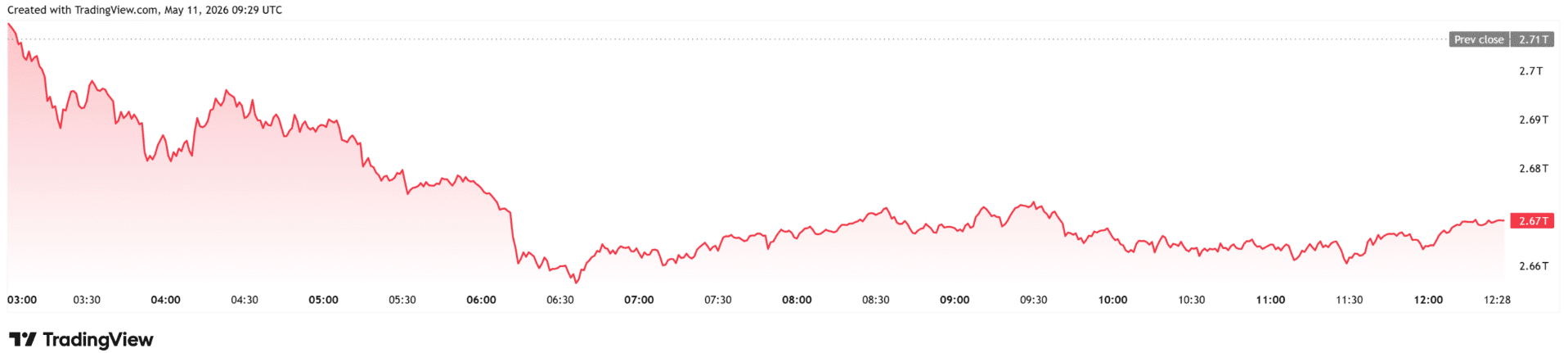
The crypto market recovery has brought fresh confidence back into digital assets, with total market value hovering near $2.79 trillion and Bitcoin still carrying the heaviest weight in investor sentiment. The rebound looks stronger than a simple relief bounce, helped by improving liquidity, ETF demand, stablecoin growth, and calmer macro signals. Still, the market is not out of the woods.
Behind the green candles sits a harder question: can this recovery hold when security risks, leverage, and global rates remain part of the equation? Latest market data places Bitcoin dominance near 58.27%, while stablecoins account for about $319 billion of crypto value.


Liquidity Is Driving the Crypto Market Recovery
The most important force behind the crypto market recovery is liquidity. When cash moves more freely through financial markets, risk assets usually breathe easier, and crypto often reacts faster than traditional equities. That appears to be happening now as investors respond to steadier bond yields, a softer dollar backdrop, and renewed appetite for Bitcoin exposure.
Bitcoin remains the market’s anchor. With BTC dominance above 58%, the market is clearly not in a broad altcoin-led phase yet. In plain terms, more than half of total crypto value is still concentrated in Bitcoin, which means the wider market may keep following BTC’s direction before capital rotates into smaller assets. Bitcoin dominance measures Bitcoin’s share of the total crypto market, making it one of the cleanest indicators of whether traders are favoring safety or chasing higher-risk tokens.
ETF Demand Gives the Rally a Stronger Base
The crypto market recovery also has a stronger institutional layer than past rebounds. U.S. spot Bitcoin ETFs reportedly kept cumulative inflows above $59 billion, with holdings above 755,000 BTC. That matters because ETF buying can absorb supply over time and give the market a deeper base than retail-driven rallies alone.
Monthly ETF inflows also improved, with April drawing about $1.97 billion into spot Bitcoin funds, the strongest monthly level of 2026 so far. This does not remove volatility, but it changes the rhythm. Instead of relying only on short-term traders, Bitcoin now has more demand from regulated investment products, financial advisers, and institutions that usually move with longer time horizons.
Stablecoins and Tokenized Assets Show Where Capital Is Waiting
Stablecoins are another key signal for the crypto market recovery. A stablecoin market near $319 billion suggests that large amounts of capital are already sitting inside crypto rails, ready to move when conditions improve. Stablecoins often act like dry powder, giving traders and institutions a fast way to buy assets without leaving the blockchain economy.
Tokenized real-world assets are also becoming more important. The RWA market expanded from about $1.5 billion in early 2023 to roughly $29.27 billion by April 2026, showing how traditional finance is slowly moving on-chain through tokenized treasuries, credit products, and other financial instruments. This trend supports the crypto market recovery because it gives crypto a more practical role beyond trading alone.

DeFi Risk Remains the Weak Link
The biggest concern is security. April 2026 saw more than $635 million lost across 28 DeFi incidents, making it one of the worst months on record for crypto exploits. That figure is not just a technical warning. It is a trust issue.
For the crypto market recovery to mature, DeFi needs stronger controls, better audits, safer cross-chain design, and faster incident response. Investors may tolerate volatility, but repeated exploits can scare away serious capital. This is where the market has to grow up. The same infrastructure that promises open finance must prove it can protect users at scale.
Key Indicators Traders Are Watching Now
Several indicators will decide whether the crypto market recovery has legs. Bitcoin dominance shows where capital is concentrated. ETF inflows show whether institutional demand is still active. Stablecoin supply reveals how much liquidity is parked onchain. Treasury yields and the U.S. dollar show whether macro pressure is easing or returning. DeFi exploit data shows whether onchain risk is rising.
There is also trading volume, which helps confirm whether price moves have real participation behind them. A rally with weak volume can fade quickly, while a rally backed by rising volume often carries more weight. Market capitalization is useful too, but it should not be read alone because it can rise even when liquidity is thin.
Conclusion
The crypto market recovery has better support than a typical short-term bounce, mainly because ETF inflows, stablecoin liquidity, and tokenized assets are creating a deeper market structure. Still, it remains a recovery with conditions attached. Bitcoin must hold its leadership, liquidity must stay supportive, and DeFi must address its security gap before investors can treat this phase as a durable expansion. For now, the market looks healthier, but not fully healed.
Frequently Asked Questions
Why is the crypto market rising again?
The market is rising because liquidity has improved, Bitcoin ETF demand remains strong, stablecoin supply is high, and investors are showing more interest in risk assets.
Why does Bitcoin dominance matter?
Bitcoin dominance shows how much of the total crypto market value belongs to Bitcoin. A high reading often means investors still prefer safer, larger crypto assets.
Are stablecoins good for crypto prices?
Stablecoins do not guarantee higher prices, but they show available capital inside the crypto system. When sentiment improves, that capital can move quickly into Bitcoin, Ethereum, and altcoins.
What could weaken the rebound?
Higher bond yields, a stronger U.S. dollar, ETF outflows, excessive leverage, weak trading volume, or another major DeFi exploit could pressure the market.
Glossary of Key Terms
Market Capitalization: The total value of all circulating coins or tokens in a market.
Bitcoin Dominance: Bitcoin’s percentage share of the total crypto market.
ETF Inflows: Money entering exchange-traded funds, often used to measure institutional demand.
Stablecoins: Crypto assets designed to track fiat currencies such as the U.S. dollar.
Real-World Assets: Traditional assets, such as bonds or credit products, represented on blockchain networks.
DeFi: Decentralized finance, a sector that offers financial services through blockchain protocols instead of traditional intermediaries.
Sources