This article was first published on TurkishNY Radio.
In crypto, scaling talk can get messy very quickly as terms pile up, technical diagrams appear, and before long, the average reader is left staring at a wall of jargon. Yet the idea behind rollups is not nearly as complicated as it sounds. Ethereum became the home of smart contracts, but that success exposed a bottleneck.


The network could not serve every user, every app, every trade, and every mint cheaply on its own. That is where blockchain rollups entered the picture. They gave Ethereum a way to process more activity off-chain while still using the main chain for security and final settlement. Ethereum’s own scaling documentation continues to identify rollups as a core layer 2 approach, split mainly between optimistic and zero-knowledge models.
The simple version of how Blockchian rollups work
A rollup collects many transactions, processes them away from Ethereum mainnet, and then sends the result back to Ethereum in a compressed form. That makes the whole system lighter, faster, and usually much cheaper for users. Ethereum documentation explains that optimistic rollups reduce computation on the main chain, while ZK rollups move computation and state storage off-chain and submit a proof with summary data.
That is why blockchain rollups matter so much. Instead of forcing Ethereum to handle every single action directly, they treat the base layer as the secure anchor underneath a busier and more flexible upper layer.
Why the market keeps returning to rollups
Every crypto cycle eventually runs into the same wall. Users want low fees, fast execution, and familiar apps. Developers want security, liquidity, and access to Ethereum’s user base. Investors want networks that can scale without breaking trust assumptions. Rollups sit right in the middle of all three needs.
L2BEAT describes rollups as layer 2 systems that post state commitments to Ethereum and validate them either through validity proofs or optimistic acceptance with a fraud-proof window. That definition is useful because it captures the essence of the model without the marketing polish.
For the market, this means blockchain rollups are not just a technical upgrade. They are infrastructure that can decide where users trade, where liquidity gathers, and which ecosystems feel practical at scale.
Blockchain Rollups in the Optimistic vs ZK Debate
The real debate is not whether rollups matter. It is which model will dominate over time, or whether both will continue to thrive side by side.
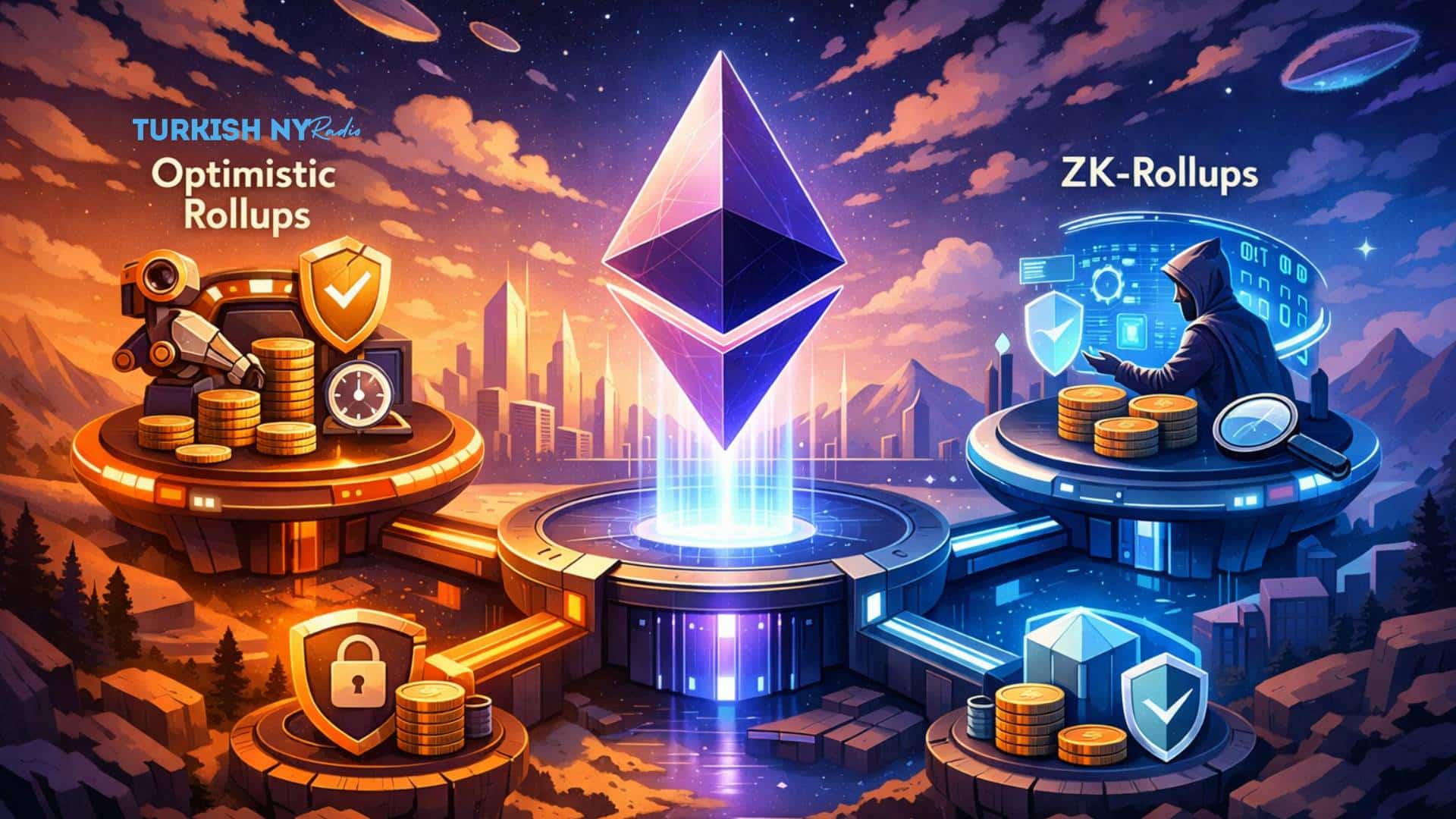
Optimistic rollups assume submitted transaction batches are valid by default. If something looks wrong, participants can challenge it through a fraud-proof process. Ethereum’s official materials describe this model clearly, and Arbitrum’s current documentation still positions its flagship rollup as an optimistic rollup that inherits Ethereum security.
ZK rollups take the opposite route as they generate a mathematical proof that confirms the transactions are valid before Ethereum accepts the state update. Ethereum and ZKsync documentation both frame this as a proof-driven method for scaling Ethereum while preserving strong security guarantees.
What optimistic rollups do well
Optimistic rollups earned traction because they were practical when the market urgently needed relief from high fees. They support Ethereum-style applications well, they improve throughput, and they have already become part of the daily transaction flow for many users.
This is why they are often seen as the workhorse model of Ethereum scaling. A network like Arbitrum did not grow because the concept sounded clever. It grew because cheaper and faster execution solved a real problem. Official Arbitrum materials also emphasize that chain data is posted on layer 1, supporting participation in validation and preserving security assumptions tied to Ethereum.

The drawback is the delay around withdrawals to Ethereum. Because transactions can be challenged, funds may need to wait through a dispute window. For active users inside the rollup ecosystem, that may not matter much day to day. For some asset flows, it matters a lot.
What gives ZK rollups their appeal
ZK rollups appeal to many researchers and builders because they feel closer to the ideal end state. Instead of trusting that a batch is honest until challenged, they verify correctness upfront. That can improve finality and reduce the need for waiting periods.
Projects in the ZK category have leaned heavily into this argument, and official documentation from Ethereum and ZKsync keeps reinforcing the central point: ZK proofs are the engine that lets these systems compress activity while still proving validity back to Ethereum.
Still, the market does not reward elegance alone. Performance, tooling, liquidity, wallet support, and developer ease all matter. That is why blockchain rollups should not be judged by ideology. They should be judged by how well they serve real users.
How readers should think about rollups as a trend
The smartest way to read this sector is to stop treating rollups as a single monolithic category. Some focus on general-purpose apps. Some target payments, gaming, or DeFi. Some lean on Ethereum compatibility. Others push deeper into specialized architectures.
For investors and industry observers, blockchain rollups are now a lens for understanding the next phase of Ethereum’s economic expansion. If Ethereum remains the settlement layer, rollups may become the place where most users actually spend their time. That changes how value accrues across tokens, infrastructure, bridges, sequencers, and application ecosystems.
For users, the story is simpler. They want transactions that do not cost a fortune. They want apps that do not lag. They want the security of Ethereum without the traffic jam. Rollups answer that demand more directly than almost any other scaling design now in use.
Conclusion
The debate between optimistic and ZK rollups is worth following, but the broader point is already clear. Ethereum scaling has moved beyond theory. Rollups are now part of the network’s practical foundation. Optimistic systems offer proven, widely used infrastructure with challenge-based security. ZK systems offer proof-driven verification with strong long-term appeal. Together, they show why blockchain rollup has become one of the most important ideas in blockchain infrastructure.
Frequently Asked Questions
What is a rollup in blockchain?
It is a layer 2 system that batches transactions off chain and settles the result on Ethereum.
What makes optimistic rollups different?
They assume transaction batches are valid unless someone submits a successful challenge.
What makes ZK rollups different?
They submit a cryptographic validity proof that shows the transaction batch is correct.
Do rollups help Ethereum scale?
Yes. They reduce congestion on Ethereum and can lower transaction costs significantly.
Will one rollup model win completely?
That is still uncertain. Current evidence suggests both models continue to serve important roles across the Ethereum ecosystem.
Glossary of Key Terms
Ethereum: A base blockchain that supports smart contracts and decentralized applications.
Rollup: A layer 2 design that batches transactions off chain and settles on Ethereum.
Optimistic rollup: A rollup that assumes validity by default and uses challenge mechanisms when needed.
ZK rollup: A rollup that uses cryptographic validity proofs to confirm correctness.
Sequencer: The component that orders transactions inside many rollup systems.
Finality: The point at which a transaction result is considered confirmed and secure.
Sources
Disclaimer: This content is for educational and informational purposes only and should not be treated as investment, financial, or legal advice.