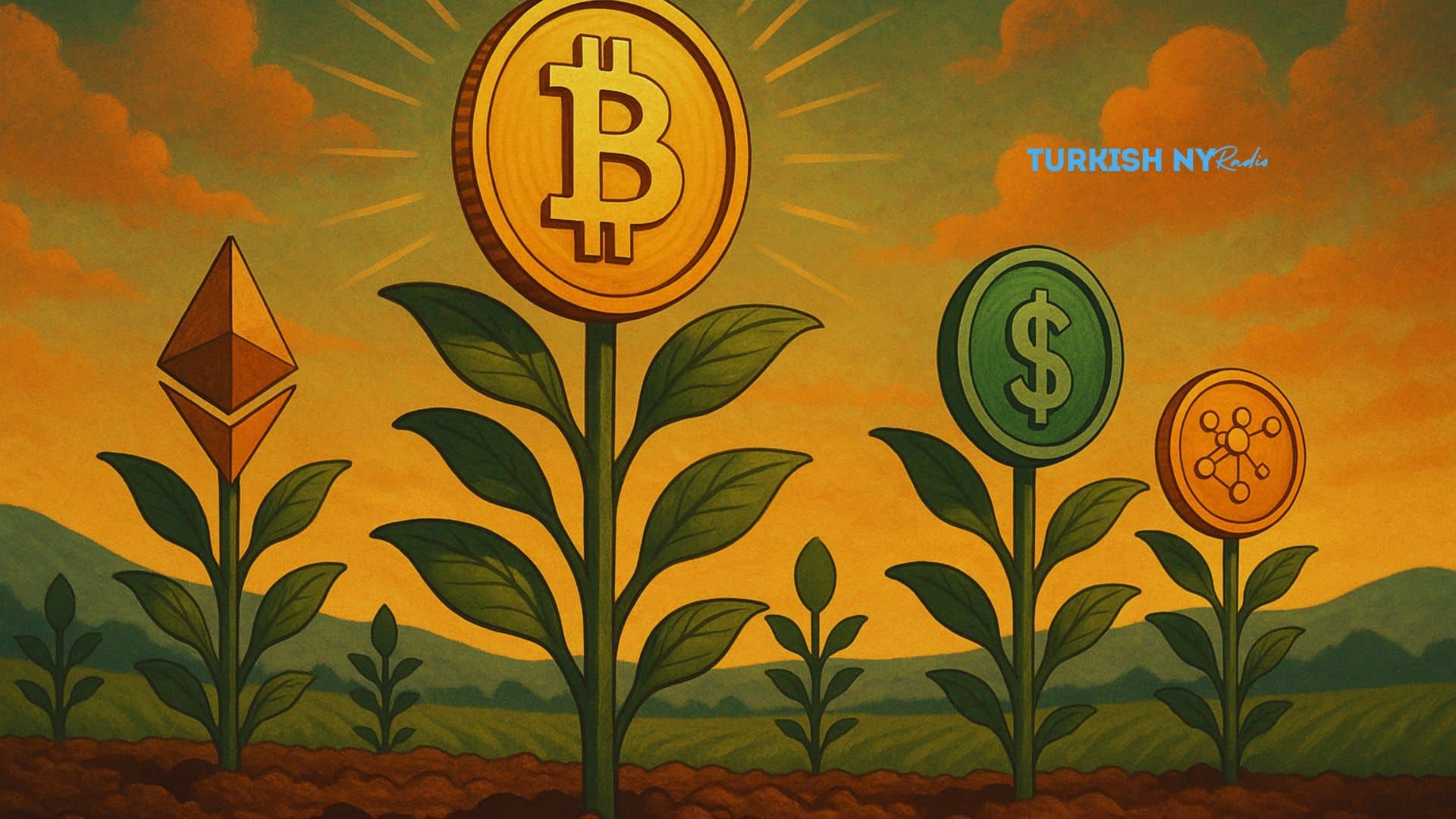
The core idea behind yield farming is crypto earning for you while you get on with life, a popular way to earn DeFi passive income that is changing how people invest.
Yield farmers do not just leave their assets to sit, but instead utilize decentralized platforms where their tokens, through interest, trading fees, or additional rewards, can create a return.


It may sound simple, but it is not a shortcut to easy money. The same systems that create opportunity also involve risks such as smart contract bugs, token volatility, and liquidity issues.
With the proper knowledge and caution, yield farming can turn digital assets into a steady, transparent source of income powered entirely by blockchain technology.
How Yield Farming Works Under the Hood
The process begins when a token holder locks or deposits assets into a DeFi platform. The standard methods consist of providing liquidity to a DEX, lending assets through a money market, and staking tokens for governance or reward purposes.
To illustrate the case, in a DEX liquidity pool scenario, an individual is required to put up two tokens (like ETH and USDC) for a smart contract that will let them swap between the two. Then, the liquidity providers take their share out of the trading fees and the likelihood of receiving bonus governance tokens.
A simpler version of the whole process would be: choose the protocol, put in assets, get a liquidity provider (LP) token, stake that LP token for additional yield if you wish, and finally, collect and not just reinvest rewards.
The indicators for measuring returns are APR (annual percentage rate) and APY (annual percentage yield, which includes compounding). It is very important to understand the difference: the yield farm with 10% APR may result in a higher APY if compounding is used.


Types of Yield Farming Strategies That Analysts Track
Several yield-farming strategies exist, each with distinct risk-reward profiles:
Liquidity Provision on DEXs
Here, assets are paired (e.g., Token A + Token B) and deposited into a pool. Each swap in the pool generates fees that are shared among liquidity providers. Bonus tokens may further amplify returns. Because fees depend on volume and volatility, returns vary significantly.
Lending and Borrowing
Assets are lent to borrowers via DeFi platforms. Lenders earn interest, sometimes boosted by reward tokens. This is less complex than multi-layer farming, but it still carries the risk of default on borrowed capital or protocol issues.
Staking LP Tokens or Governance Tokens
After providing liquidity, many platforms allow staking LP or governance tokens to earn additional rewards. This creates a layered strategy: deposit → LP token → stake for yield. The complexity increases, and so do potential vulnerabilities.
Aggregators and Automators
Some systems automatically shift deposits between protocols to maximize yields. These automation tools simplify farming but require confidence in the underlying protocol’s code and operations.
The Rewards: Why Some View It as DeFi Passive Income
Yield farming offers several appealing features:
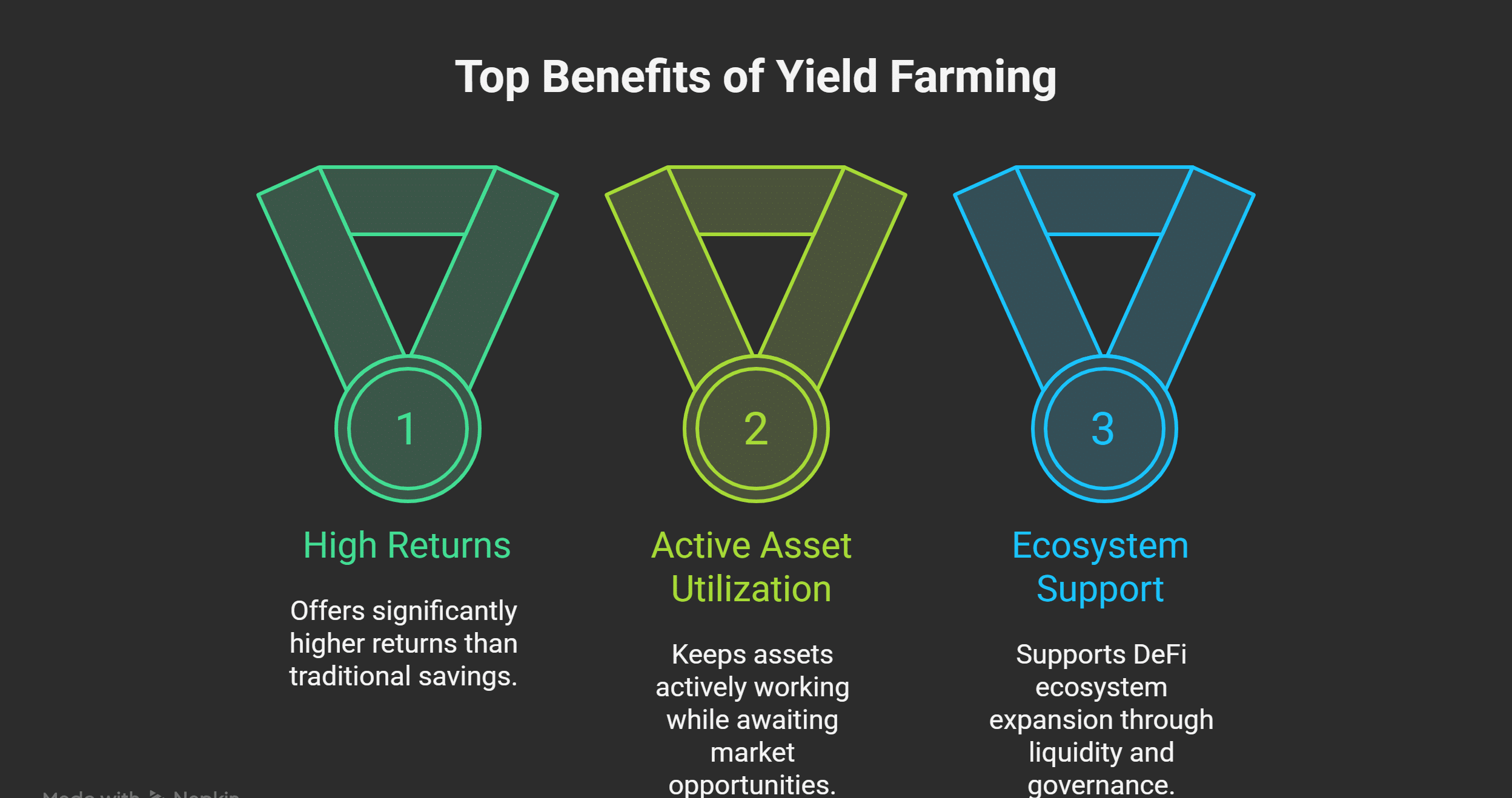
- It can deliver significantly higher returns compared to traditional savings or fixed income. Some early pools offered double-digit or even triple-digit APYs (though such rates come with significant caution).
- It allows token holders to keep assets actively working while waiting for market opportunities, rather than simply holding.
- DeFi is mostly about providing liquidity, decentralized lending, and governance, thus participating in the ecosystem’s expansion by being the supporting force.
- To blockchain developers and analysts, the yield-farming data (TVL, APY, protocol activity) act as indicators of protocol health and user behavior.
The Risks: What to Look Out For
Every strategy carries risk, and yield farming is no exception. Key hazards include:
Impermanent Loss. When providing liquidity in a token pair, if one token’s price changes significantly relative to the other, the Value of the deposited assets may lag what they would have been if held.
Smart Contract Vulnerabilities & Hacks. Yield-farming pools are operated on smart contracts. If the software is faulty or insecure, money may be lost.
Token Price Volatility and Reward Token Risk. High APYs often rely on reward tokens whose Value may collapse. A high-return pool in nominal terms may lead to losses when the reward token’s value drops.
Regulatory and Protocol Risk. DeFi protocols could be subjected to regulatory scrutiny, liquidity might dissipate, or governance might act in an unexpected way.
Sustainability of High Yields. Some yields may be temporarily inflated (e.g., promotional rewards) and not persist. If rewards drop, returns may collapse.
How to Get Started with Yield Farming (Safely)
For financial students, analysts, or developers new to farming, the following approach helps:
- Start with known protocols with a significant total Value locked (TVL). A bigger TVL often indicates more mature infrastructure, though it’s not a guarantee of safety.
-
Whenever you can, pick stable asset pools (for instance, stablecoin pairs) in order to minimize the risk of impermanent loss stemming from price fluctuations.
-
Be aware of and monitor APY against APR and the frequency of compounding.
- Keep withdrawal mechanisms and vesting periods in mind. Some protocols lock assets for a time.
- Use hardware wallets or trusted wallets to connect to DeFi platforms. Ensure wallet permissions are reviewed.
- Keep abreast of protocol audits, community reviews, and any hacking incidents. Stay informed about the underlying smart contracts.
- Only commit capital one can afford to lose. Diversify across strategies rather than putting everything in a single pool.
- Regularly claim and reinvest (if you’re actively managing) or monitor for yield drop or reward token devaluation.
- Be prepared for tax or regulatory implications in one’s jurisdiction.
Key Indicators for Cryptos and Yield Farming Protocols
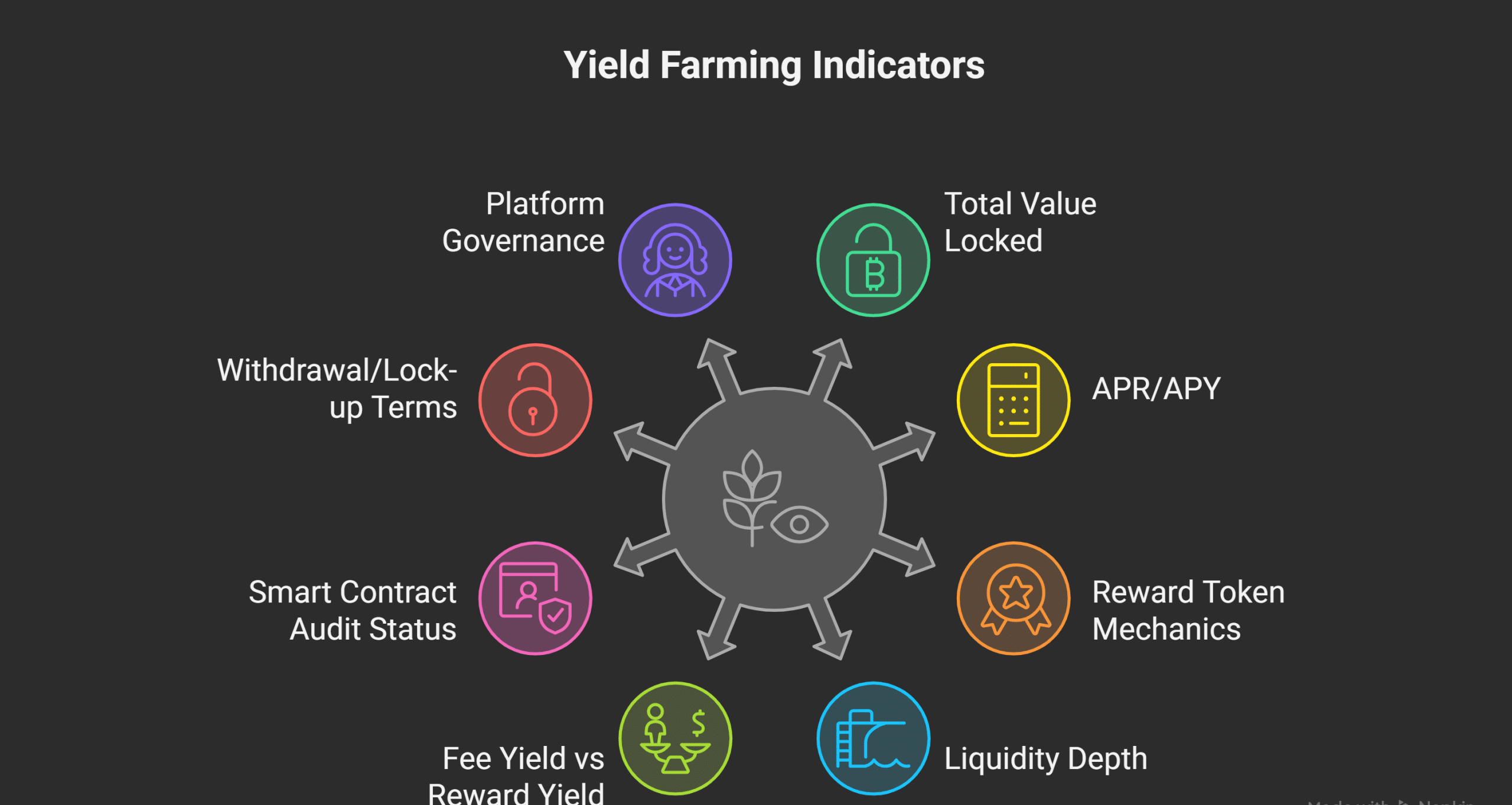
For analysts and developers seeking depth, a few indicators matter:
Total Value Locked (TVL): One of the measures for assets that are secured in the DeFi protocol. A higher TVL might be an indicator of the increased usage and trust.
APR/APY: The stated return rate. Determine if compounding is part of (APY) or not (APR).
Reward Token Mechanics: What are the issued tokens for reward, how is the supply controlled, and does the inflation of tokenomics dilute the Value.
Liquidity Depth: In a pool, how significant are deposits relative to market size? Thin liquidity can amplify risk.
Fee Yield vs Reward Yield: Distinguish between actual trading fees earned and bonus token incentives.
Smart Contract Audit Status: Check for third-party verification, security reports, and active open bug-bounty programs.
Withdrawal/Lock-up Terms: Certain yield farms might require locking up the deposited assets which will then affect liquidity and risk in the farm.
Platform Governance: Who decides on the matters of rewards, token distribution, and upgrades?
Final Thought
Yield farming is able to link the earning of interest in traditional finance with the decentralized finance ecosystem. It is a process that allows the holders of cryptocurrencies to earn interest without having to trade actively; however, it still requires constant monitoring.
The reverse of interest rates is not a promise; rather, it is a function of the protocol’s state of health, the tokens’ market values, risk management, and the overall conditions in the market.
Yield farming may entice financial students, crypto aficionados, blockchain developers, and analysts alike to become hands-on with the mechanics of DeFi, the creation of incentives, and protocol design but, the area that is going to be worked on needs to be properly selected.
Glossary of Terms
-
Annual Percentage Rate (APR): The total simple interest generated over a year without reinvestment of the interest.
-
Annual Percentage Yield (APY): The total interest generated over a year with the compounding effect included.
-
Liquidity Provider (LP): A person who provides tokens into the liquidity pool to ease the process of trading or borrowing.
- Impermanent Loss: Loss incurred when token prices diverge after deposit, causing the Value of assets in a pool to lag the Value had they been held outside.
- Governance Token: A token that empowers its holders to make decisions on matters such as protocol upgrades, reward distribution, or other decisions through voting.
- Smart Contract: A self-executing code on a blockchain that takes care of contracts automatically.
- Total Value Locked (TVL): It refers to the accumulated value of assets that have been put into a DeFi protocol; usually, it is utilized as a measure of the size of the protocol or its health.
- Yield Aggregator: It is the protocol that takes care of transferring assets from one farm to another automatically based on profits to maximize them.
- Rug Pull: A scenario that is intentionally done where the developers take away money from a protocol, thus leaving the liquidity providers unable to withdraw their assets.
- DeFi (Decentralized Finance): Services related to finance that are based on the blockchain technology and that are carried out without conventional intermediaries.
Frequently Asked Questions
1. Is yield farming really a source of passive income?
Yield farming is sometimes considered to be an effortless income source. However, the truth is that it usually requires a great deal of monitoring concerning returns, the Value of the respective tokens, and the changes in the contracts. Risk management through rewards being cut down or impermanent loss is the reason why many strategies require active management.
2. What is the minimum amount of money needed to start yield farming?
The amount of capital needed greatly depends on the specific protocol and the blockchain used (gas/transaction fees come into play). The typical beginner would most likely choose to invest in stablecoins on blockchains with low fees. Make sure to properly check the fees applied to withdrawing and depositing before you go in.
3. Can yield farming be managed in a safe way?
Indeed, but still not without risks. The use of audited protocols, differentiating one’s approaches, making use of pools containing stable assets, and staying educated might increase safety but will not rule out the possibility of a smart contract failure or a token’s devaluation.
4. How does the regulatory risk affect yield farming?
DeFi is presently working in a situation of mixed regulations. Protocols may be hit with future enforcement actions, tax implications, or shifts in legal status. As an illustration, in many cases, the law treats the claiming of rewards as the point at which taxes become due, in other words, the point at which the crypto income is taxable. Therefore, it is vital to keep track of the legal situation in your area.