
This article was first published on TurkishNY Radio.
Ether is about to embark on another of its most significant shifts in recent memory, and Vitalik Buterin urges members to comprehend the magnitude of the change. In a recent talk, he stressed that the introduction of PeerDAS Ethereum with the quickly developing ZK-EVM network is more than just an upgrade; they constitute a fundamental inflection point.


With PeerDAS Ethereum now live on mainnet, the network’s future is looking quicker, more independent, and more reliable.
PeerDAS: The Start of a High-Bandwidth Ethereum
Vitalik described PeerDAS Ethereum as the technology that finally allows the network to scale data capacity without forcing validators to run heavier hardware. PeerDAS, which stands for Peer Data Availability Sampling, lets nodes sample small pieces of a block rather than downloading everything. This dramatically cuts bandwidth requirements.
Also read: Silent EVM Wallet Drain Targets Ethereum Users Across Multiple Chains
“This isn’t just an improvement, it changes how Ethereum thinks about data entirely,” Vitalik explained. He believes PeerDAS Ethereum will act as the backbone of future throughput upgrades, especially as rollups continue to rely on blobs for cheaper data posting.
ZK-EVMs Move Toward Being the New Normal
Alongside PeerDAS, ZK-EVMs are becoming mature enough for everyday use. These proof-based virtual machines allow nodes to verify the correctness of execution without re-running every computation. The result is a more efficient network that still protects security and decentralization.
Vitalik highlighted that while ZK-EVMs are progressing quickly, “they still need more battle-testing before becoming the main verification method.” Pairing ZK-EVMs with PeerDAS Ethereum creates a powerful combination: less computation, less data load, and far greater throughput.
A Multi-Year Roadmap of Deep Structural Change
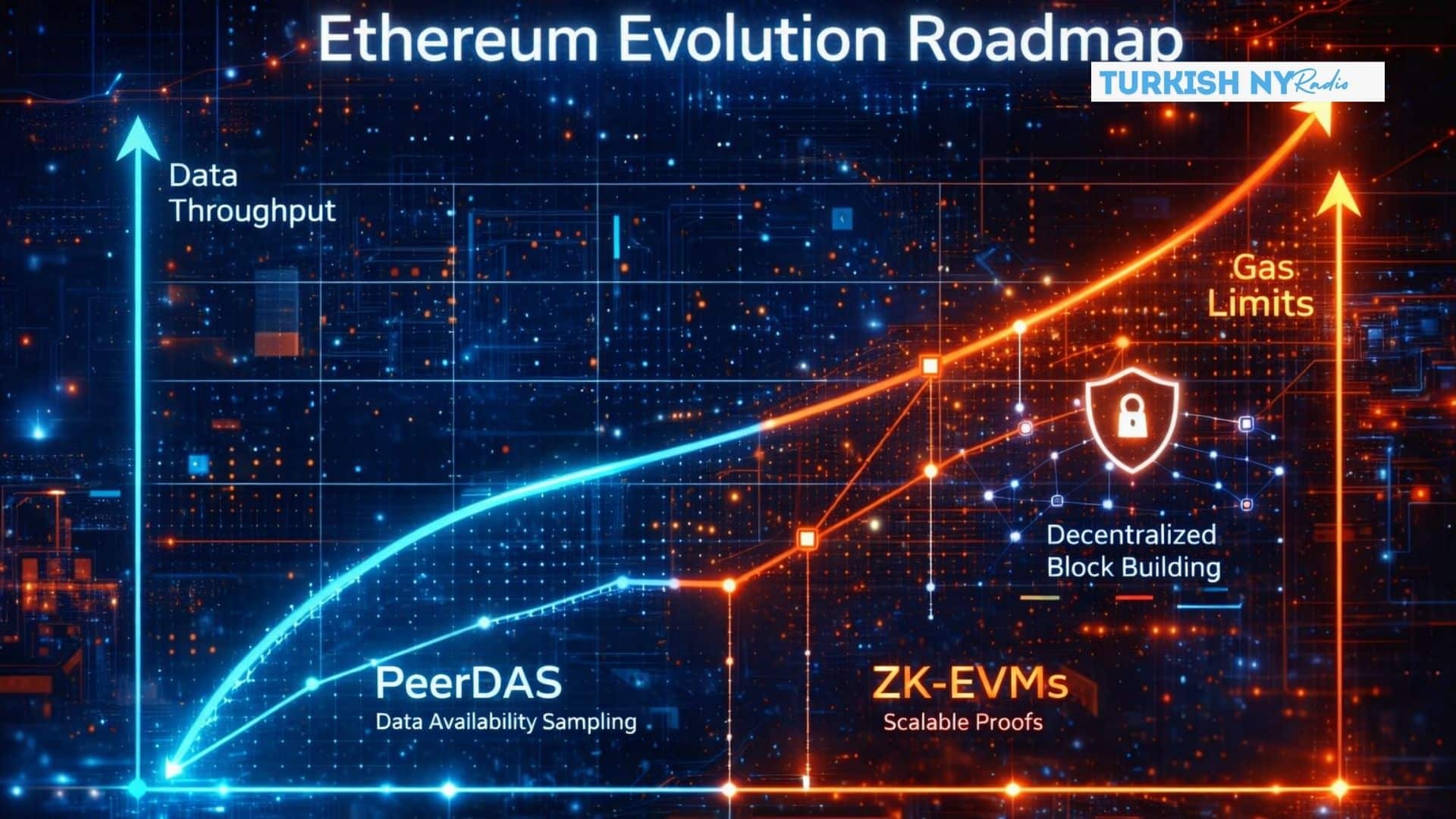
One of the points Vitalik stressed is that Ethereum’s evolution is not a one-time event. The shift sparked by PeerDAS Ethereum is expected to take several years and will unfold in stages. In 2026, the focus will be on implementing changes such as balance autoscaling, ePBS, and gradual gas limit increases. These will give the network breathing room as more scaling tools become production-ready.
The real transformation happens closer to 2027–2030. By then, ZK-EVM proofs could become the default method of validation, allowing the network to safely increase block capacity. Throughout this period, PeerDAS Ethereum will continue enabling larger and more efficient data delivery.
The Push for Fair, Distributed Block Building
Vitalik also touched on one of Ethereum’s longer-term goals: making block building more distributed. Rather than having a single builder put together an entire block, he envisions systems where different actors contribute pieces in a decentralized way.
“The future of Ethereum is one where no single entity holds full control over block creation,” he said. This viewpoint coincides closely with the architectural aims of PeerDAS Ethereum, where spread validation of data around the system rather than aggregating it.
Conclusion
Ethereum is obviously entering a new phase, and the excitement, as well as the challenges, are palpable. The development of PeerDAS Ethereum and the quick advancement of ZK-EVMs demonstrate that the network is not merely fiddling around the edges; it is rewriting its basis for the coming decade.


Vitalik’s vision depicts a future in which Ethereum is quicker, more equal, and more democratic than ever, but it will also need perseverance and careful engineering. What is clear is the reality that PeerDAS Ethereum has begun redefining the possibilities, and this is merely the starting point of where this shift will take us.
Also read: Ethereum Whale Alert as Jack Yi Lines Up $1B More for ETH
Summary
This article highlights how Vitalik Buterin views PeerDAS Ethereum as a transformative shift rather than a routine update. With PeerDAS already active and ZK-EVMs nearing wide-scale readiness, Ethereum is entering a long-term structural evolution aimed at boosting data capacity, improving efficiency, and protecting decentralization. Over the coming years, gas limit increases, ZK-EVM validation, and distributed block building will shape a more scalable network. PeerDAS Ethereum sits at the heart of this next phase.
Glossary of Key Terms
PeerDAS Ethereum: A system that verifies data using random sampling instead of full downloads.
ZK-EVM: A zero-knowledge proof-based virtual machine compatible with Ethereum’s execution model.
Data Availability Sampling: A method that checks whether required data is accessible without downloading everything.
ePBS: A protocol change separating proposers and builders at the consensus level.
Gas Limit: The maximum total computation allowed in a block.
FAQs for PeerDAS Ethereum
1. Why is PeerDAS Ethereum important?
It allows Ethereum to scale data throughput without adding hardware pressure to validators.
2. Does PeerDAS reduce decentralization?
No, it actually supports decentralization by keeping node requirements low.
3. Are ZK-EVMs fully ready today?
They’re advanced enough for use but still need more security hardening.
4. How do ZK-EVMs and PeerDAS work together?
PeerDAS cuts data load, while ZK-EVMs reduce computation, together they boost scalability.
5. What long-term changes did Vitalik outline?
Higher gas limits, standard ZK-EVM validation, and more distributed block building.