
This article was first published on TurkishNY Radio.
The US Iran war spending in Bitcoin has drawn attention after newly disclosed figures showed how quickly military expenses can accumulate.


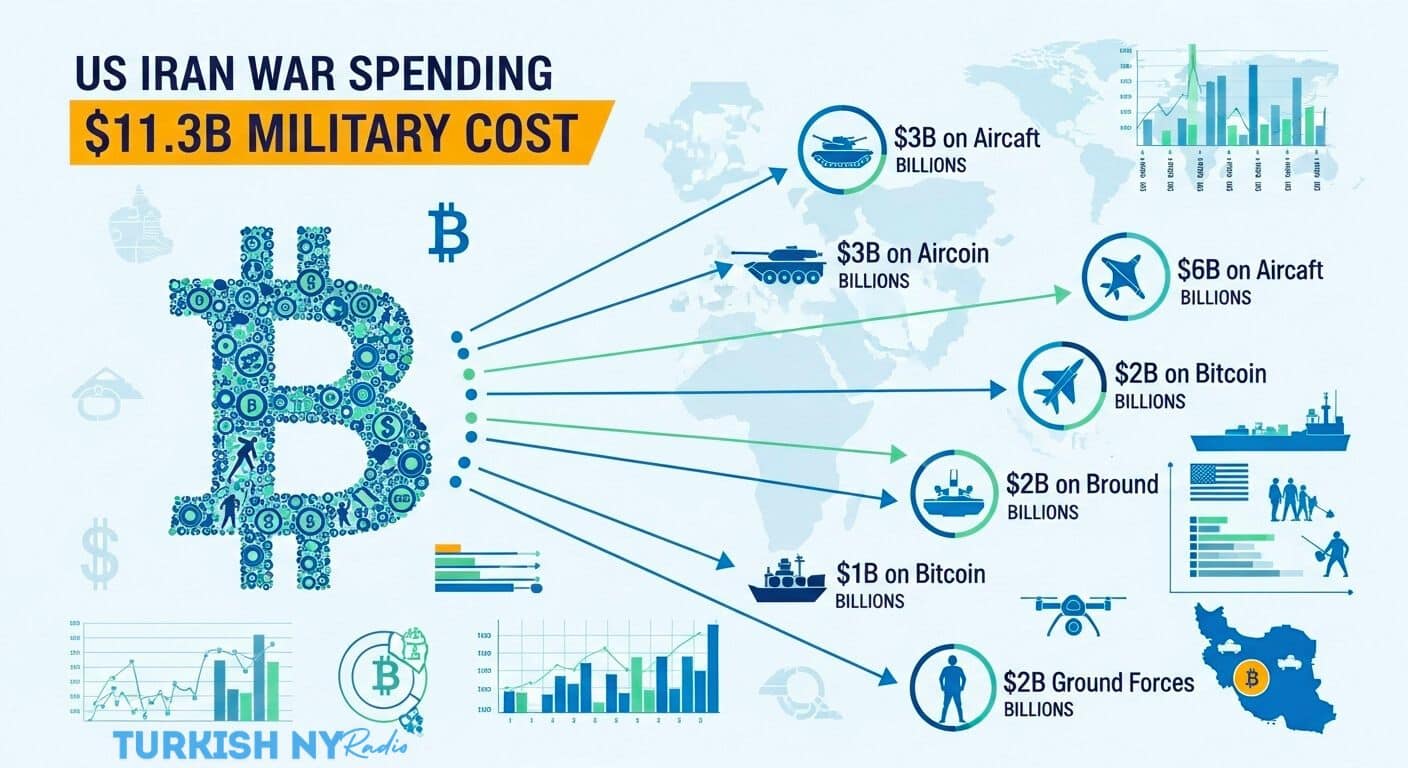
In the first six days of the conflict, the United States spent at least $11.3 billion, an amount that equals nearly half the market value of the federal government’s Bitcoin reserves.
The spending estimate was shared with US senators during a closed-door briefing on March 11, where administration officials outlined the initial cost of the conflict.
Reuters, citing officials present at the meeting, reported that the figure reflects only the early phase of military operations and does not represent the total expected cost.
Lawmakers were also told that $5.6 billion worth of munitions were used during the first two days of airstrikes, highlighting how quickly operational costs increased once the campaign began.
Several members of Congress indicated that the White House may soon request additional funding to support continued military operations.
The figures have led analysts to examine US Iran war spending in Bitcoin terms, offering a clearer perspective on the scale of federal spending.
US Iran War Spending in Bitcoin Shows Cost Benchmark
Data from BitcoinTreasuries.net, a widely cited tracker of sovereign Bitcoin holdings, shows that US government agencies collectively hold 328,372 Bitcoin.
At a market price of around $70,430 per BTC, those holdings are currently worth approximately $23.13 billion.
Using that benchmark, the US Iran war spending in Bitcoin becomes easier to visualize:
- The $11.3 billion spent in six days equals roughly 160,443 BTC
- The amount represents about 48.9% of the value of the government’s Bitcoin reserve
- Daily military spending averages around $1.88 billion
If spending continued at that pace, the value of the government’s entire Bitcoin reserve would equal just over 12 days of military operations.

Congressional aides also told Reuters that a supplemental spending request of roughly $50 billion could be discussed in Washington. If approved, that amount would exceed twice the value of the federal government’s current Bitcoin holdings.
These calculations simply illustrate the scale of federal spending. They do not suggest that the United States is using Bitcoin to finance military operations.
US Iran War Spending in Bitcoin and the BTC Reserve Limit
The federal government’s Bitcoin holdings are tied to the Strategic Bitcoin Reserve, which was created through a White House executive order earlier this year.
Under the policy framework, Bitcoin placed into the reserve cannot be sold or liquidated for general government spending. The order states that digital assets held by the government must be maintained as a national reserve asset.
Government agencies are permitted to transfer or dispose of these assets only under limited circumstances, including:
- Court-ordered restitution
- Law-enforcement investigations
- Revenue-sharing agreements with state authorities
- Legal obligations requiring asset releases
Most of the Bitcoin in the reserve originates from criminal asset seizures and civil forfeiture proceedings handled by the US Treasury and law-enforcement agencies.
Because of these restrictions, the comparison between military spending and Bitcoin holdings serves only as a financial reference point rather than a funding source.
Military Spending Debate Revives Bitcoin Inflation Narrative
Rising military budgets have renewed discussion among analysts about Bitcoin’s role during periods of heavy government spending.
Arthur Hayes, co-founder of BitMEX, has argued for several years that prolonged military spending can increase borrowing and inflation pressure in the global economy.
In a 2023 analysis discussing US military commitments, Hayes wrote:


“Added to Ukraine’s tab, America’s military budget is set to truly explode. This will increase future government borrowing, and the sky’s the limit when it comes to the sums of capital a war can waste.”
Hayes believes that growing fiscal pressure may push investors to reconsider traditional safe-haven assets such as long-term government bonds.

He wrote:
“If long-term US Treasury bonds offer no safety for investors, then their money will seek out alternatives. Gold, and most importantly, Bitcoin, will begin rising on true fears of global wartime inflation.”
Within that context, comparisons such as US Iran war spending in Bitcoin highlight the broader debate about monetary policy and fiscal sustainability.
Bitcoin Market Shows Stability During Geopolitical Tension
Despite the geopolitical uncertainty surrounding the conflict, Bitcoin has remained relatively stable in recent weeks.
Market data compiled by CryptoSlate shows that Bitcoin has gained nearly 4% since the first US strikes on Iran in late February 2026.
Andre Dragosch, Head of Research at Bitwise Europe, attributed the asset’s stability to the increasing presence of institutional investors in the market.
He explained:
“Bitcoin has turned into a serious institutional asset with deep liquidity and frequent participation of large sophisticated investors.”
As the conflict continues, the discussion around US Iran war spending in Bitcoin reflects a broader question facing global markets: how digital assets may behave during periods of geopolitical and fiscal uncertainty.
Summary
- The United States spent about $11.3 billion in the first six days of the Iran conflict, showing how quickly military costs can rise during active operations.
- That amount equals around 160,443 Bitcoin, which is nearly half of the US government’s tracked Bitcoin holdings.
- Looking at US Iran war spending in Bitcoin terms helps illustrate the true scale of these expenditures.
- Some analysts believe rising military budgets could increase interest in Bitcoin as an inflation hedge.
Glossary of Key Terms
1. Bitcoin (BTC)
Bitcoin is a digital currency that runs on a decentralized blockchain network. It isn’t controlled by any government or bank, and its supply is limited to 21 million coins.
2. US Iran War Spending in Bitcoin
This term refers to converting the cost of US military operations in the Iran conflict into Bitcoin value. It helps readers easily understand the scale of spending.
3. Strategic Bitcoin Reserve
The Strategic Bitcoin Reserve is a US policy that keeps government-held Bitcoin as a long-term national asset. These coins generally come from seized funds and are not meant for spending.
4. BitcoinTreasuries Data
BitcoinTreasuries is a public website that tracks how much Bitcoin governments, companies, and institutions hold. Researchers often use this data to measure Bitcoin ownership trends.
5. Sovereign Bitcoin Holdings
Sovereign Bitcoin holdings refer to Bitcoin owned by national governments. These assets are usually obtained through criminal investigations, asset seizures, or financial enforcement actions.
6. Institutional Bitcoin Adoption
Institutional adoption describes large financial players such as asset managers, hedge funds, and corporations—entering the Bitcoin market through investment, custody services, or trading.
7. Wartime Fiscal Spending
Wartime fiscal spending refers to the money governments spend during military conflicts. This includes weapons, military operations, logistics, and other defense-related expenses.
8. Inflation Hedge
An inflation hedge is an asset people buy to protect their money from losing value. Some investors view Bitcoin this way because its supply cannot increase.
FAQs About US Iran war spending in Bitcoin
1. What does US Iran war spending in Bitcoin mean?
It simply compares the $11.3 billion spent during the first six days of the conflict to Bitcoin’s value. This helps readers better understand the scale of wartime spending.
2. Can the US government use its Bitcoin reserve to pay for the war?
No. The Strategic Bitcoin Reserve is designed to hold Bitcoin as a long-term national asset. Current rules prevent the government from selling it for military spending.
3. Why is military spending being compared to Bitcoin?
Using Bitcoin as a comparison helps people visualize the size of the spending. Converting the cost into BTC makes the financial scale easier to understand.
4. Could higher war spending influence Bitcoin demand?
Some analysts believe large military budgets can increase borrowing and inflation concerns. In such situations, investors may look toward assets like Bitcoin for long-term value protection.