The rise of digital assets has opened up opportunities but it has also brought a wave of crypto scams that are even tricking experienced investors. From fake investment platforms to impersonation and romance scams, fraudsters are finding new ways to steal funds in the fast-moving crypto world.
According to a 2024 report, crypto-related fraud hit over $9.9 billion in losses, with phishing, Ponzi schemes, and romance-style “pig butchering” scams leading the way.


Phishing and Fake Website Crypto Scams
One of the most common crypto scams is phishing. This involves fake emails or websites that impersonate legitimate crypto exchanges or wallets. Scammers often create clone sites with slightly altered URLs, such as a fake exchange login page, to get users to enter their wallet keys or passwords.
For example, a user might get an email that looks like it’s from a popular crypto platform asking them to “verify” their account. Clicking the link takes them to a near-identical site where the victim unknowingly enters their private keys or seed phrase. The fraudster then drains the victim’s wallet.
To avoid this crypto scam; always check the website’s URL and SSL certificate before entering any info.
It is advised to bookmark the official exchange sites instead of depending on emailed links. Using two-factor authentication (2FA) on crypto accounts is a recommended practice and will offer additional security.
The Federal Trade Commission (FTC) in the US states that “only scammers demand payment in cryptocurrency” and that any promise of guaranteed profits or crypto payments should always be viewed as a red flag.
Also read: Crypto Scams 2025:The Hidden Traps and How to Avoid Crypto Fraud
Ponzi Schemes and High-Yield Investment Crypto Scams
Ponzi-style and high-yield investment schemes are still a top crypto scam trend. These scams promise big returns (often with flashy websites or social media ads) but pay early investors with funds from later ones.
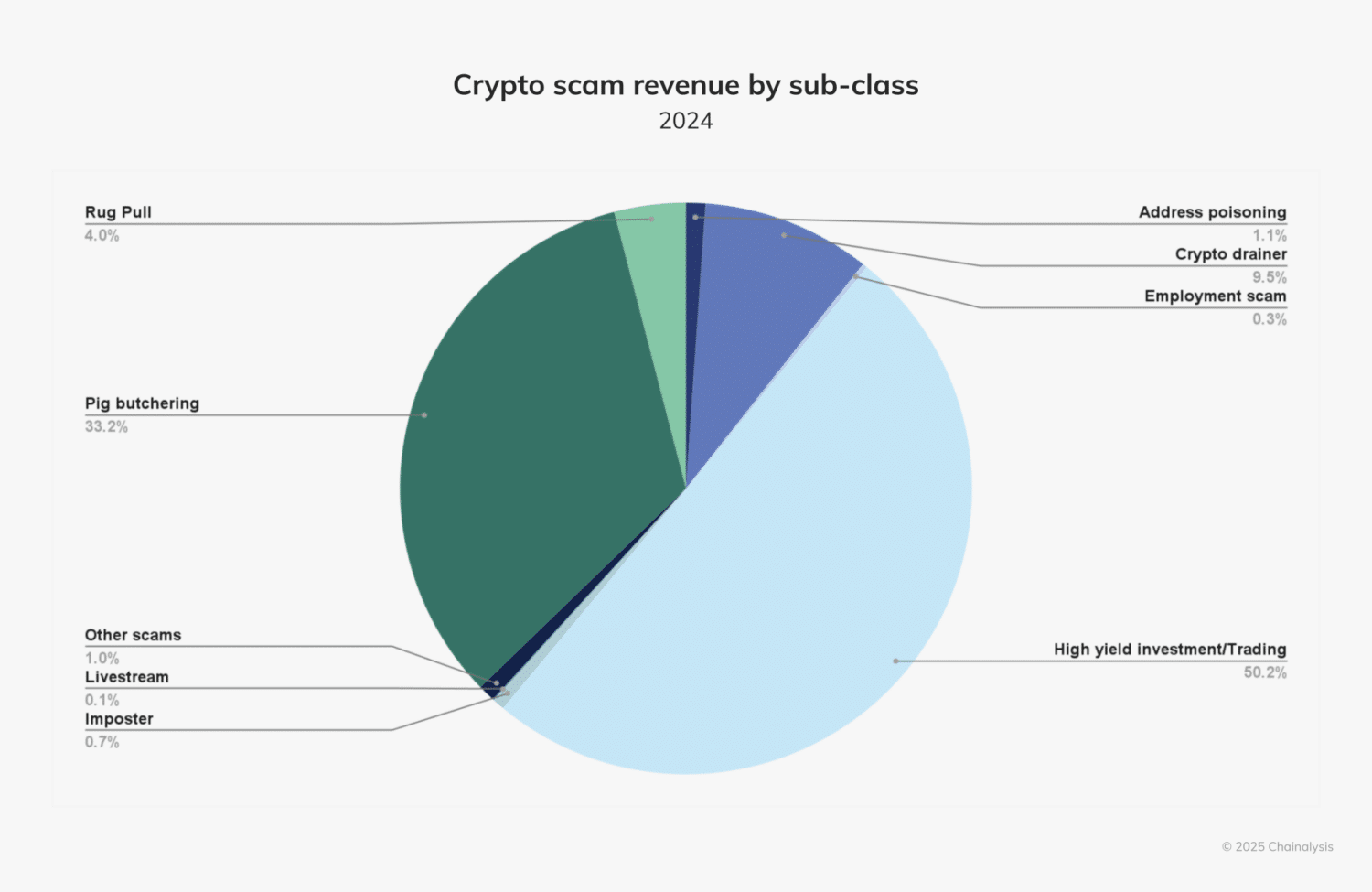
Chainalysis says high-yield investment scams (HYIPs) and Ponzi schemes accounted for about 50% of all crypto scam revenue in 2024. While overall HYIP inflows declined, they still pulled in half of all fraud proceeds in 2024.
Sources note that these scams promised outsized returns and continued to bring in billions. Famous examples include long-running schemes where victims get small payouts at first but can’t withdraw larger sums.
These scams use pressure tactics: guaranteed profits, referral bonuses, or celebrity endorsements. To spot them, remember the golden rule: if it sounds too good to be true, it is. The FTC explicitly warns that “only scammers will guarantee profits or big returns”.
Before investing, investors should research the project team and look for red flags: no registration with regulators, opaque whitepapers or unverifiable marketing claims. Due diligence is key. Use only reputable exchanges or funds and never send crypto to an unverified “investment platform” that promises easy gains.
Impersonation and Giveaway Crypto Scams
In this type of scam, fraudsters pretend to be someone trusted, who could be a celebrity, social media influencer, or even a government official, to ask for crypto. For example, scammers have created fake Elon Musk Twitter accounts promising “giveaways” of Bitcoin or Ethereum if investors send them a small amount first.
Experts note that fake celebrity endorsements are common. Scams will show slick graphics of Musk or other figures and claim to match any crypto sent. Similarly, “giveaway scams” promise to double investors’ crypto if sent in, but of course, the funds disappear once sent.
Other impostors might pose as crypto wallet support or regulators. Chainalysis reported a case of scammers hijacking the SEC’s social media to trick people into transferring crypto.
Always be skeptical: don’t trust private messages on social media or emails asking for crypto; even if they say they are from a company or celebrity.
Always check official announcements via verified channels. Remember, legitimate entities won’t ask to send cryptocurrency first. The FTC advises never to click on unsolicited links promising cryptocurrency returns.
In short, if someone online offers free crypto or guarantees a windfall after users send funds, it’s a classic crypto giveaway scam.
Romance and “Pig-Butchering” Crypto Scams
Romance scams (often called “pig butchering” in crypto terms) have exploded in recent years. In these scams, a scammer builds a fake online relationship with the victim on dating apps or social media; then steers the relationship toward a fraudulent crypto investment.
Experts describe pig butchering as scams where perpetrators cultivate relationships and convince victims to participate in fraudulent schemes. These con artists spend weeks or months gaining trust; eventually, they convince the victim to send cryptocurrency for a too-good-to-be-true investment.
Reports said pig-butchering scams jumped about 40% in 2024. These scams start with flirtatious messages; then financial talk. The FTC advises; “Never mix online dating and investment advice”. If a new love interest quickly tells to invest in crypto, that’s a red flag.
To stay safe, never send money or crypto to someone only known online. If a supposed partner suggests using a specific crypto platform to trade, pause and verify independently. Use common sense and protect your heart and your wallet: as scammers rely on emotional trust before “fattening up” victims for a big payday.
Rug Pulls and DeFi Exit Scams
A rug pull is a crypto exit scam where a project’s developers suddenly abandon the project and run off with investors’ funds. DFPI’s official definition explains it as a scheme where a developer “attracts investors to a new crypto project, pumps up the value, and then pulls out, leaving investors with a worthless currency”.
In reality; rug pulls happen in DeFi or NFT projects. Scammers launch a new token, promote it often via social media or influencers, collect millions, then disable liquidity so the token price crashes to zero. Coinbase sums it up nicely: “developers abandon a project after raising assets, leaving participants with worthless tokens”.
Very carefully, investors should take measures to prevent themselves from falling victim to crypto scams with new unproven projects. Study the team and community thoroughly; find audits of good repute; and do not trust the promises that sound too good to be true. Check the liquidity if it is locked and if the source code is accessible.
Warning signs are anonymous developers, poor documentation and huge early token allocations to insiders. In general, if a crypto project promises guaranteed high yields or uses aggressive marketing tactics, it should be treated with suspicion as it’s probably a rug pull waiting to happen.
Also read: Fake Love, Real Loss: Crypto Scam Exposed
Expert Analysis: Trends and Countermeasures
Regulators say crypto scams are getting more diverse and sophisticated. Sources cite data that crypto scam losses are on track to set new records (up to $12.4 billion in 2024), driven by big pig butchering operations and even AI generated scams.


Crypto fraud has been polishing off almost 24% more each year since 2020. According to Chainalysis’ 2024 report; high-yield investment scams and pig butchering together accounted for more than 80% of all scam proceeds. The graphic below illustrates how much revenue each scam type generated in 2024:
Experts say scammers are now using professional services such as P2P marketplaces; chatbots etc; to scale their operations. For example; fraud rings in Southeast Asia have reportedly built “scam compounds”; where teams run multiple schemes at the same time. They even adapt to law enforcement takedowns by registering new domains and channels.
Expert and regulator advice: Investors should be educated and aware. The FTC and other consumer agencies update warnings (e.g. phishing and impersonation tactics) regularly. Use proven security practices like hardware wallets; reputable custodians and double check sources.
Traders and investors should stay updated through official notifications (like the DFPI and FTC consumer advisories). Always keep in mind the only safe crypto is the one you control and verify. When traders and investors combine knowledge with these best practices; they can substantially reduce the risk of getting scammed.
Conclusion
Based on the latest analysis; crypto scams are getting bigger and more sophisticated but investors can defend themselves by knowing the warning signs and best practices. Always be skeptical of unsolicited crypto opportunities. Verify every platform; and contact and never rush into investments.
By being informed and following the above advice; investors can reduce the risk of getting scammed.
For in-depth analysis and the latest trends in the crypto space, our platform offers expert content regularly.
Summary
Expert sources say scam activity is on the rise but they stress caution and due diligence by checking URLs, verifying credentials, avoiding “too good to be true” offers as the best defense. Implementing robust security measures (2FA and audits) and heeding regulatory advisories; will help investors protect their crypto.
Frequently Asked Questions About Crypto Scams
What is a crypto scam?
A crypto scam is any fraudulent scheme that uses cryptocurrencies to deceive victims. Examples include phishing for wallet credentials, fake investment programs or exiting a project after taking investors’ money. These are illegal and designed to steal funds or personal data.
How can investors recognize and avoid a crypto scam?
Common warning signs include guaranteed high returns; pressure to act fast; unsolicited investment tips or requests for upfront crypto payments. Always verify websites and social media accounts; use reputable exchanges and enable security features like 2FA. Never send crypto to unverified addresses or unknown individuals.
What is the “rug pull” scam?
Rug pull is when the creators of a cryptographic project simply take their exit faking the project and disappearing with the investors’ money, thus making the token worthless.
What is a “pig butchering” scam?
A pig butchering scam is basically a combination of romance and investment fraud. First, the scammers will make a victim their friend; then they will gain trust and finally, they will try to persuade the victim to invest in the fake cryptocurrencies created for the scammers.
Glossary
Cryptocurrency: A digital currency (like Bitcoin, and Ethereum) that works on a decentralized network of blockchain technology.
Blockchain: a very secure way of keeping a public record about all transactions of cryptocurrencies by using the technology of linking them in “blocks”.
Crypto Wallet: a digital place (it can be software or hardware) where your cryptocurrency private keys are stored. If you lose your wallet or your keys, you lose access to and control of your funds completely.
Phishing: a form of fraud that leads to the investors being deceived into disclosing their confidential information (passwords, keys); it is done by someone pretending to be another.
Ponzi Scheme: an investment fraud that pays back its early investors with the funds coming from the new investors, not from profit. At some point in time, it collapses when the new investments come to a halt.
2FA: is an extra security layer that requires two different forms of verification like a password and a code sent to your mobile phone, before you are allowed to access your account. It’s a way to protect yourself from being hacked.