
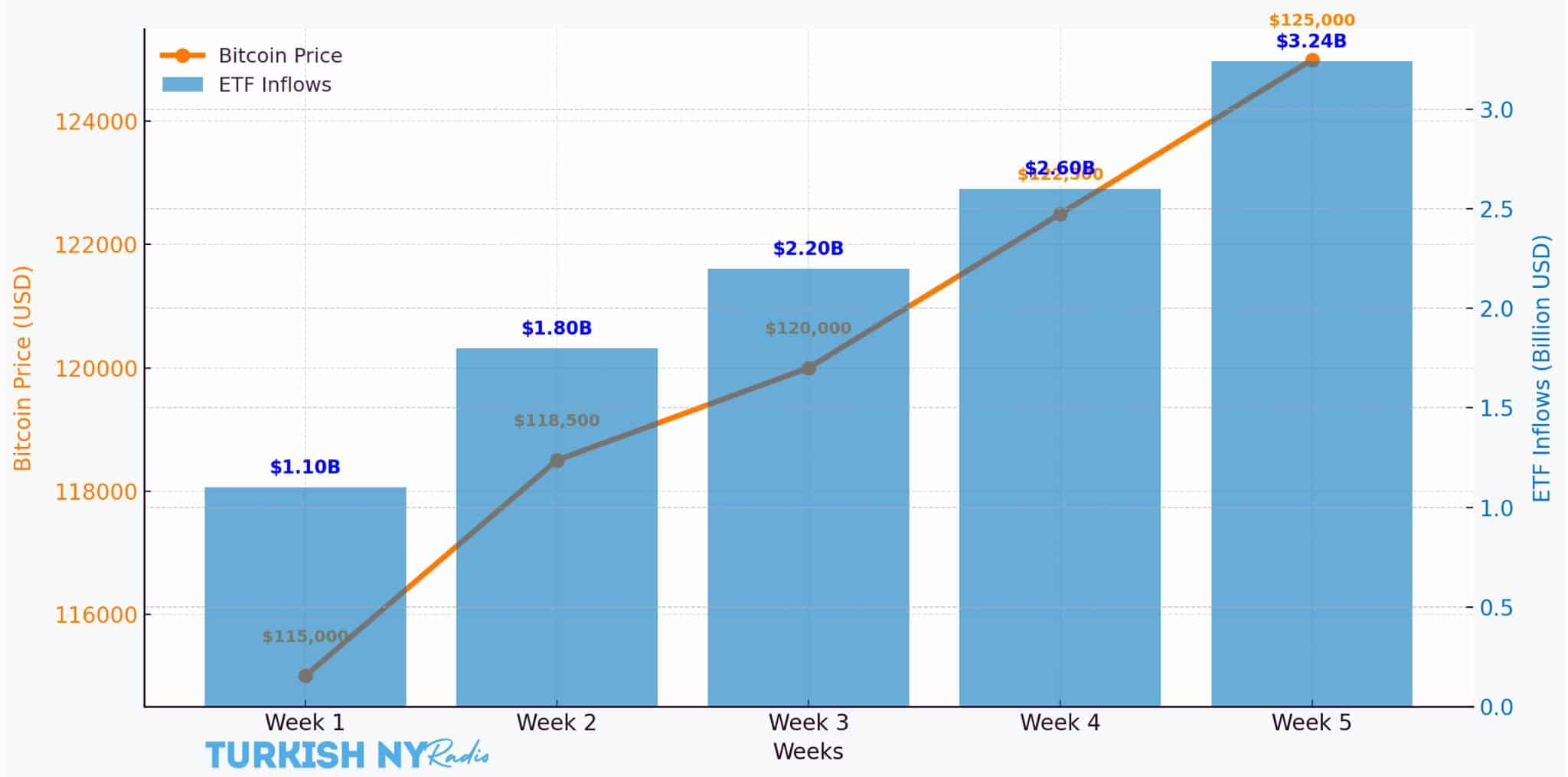
U.S. spot Bitcoin ETFs took in $3.24 billion last week, the second-largest weekly inflow since these funds first came to market in early 2024. That reversed an outflow of $902 million in the previous week, bringing the four-week total to nearly $4 billion.
IBIT from BlackRock took the helm, taking up $1.82 billion, with its assets under management sitting at or above $95–96 billion. Fidelity’s FBTC brought in about $692 million, or roughly 38 percent as much as IBIT.


How Spot Bitcoin ETFs Pushed Prices Beyond $125K
The inflow of capital into spot BTC ETFs catapulted the top crypto above $125,000 to reach a new high since August. The strong inflows highlighted a rotation from traditional assets to regulated crypto exposure amid general macro uncertainty.
Investors continued to seek out digital assets as a means of diversification, driving increased demand through institutional channels. As per reports, this shift echoes renewed faith in Bitcoin’s long-term value, evident from an increase in trading volumes as well as record ETF activity.
Also Read: SEC Streamlines Crypto ETF Listings: Is Bitcoin on the Road to $150K?

Interest of Safe-Haven and Bitcoin’s Shrugging-Off Resistance
Some analysts say some of the rally reflects increasing safe-haven demand as the U.S. government heads toward a possible shutdown. As geopolitical wars gripped the market, money shifted towards gold and Bitcoin as safe-haven assets to skirt public policy concerns.
At the same time, Cointelegraph reported that Bitcoin reserves on centralized exchanges now stand at around 2.83 million BTC, a six-year low, in yet another indication of an ongoing supply squeeze that has served to accentuate the impact of ETF inflows.
Community Tone & On-Chain Signals
On X, analysts mentioned the growing strength of IBIT and signaled multi-day inflow runs in spot ETF products. Reddit threads argued whether inflows could trigger a sustained breakout or whether momentum would fizzle. One sentiment read,
“ETF inflows are on the uptick, but supply is drying up.”
On-chain data supports this narrative; open interest in futures reached new all-time highs recently, suggesting institutional conviction in the trend.
Price Outlook: Ranges & Risk Zones
| Scenario | Key Conditions | Target Band |
| Base-case continuation | ETF demand remains strong, macro conditions stable | $128,000–$135,000 |
| Rotation/range | Inflows moderate, market digests recent gains | $118,000–$126,000 |
| Momentum extension | Fresh institutional inflows, USD weakens | $135,000–$140,000 |
| Correction & test | Flow reversal, macro shock, profit taking | $110,000–$116,000 |
Citigroup recently cut their year-end Bitcoin target to $133,000, with macro offset risks such as U.S. dollar strength and gold falling.


That critical support zone is now approximately $117,300–$118,000. A sustained break would open the door to further retracements.
Also Read: Crypto ETF Filings Flood SEC: Avalanche, Sui, Bonk, and LTC in Spotlight
Why This Shift Matters
The increasing significance of IBIT highlights how institutional players now drive Bitcoin liquidity and price action. As the fund grows, its inflow and redemption cycles determine to what extent Bitcoin takes on or off shifts capital.
Meanwhile, the diminishing supply on exchanges exacerbates every bout of demand, forcing price action to be even more exaggerated. Recent findings published on arXiv also illustrate a tightening correlation between Bitcoin and the traditional indices such as the Nasdaq and S&P, signaling an increasing adoption by institutional investors.
More crypto news on spot Bitcoin ETFs, expert analysis, and price forecasts is available now on our crypto news platform
Summary
U.S. spot Bitcoin ETFs captured inflows of $3.24 billion, the second largest week ever for the product type, helping power Bitcoin to above $125,000. BlackRock’s IBIT was the top contributor, with $1.8 billion, and Fidelity’s FBTC brought in an additional $692 million.
Analysts attributed the increase to strong demand for ETFs, declining exchange supply, and safe-haven buying in the face of an uncertain U.S. fiscal outlook, with some saying at least one forecaster sees upward potential toward $140,000 if inflows stay high.
Glossary of Key Terms
1. Spot Bitcoin ETF
An investment product that allows people to buy into Bitcoin in the stock market, which is kind of like a trading fund for Bitcoin; this method directly holds Bitcoin rather than cash or other assets.
2. Inflows
Money moving into an investment, like a Bitcoin ETF. Basically this is the deposits indicating how much new money investors are adding each week.
3. Exchange-Traded Fund (ETF)
An investment fund that can be bought and sold on stock exchanges. It pools assets (like Bitcoin) together so that investors can easily buy them.
4. Institutional Investors
Big institutions like banks, hedge funds, and so forth that place multimillion-dollar bets at a time. They often drive market direction just as heavy hitters do in a poker game.
5. Safe-Haven Asset
A kind of investment people seek in uncertain times. Gold and Bitcoin serve as examples assets thought to retain value when markets go wobbly.
6. Bitcoin Supply
The total amount of Bitcoins issued so far. When fewer coins rest on exchanges, it’s analogous to reduced stock on store shelves, and prices can increase more quickly.
7. Liquidity
How much of something is being bought or sold without causing its price to move very much? A “liquid” market is one that resembles a busy shop where trading can take place quickly.
8. Correlation
How closely two things move in tandem. If Bitcoin and the stock market move up or down in tandem, they’re said to have a strong correlation.
Frequently Asked Questions About spot Bitcoin ETFs
What exactly are spot Bitcoin ETFs, and why are they all the rage?
Spot Bitcoin ETFs enable investors to obtain direct exposure to Bitcoin in regulated funds. They are popular for combining the potential of crypto with institutional-grade security and compliance.
What impact do spot Bitcoin ETFs have on the price of Bitcoin?
Heavy inflows to spot Bitcoin ETFs boost demand and diminish available supply on exchanges, helping to drive up the price of Bitcoin as markets gain more confidence in institutional participation.
Are spot Bitcoin ETFs safe and regulated?
If so, wouldn’t spot Bitcoin ETFs be subject to financial regulators, which guarantee secure custody and transparent reporting through adherence with market standards for investor protection and accountability?
What might impact the future of spot Bitcoin ETFs?
The future seems to depend on the market cycles of Bitcoin, worldwide regulations, institutional interest, and ETF inflow momentum that will determine sustainability and investor growth.