This article was first published on TurkishNY Radio.
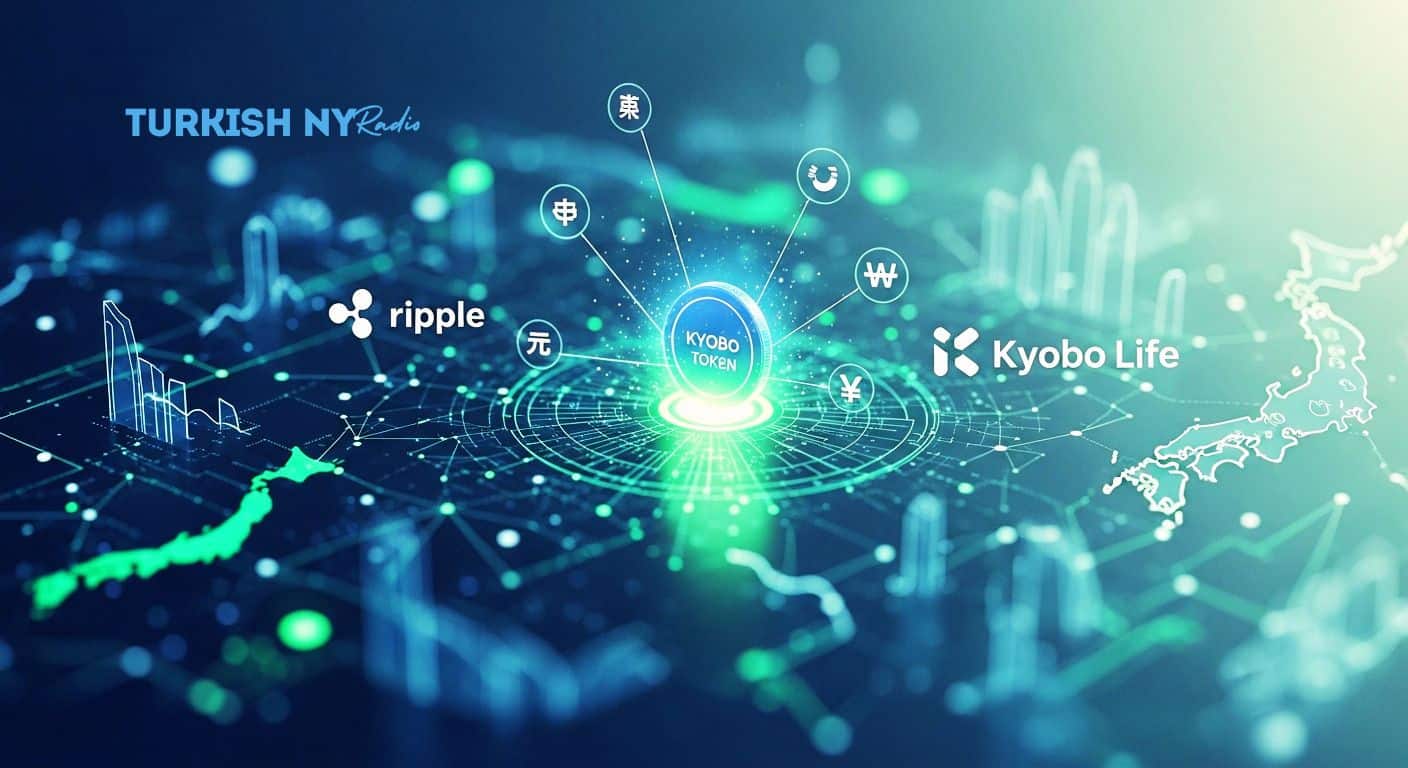
The Ripple partners with Korea’s Kyobo Life to tokenize government bond settlement development signals a measured but notable step toward modernizing how sovereign debt transactions are processed.


Rather than announcing a full rollout, the companies are starting with a pilot designed to test whether blockchain infrastructure can realistically shorten settlement times in Korea’s bond market.
Ripple confirmed the agreement in its official release, stating that Kyobo Life Insurance one of South Korea’s largest insurers will work with its Ripple Custody platform to explore tokenized settlement.
The goal is to move beyond the conventional T+2 cycle, where trades settle two days after execution, and instead evaluate near real-time processing.
Ripple Kyobo Tokenization Pilot Details Unclear
The Ripple partners with Korea’s Kyobo Life to tokenize government bond settlement initiative is clearly positioned as an exploratory phase. Ripple’s release does not outline transaction volumes, specific government bond issuances, or a timeline for live deployment.
The statement notes that both parties will “assess the technical and regulatory feasibility” of tokenized treasury settlement. This phrasing indicates that the project is focused on testing infrastructure performance and compliance requirements before any broader adoption.
Kyobo Life will also examine the use of stablecoin-based payment rails within this framework. However, no stablecoin type or regulatory pathway has been confirmed. That leaves open questions about how such payment mechanisms would operate under South Korea’s financial rules.
Ripple Kyobo Tokenization Targets Bond Settlement
The Ripple partners with Korea’s Kyobo Life to tokenize government bond settlement pilot reflects a broader effort across financial markets to improve efficiency in post-trade processes. Traditional settlement systems depend on multiple intermediaries, manual reconciliation, and delayed clearing, which can increase both cost and risk.
Research from the World Bank shows that distributed ledger technology can streamline these processes by enabling shared records and reducing reliance on intermediaries.
Similarly, findings from the Bank for International Settlements highlight that tokenized securities can support “atomic settlement,” where payment and asset transfer happen simultaneously.
These efficiencies are central to why institutions are testing tokenization in fixed-income markets, even though large-scale implementation remains limited.
Asia’s Regulatory Progress Supports Experimentation
The Ripple partners with Korea’s Kyobo Life to tokenize government bond settlement move comes at a time when several Asian markets are advancing structured frameworks for digital assets.
South Korea has already established licensing regimes for crypto-related payment providers and is exploring policies around local-currency stablecoins. Japan, Singapore, and Hong Kong have also introduced regulatory sandboxes and pilot programs focused on tokenized assets.
The Monetary Authority of Singapore, through its Project Guardian initiative, has reported early success in tokenizing bonds and other financial instruments.
These developments create a regulatory environment where pilot programs like Ripple’s can be tested with clearer oversight compared to other regions.
Ripple Deepens its Institutional Strategy
The Ripple partners with Korea’s Kyobo Life to tokenize government bond settlement agreement also reflects Ripple’s broader shift toward institutional infrastructure following the resolution of its legal dispute with the U.S. Securities and Exchange Commission in 2024.
Since then, Ripple has expanded its presence across Asia and the Middle East, announcing custody and payment partnerships in Japan, Singapore, and the UAE.
The company is positioning Ripple Custody as a backend system for regulated financial institutions rather than a consumer-facing product.
This approach aligns with growing demand for secure custody and settlement layers that can support tokenized assets within existing financial systems.
Cautious Outlook as Testing Begins
While the Ripple partners with Korea’s Kyobo Life to tokenize a government bond settlement initiative, which highlights increasing institutional interest in blockchain-based settlement, expectations remain measured.
The pilot phase will determine whether the technology can meet regulatory standards, integrate with current infrastructure, and deliver meaningful efficiency gains.
Until those results are clear, the project remains a controlled test rather than a confirmed shift in how Korea’s bond market operates.
Summary
- Ripple has teamed up with Korea’s Kyobo Life to explore tokenized government bond settlement through its custody platform.
- The aim is to speed up the usual T+2 process and test near real-time settlement.
- For now, the project remains a pilot with no fixed timeline or transaction scale.
- It also includes early exploration of stablecoin payment options.
- Asia’s evolving regulations support such initiatives.
- The move highlights Ripple’s increasing focus on institutional infrastructure.
Glossary of Key Terms
1. Tokenization
This means turning something real, like a government bond, into a digital version on a blockchain. Think of it like scanning a document and making it securely usable online.
2. Government Bonds
These are basically loans people or institutions give to a government. In return, the government pays them interest over time, similar to earning from a savings plan.
3. Blockchain
A shared digital system that records transactions securely. You can imagine it as a notebook that many people can see and verify, but no one can secretly change.
4. T+2 Settlement Cycle
This is the usual system where a trade takes two days to fully complete. It’s a bit like placing an order today but having it officially processed later.
5. Real-Time Settlement
This means transactions are completed almost instantly. Like sending money online and seeing it arrive within seconds instead of waiting days.
6. Stablecoin
A type of digital currency that keeps a steady value, often tied to regular money like the US dollar, so it doesn’t swing wildly in price.
7. Ripple Custody
A secure storage system by Ripple for digital assets. You can think of it as a digital vault used by financial institutions to keep assets safe.
8. Pilot Program
A small test run before a full launch. It’s like trying something on a limited scale first to see how well it works before expanding it further.
FAQs About Ripple Kyobo Tokenization
1. What is Ripple Kyobo Tokenization?
It’s a pilot where Ripple and Kyobo Life are testing blockchain to settle government bonds faster, with the goal of making transactions quicker and more efficient.
2. How will payments and costs work in this system?
Stablecoins may be used to speed up payments, but exact costs, fees, and pricing details haven’t been shared yet since the project is still being tested.
3. What are the main benefits of tokenized bond settlement?
It can speed up settlement, reduce the need for intermediaries, lower risks, and improve transparency, helping institutions process bond transactions more smoothly and efficiently.
4. Is the system secure and when will it be available?
The pilot is testing security and regulatory compliance. There’s no confirmed launch date yet, as rollout depends on results and approval from financial authorities.