![BitTorrent [New]](https://s2.coinmarketcap.com/static/img/coins/64x64/16086.png)


This article was first published on TurkishNYR.
Restaking risk has become rampant in DeFi, with protocols tempting validators with multiple layers of yields on the same staked token . By reusing staked tokens in multiple networks, these platforms offer bonus payouts, but analysts say this results in layered exposure.


At worst, a security failure in one protocol could cascade and put the network’s security at risk. Industry analysts point out that restaking protocols could pose an enormous systemic risk as the same staked token is counted over and over again as collateral.
Analysis warns that slashing based on a single restaked Network is, in fact, virtually slashing the validator’s collateral on all networks, Ethereum included.
Put simply, the promised yield is an artificial rebate from token emissions or venture rewards rather than any genuine improvement in economic value. The high returns offered by restaking often hide stacked risks that converge into centralization pressures and potential liquidity crisis with no clear long-term payoff.
What is Restaking and Why the Hype?
Restaking is a new staking pattern that allows users to reuse already staked tokens. Staking itself is when users lock up a token to secure the blockchain while being paid some interest.
Restaking goes one step further: validators recommit their staked tokens to secure other networks or services. This allows a single 32 ETH deposit for example, to validate more than one protocol (referred to as Actively Validated Services, or AVSs).
This makes capital more efficient, validators can earn multiple rewards with one stake, and new projects get security without needing their own validator base. But more layers of restaking mean there are more dependencies.
The greater the amount of staked tokens, the more “trust” can be granted to each such service. But now the security of each layer directly depends on that base token stake. This makes any failure in an AVS, be it a smart-contract bug or a slashing mishap, is potentially dangerous to all other protocols backed by the same token.
In essence, restaking compounds exposure as the collateral is “doubly counted” across networks.
The Mirage of Yield: Synthetic vs. Actual Benefits
On the surface, restaking seems like free money. Validators see higher APYs, and liquid restaking tokens (LRTs) have gone up in demand. This pump was propelled by token incentives; a lot of restaking projects promised huge rewards and venture-funded bonus yields to draw in capital.
But experts caution that most of those yields are utterly artificial. Restaking’s added bonuses are issued based on token emissions that inflate supply, borrowed liquidity incentives provided for by venture treasuries or speculative fees paid in volatile tokens.
This is to say that yields are often a side effect of marketing and inflation, not actual productivity. Once the “mining bonus” from token giveaways wore off, analysts point out that restaking yields stagnated rather fast. In time, new capital inflows began to subside, though total restaked TVL is still high.
Unlike traditional staking or lending that generates interest income from network fees or other benefits, restaked capital doesn’t directly add value to users’ service.
Speaking in an interview, one commentator suggested that real yields would need to be connected with “real network usage” and restaking only “recycles” collateral.
Re-staking enthusiasts say there’s “security pooling,” but unless end-users or revenue actually pays for those security resources, that staking is paid for by fresh token issuances.
Without actual fees or customers in the AVSs, the extra APYs appear unsustainable.
Layered Risks of Restaking
Restaking may seem like an efficient proposition, but it risks adding to the pile of dangers. Here are the main dangers:
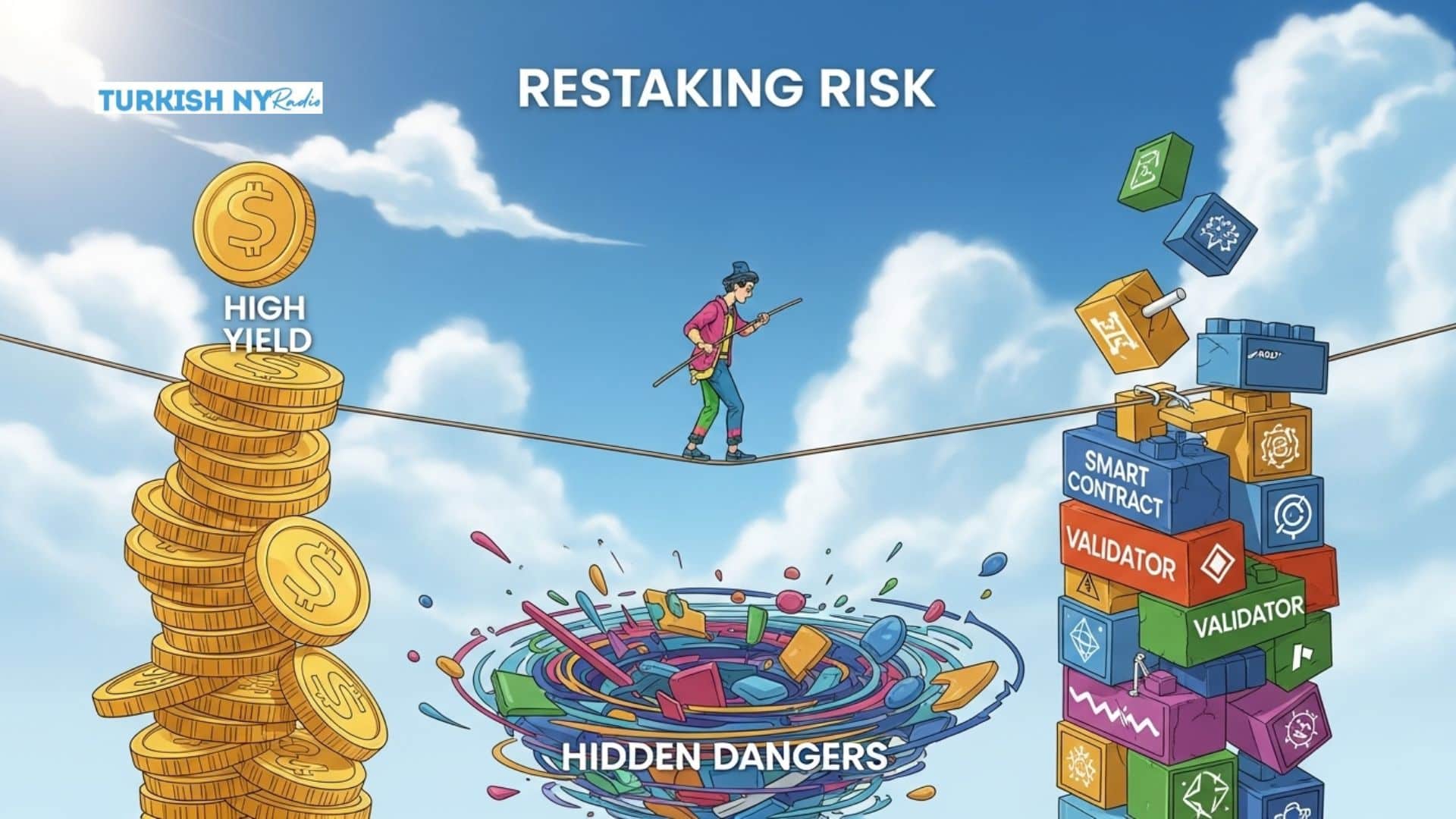
Slashing and Cascading Losses: In the case of proof-of-stake, validators face getting slashed if they misbehave. With restaking, every additional protocol a validator participates in introduces new slashing conditions. If a validator gets slashed on one of the re-staked services (e.g., due to a bug or misconfiguration), they would lose their ability to validate any protocol they had previously worked on. One error or attack in any AVS could wipe out the validator’s entire staked ETH.
Even honest mistakes qualify as “misbehavior” under slashing rules, meaning honest validators can get slashed due to operational errors, misconfigurations, and bugs. In short, mistakes scale with complexity. The more AVSs an operator is running, the more opportunities for something to go wrong, and the greater chance that a single mistake will lead to a catastrophic loss.
Centralization Pressure: Restaking tends to favor large, professional operators. The report says that AVSs will opt for the largest and most efficient validator providers, resulting in a spiral towards centralization. Big operations have scale benefits (less cost, more industrial-grade hardware, etc.), allowing them to provide slightly higher yield to stakers.
This draws in extra capital and further consolidates power. If a few big operators are responsible for most of the $15-$19b restaked ETH, then any error they make affects a huge portion of the ecosystem. That kind of density makes unusual events (such as a slashing error) much more dangerous.
Complex Smart-Contract and Liquidity Risks: New smart contracts and systems that should work are added by each restaking protocol. The more layers put on top, the more code and integrations that can fail. The complications of restaking can leave users vulnerable to hacks or coding errors. For example, in the 2022 Ankr exploit on BNB Chain (a restaking-like system), a bug cascaded after a hacker minted quadrillions of fake tokens and essentially wiped out the value of lots of staking derivatives across DeFi.
If something similar were to happen in Ethereum restaking, it could potentially cause a flash crash of many LST prices and even more widespread liquidations.
Restaking ties up liquidity in odd ways. If a lot of people are voluntarily depositing their tokens into restaking chains, it can suck liquidity out of these platforms (e.g., fewer tokens available for lending or trading), thereby increasing volatility and shock.
Regulatory and Market Sentiment Risk: As restaking expands, regulators could take notice and act. Experts warn that regulators view restaking differently than simple staking, because it adds layers of financial leverage. Tougher rules could be put in place to reduce systemic risk.
In the meantime, during a market downturn, the whole reliance built on restaking and token incentives can suddenly “cause a liquidity crisis” should asset values plummet.
Comparing Staking Models and Risks
| Staking Model | Reward Source | Complexity/Risk Level | Key Risks |
| Traditional Staking | Base network inflation and fees | Low | Network slashing (e.g. double-signing); lock-up periods. |
| Liquid Staking (LSD) | Staking rewards + liquidity incentives | Medium | Smart-contract bugs; derivative hacks; LSD token depeg. |
| Restaking (LRT/AVS) | All above + project token emissions, AVS fees | High | All above + cascade slashing, centralization, systemic dependencies. |
How has the Market Reacted? TVL and Incentives
Yet, restaking protocols have drawn in capital, despite these risks. EigenLayer went from being launched to having almost $19billion TVL in less than one year. A lot of that is from liquid staked tokens being deposited from lenders like EtherFi or Karak and getting restaked through EigenLayer.
Other restaking networks like Symbiotic and Karak have, likewise, grown, drawing in funds with the promise of APYs several percentage points above plain staking.
Researchers also point to an anomaly: with around $19B restaked, that amount now competes with the whole DeFi lending sector. If things went wrong, nearly all of the DeFi economy would feel the shock.
Some analysts also believe that the demand side of restaking is weak and the real revenue of most Actively Validated Services (AVSs) has not yet been achieved. so. In other words, restakers are “blind mining” with no assurance that such services will ever be valuable. The mismatch of abundant supply of staking power compared with scarce real demand is why many experts tackle that restaking could prove sustainable.

Expert Warnings and Critiques
The deep thinkers of the crypto community have sounded the alarms. Blockworks columnist Steven Walbroehl likened restaking to financial engineering gone awry. “Stack enough financial risk onto a blockchain system, and you’re inviting more fundamental instability”.
He noted that the Ethereum cofounder Vitalik Buterin, too, has raised concerns about “heavy systemic risk” resulting from restaking.
According to Vitalik, a failure in the layer that actually does restaking could require an Ethereum fork to reverse damages, damage which would threaten the social consensus of the network.
In fact, it is argued that if even a small part of ETH is restaked uncontrollably (disregarding voluntary caps), an individual bug could compromise Ethereum’s fundamental security.
Restaking seems to reward a few “super-providers” and concentrates risk. As one industry insider notes, staking rewards have only just been introduced; the long-term effects of restaking remain untested.
For now, many experts have concluded that until AVSs start generating actual, trackable utility: fees, tokenomics, etc., restaking yields amount to speculation at best.


Conclusion
Restaking risk is still a big issue even if there is the potential for slightly better returns. Analysis shows restaking’s extra returns are mostly cosmetic, because they’re token incentives, not genuine network use.
Meanwhile, each level of restaking increases potential losses as a single slashing or contract exploit can drag down the full protocol.
Until stronger protections, transparent monetization and more decentralization appear, the system should be approached with caution.
Glossary
ReStaking: The use of a already staked cryptocurrency (such as staked ETH) as security in another protocol.
Staking: Locking up cryptocurrency in a proof-of-stake blockchain to help secure and govern it, and getting payments in return.
LST / LSD (Liquid Staking Token/Derivative) A token one gets for staking on a platform
TVL (Total Value Locked): The sum of tokens committed to a DeFi protocol.
Slashing: The act of confiscating a portion of a validator’s stake as punishment for protocol violations (like double-signing).
Frequently Asked Questions About Restaking Risks
What is “restaking” and how does it differ from standard staking?
Restaking makes it possible to stake the same crypto, which is already staked before, and secure more than one networks.
Why do some projects offer high yield on restaking?
A lot of restaking revenue is derived from incentive mechanisms, such as token airdrops or venture capital subsidies, rather than natural demand. Small fortunes were given away as bonus tokens to early adopters; continued yields now depend on those emissions.
What are the primary risks if one restakes assets?
If any one of the protocols on which a user is staking fails or sets off a penalty, the user loses that stake across the board. Even a honest mistake on one service can eliminate the entire restaked collateralcubist. dev. There’s also smart-contract risk (hacks/bugs), liquidity risk (difficulty exiting positions), and systemic risk if, say a handful of validators centralize power.
Are there any safeguards against restaking risks?
Some teams are putting together tools (such as anti-slashing key managers) that can help reduce the risks and several protocols encourage voluntary caps to the amount of token that may be re-staked.