
This article was first published on TurkishNY Radio.
Explosive growth in the blockchain world has left the public seeking a greater understanding of how networks secure and sustain themselves. As space grows, more and more students, analysts, developers, and crypto users are yearning to learn how it all works.


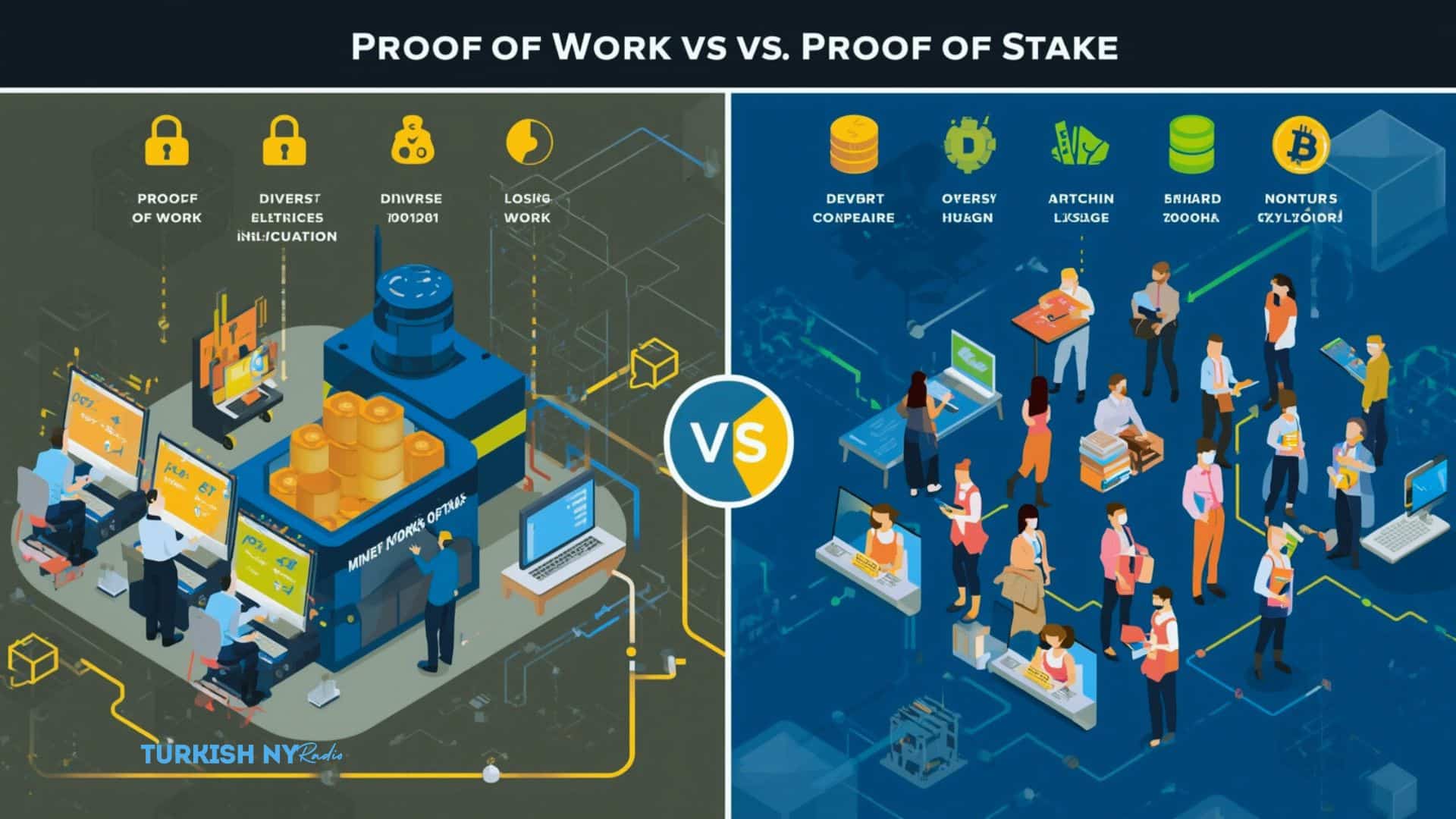
The Proof of Work vs Proof of Stake debate is one of the most critical conversations in the space. Both defend the network, log transactions, and shape network behavior. Their design choices determine security, speed, accessibility, and environmental impact.
Comparing two such models can offer readers insight into how different blockchains operate and why they end up with the trajectories they do.


How Proof of Work Built the First Generation of Blockchains
Proof of Work (PoW) was the first successful model for blockchain security. It depends on miners who run algorithms on computers to solve problems. The correct answer allows a miner to append a new block of transactions to the ledger.
It’s how this work builds trust in the network and enables someone to prevent that trust from being overwritten in the ledger. Miners are always in competition with one another, so they are constantly upgrading their equipment to solve problems more quickly.
It’s the high energy demand because you need a powerful machine to do this PoW. Research from the Cambridge Bitcoin Electricity Consumption Index found that mining consumes electricity at levels that rival those of small- to mid-size nations.
This is the issue that has raised interest in PoW energy use, primarily from regulators and environmental groups. PoW energy use varies by location, but it often shapes public discourse and policy. The debate over PoW energy use led many developers to focus on alternative systems that use less power while still providing security.
There is also, of course, a competitive element to mining that can work against decentralisation. Those with lower power supply and weaker hardware are unable to participate in mining efficiently. Larger mining entities could eventually come to dominate compared with miners of yesterday. That said, PoW’s transparency is part of its appeal to those interested in long-term stability.
How Proof of Stake Changed Blockchain Participation
There’s another type of validation known as Proof of Stake. Validators, “mine” not by digging underground, but by locking up a certain amount of cryptocurrency. The network then picks validators to verify transactions and form blocks. Choice may be based on stake amount, validator performance, and even luck. Indeed, this system lowers the bar to participation because it does not require burdensome hardware.
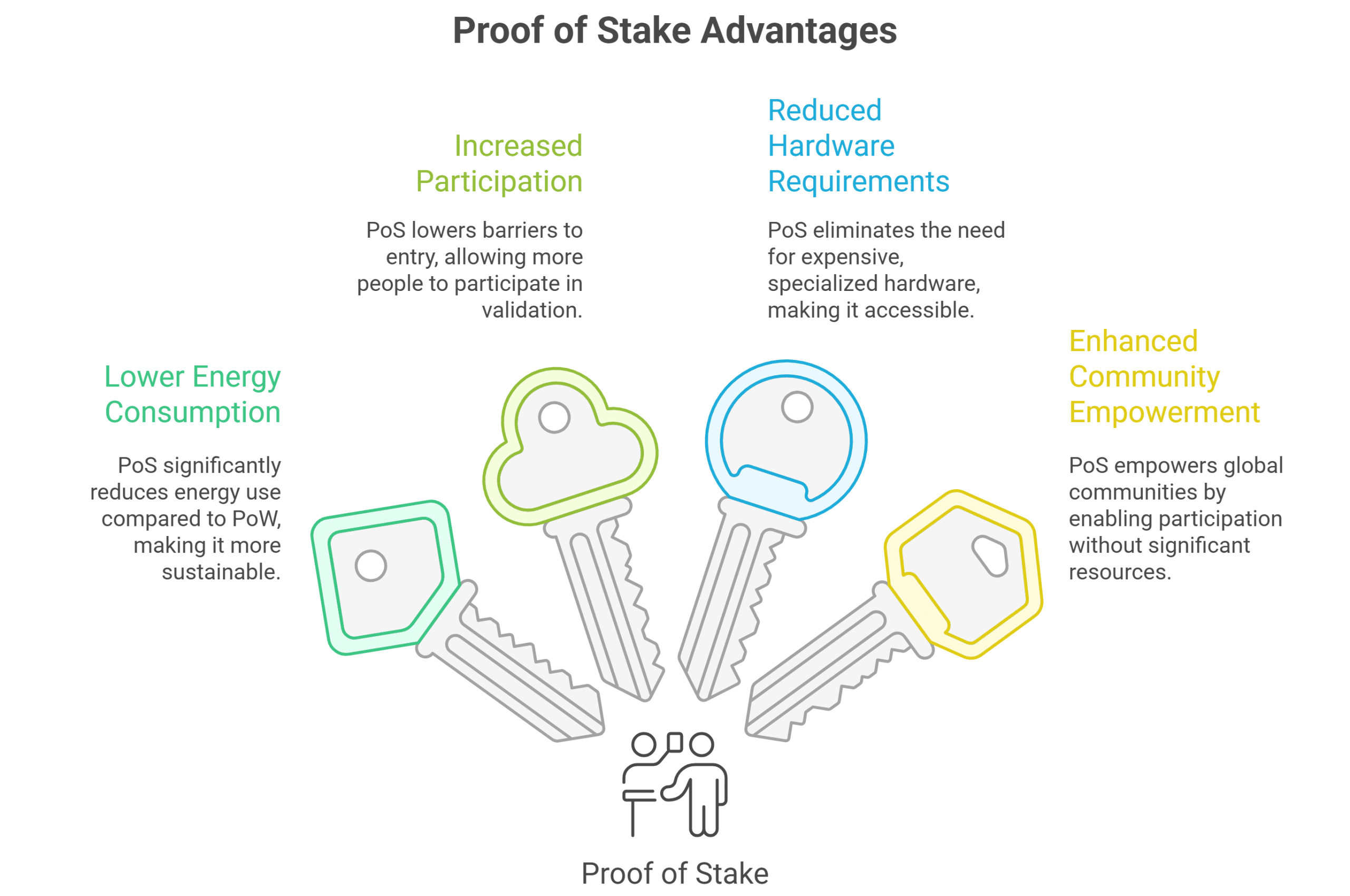
“Proof of Stake does not require anywhere near the energy PoW requires, one of the most apparent advantages of PoS, and possibly one that will stand out even as it becomes more commonplace. Following Ethereum’s successful The Merge, the network reported that energy consumption has fallen by over 99%.
The PoW energy use also began to dominate public discussions, as it became clear that an alternative model could provide security at much lower power levels. Current thinking in the field now compares Proof of Work vs Proof of Stake based on energy use and whether shinier technology or increased energy consumption is more sustainable in the long term.
There are also significant barriers to entry with Proof of Stake. Validation is possible even on a standard computer without special hardware. This increases participation and diversity of the validator set. It also empowers blockchain communities who’d like to engage globally but don’t have large amounts of money or physical resources.
Security Strengths Across Both Systems
Security is a key point in the Proof of Work vs Proof of Stake discussion. Both systems employ distinct approaches to overall network defense. Proof of Work can be harvested by computational power. Rewriting the blockchain would require a significant amount of hardware resources. This keeps a secure record of large Proof-of-Work networks.
Proof of Stake is based on economic incentives. Validators who engage in dishonesty risk losing some or all of their stake. This fine forces an attacker to pay in order not to harm. Many networks include layers such as slashing penalties, randomness, and validator rotation to provide stronger protections.
Both systems face unique challenges. Centralization may occur in Proof-of-Work systems when large pools gain control. Proof-of-Stake could centralize voting power in the hands of token whales. These risks incentivize developers to evolve rules, fine-tune governance systems, and implement safety measures to maintain long-term network health.
Energy Use and Environmental Influence
Energy consumption is the most frequently cited distinction between the two systems. The discussion around PoW energy use has been integrated into the global discourse on climate responsibility and technological sustainability. Given that PoW involves continuous and heavy computational overhead, the PoW energy use is still many times more than that of PoS.
Arguments between Proof of Work vs Proof of Stake always come down to PoS consuming way less electricity, as there’s no hardware competition in validation.
Reduced energy use has helped Proof of Stake win favor with institutions, regulators, and companies striving to comply with environmental regulations. Users in regions with relatively high electricity costs or less quantifiable mining resources can benefit from sustainable operations. Such a shift in perception affects the long-term adoption of the entire blockchain ecosystem.
Scalability and Network Performance
Scalability defines how well a blockchain handles increased demand. Proof-of-work networks often process fewer transactions per second. The dependence on mathematical puzzles slows block formation and limits throughput. When traffic rises, fees increase because users compete for limited block space.
Proof-of-Stake can process transactions more efficiently. Without mining delays, blocks arrive faster, and fees remain lower. This architecture supports decentralized applications, trading platforms, and financial tools that require high-speed performance.
Many developers choose staking networks when designing systems that require large transaction volumes. The performance gap often shapes the direction of new blockchain projects.
Why Adoption Patterns Are Changing
For new projects, it’s mostly proof-of-stake. A combination of lower barriers to entry, environmental friendliness, and scalability. And as the age-old Proof of Work vs Proof of Stake debate rages on, teams emphasise that Proof of Stake is more relevant for modern-day use cases such as smart contracts, real-time payments, and digital identity systems.
However, Proof of Work remains relevant. Some communities value the predictability and long history of mining-based networks. These networks often emphasize immutability and long-term security proven over many years. Their supporters believe that computational security remains a strong foundation for decentralized systems.
Still, the trend away from staking does continue as blockchain pushes further into the mainstream. Lower energy consumption, readily available participation, and faster transaction confirmations make Proof of Stake appealing for new use cases across decentralized finance, supply chain tracking, and asset tokenization.
Limitations and Risks
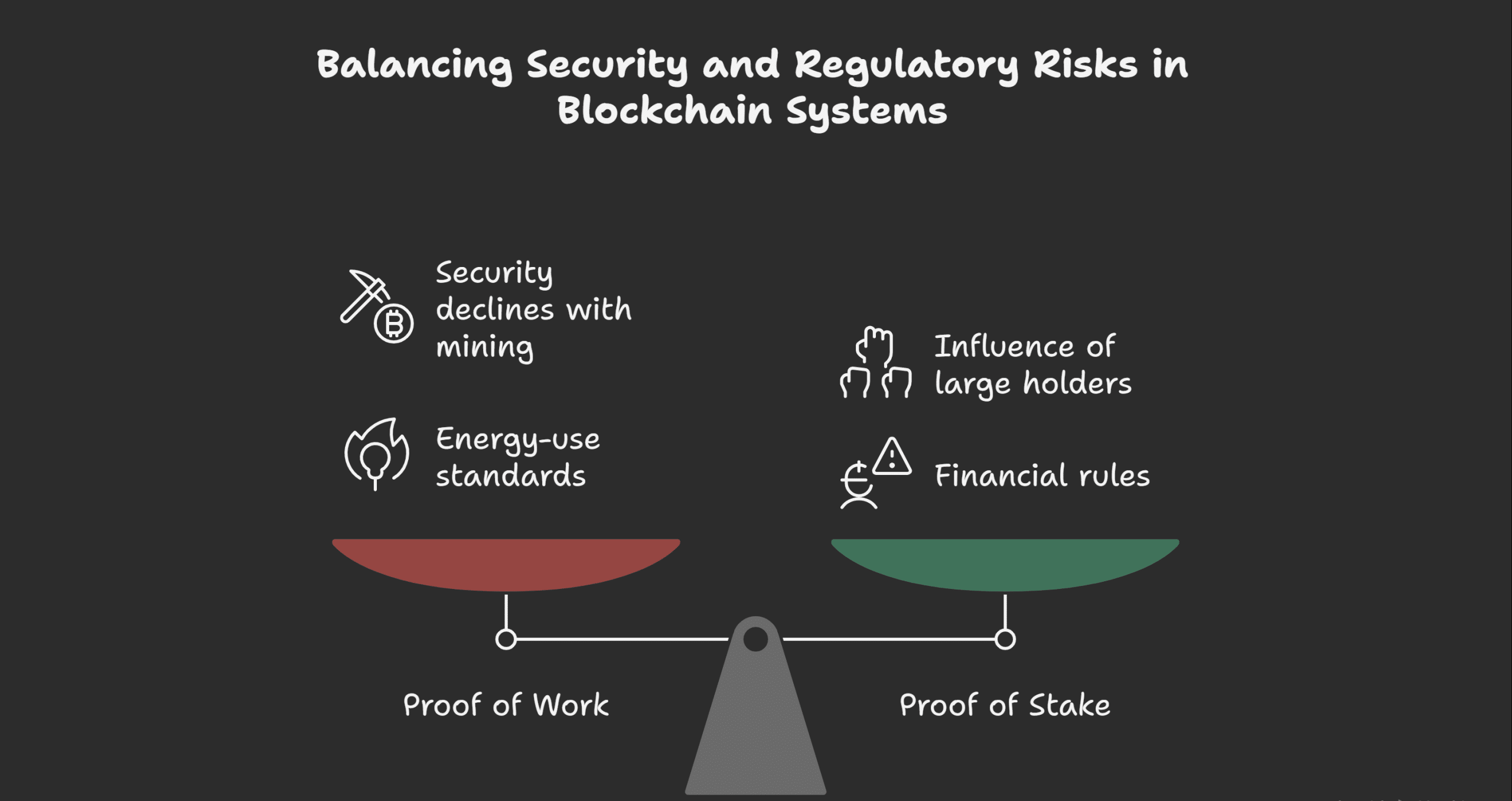
Both systems present risks that users and developers must understand. Proof-of-work can become less secure if mining participation declines. Drops in price may reduce reward incentives, thereby lowering hash power. Proof-of-Stake faces risks when large holders accumulate influence. Poorly designed smart contracts or validator rules may create vulnerabilities.
Regulatory concerns also shape development choices. Some jurisdictions evaluate energy-use standards that directly relate to Proof-of-Work networks. Others focus on financial rules that affect staking rewards and validator responsibilities. Understanding these issues helps users navigate the broader environment.
How Public Sentiment Shapes Blockchain Trends
Social platforms and community discussions influence how users compare Proof of Work vs Proof of Stake. Analysts often track conversations about major networks like Solana, especially when discussing price direction and ecosystem growth.
These discussions highlight how user experience, network performance, and validator participation shape public trust. Frequent conversations about speed, low fees, and developer support reflect how staking networks attract builders and investors.
Public perception often shifts toward models that balance security with efficiency. This reality helps explain why Proof of Stake receives strong interest from both communities and institutional partners.
Conclusion
The Proof of Work vs Proof of Stake discussion reflects two views on blockchain growth. Proof of Work offers strong computational security and a proven track record. The latter system, known as Proof of Stake, is efficient, accessible, and low-energy.
They both have helped define the course of blockchain technology and how networks are formed, scaled, and evolved. Knowing that provides readers with a sound background for comparing blockchain trends.
These models will be foundational to conversations about security, sustainability, and the world’s adoption of blockchain as the industry continues to evolve.
Glossary
- Blockchain: A digital ledger that records transactions in connected blocks.
- Consensus mechanism: A mechanism for networks to confirm transactions and provide security.
- Validator: Someone who validates blocks in the Proof of Stake network.
- Miner: One of the individuals who resolves puzzles and adds such blocks to a Proof-of-Work network.
- Hash rate: The computing power of the network’s participants.
- Energy Use: The power that a blockchain uses.
- Staking: Temporarily locking up tokens to secure the network and receive rewards
- Slashing: A penalty for validators who break rules in a Proof of Stake system.
- Decentralization: Distribution of power among many users.
- Throughput: The number of transactions a network processes per second.
- Smart contract: A self-executing program stored on a blockchain.
- Node: A computer that runs blockchain software.
Frequently Asked Questions
1. Why do some networks still use Proof of Work?
Some networks prefer the long-term security model that relies on computation. They trust the established history and predictable structure of mining-based systems.
2. Does Proof of Stake guarantee better performance?
Proof-of-Stake often provides higher throughput, but results vary across networks. Performance depends on design choices, validator rules, and network upgrades.
3. Is staking risky?
Staking carries risks related to price volatility, validator penalties, and technical failures. Users should evaluate platform rules and security features before staking.
4. Does high energy use weaken Proof of Work?
Energy use creates environmental pressure, but it does not reduce security. The primary concern is sustainability and regulatory scrutiny, rather than network strength.