
The debate around Bitcoin vs stablecoins often sounds louder than it really is, with one camp claiming that only Bitcoin matters and another insisting stablecoins carry the real utility. In practice, these assets serve very different purposes inside the same digital economy.
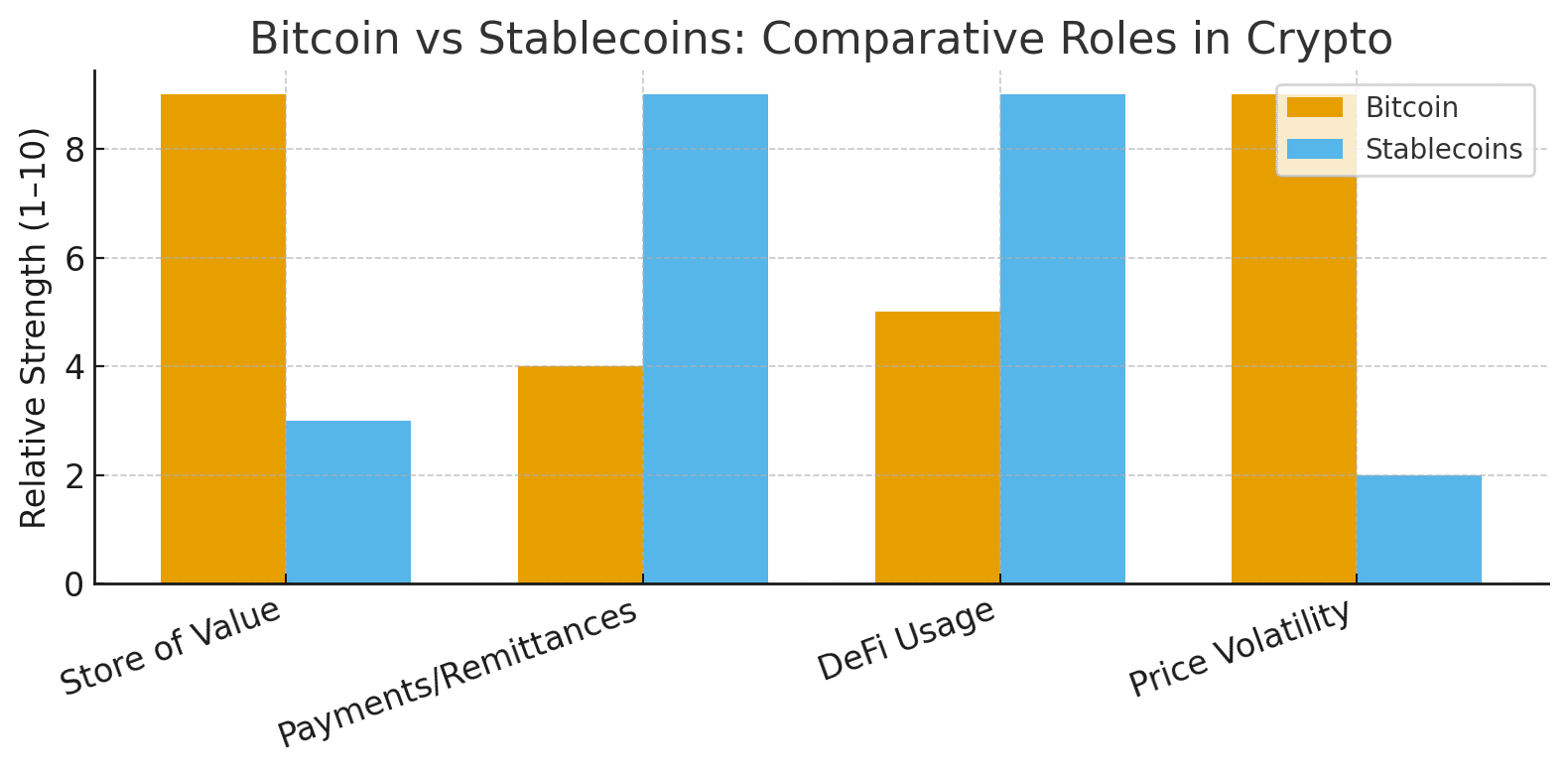
Bitcoin functions like digital gold, a scarce, decentralized asset that many treat as a long-term store of value and macro hedge. Stablecoins, on the other hand, behave more like digital dollars, engineered to maintain a steady value so traders, businesses, and protocols can move money, settle trades, and run DeFi strategies without constant price shocks.


Understanding how Bitcoin vs stablecoins complement each other, rather than compete, is key to understanding how modern crypto markets actually operate.
Bitcoin in a nutshell: scarce, volatile, and long term
Bitcoin, launched in 2009, was the first successful decentralized cryptocurrency. It runs on a peer-to-peer network with no central issuer, no single company, and no headquarters. Every node follows the same open-source rules, making the system resilient and hard to censor.
Several characteristics define Bitcoin’s role in the market:
-
Fixed supply
The protocol caps total supply at 21 million BTC. New coins enter circulation as mining rewards, which are cut roughly in half every four years in a process known as “halving.” This predictable scarcity is a major part of Bitcoin’s appeal. -
Transparency and security
All transactions are recorded on a public blockchain that anyone can inspect. The chain’s history is effectively immutable, protected by thousands of miners and nodes worldwide. -
Censorship resistance
Because the network is decentralized, it is difficult for any government or corporation to block valid transactions at a global scale.
For many, these traits position Bitcoin as a store of value rather than day-to-day money. Holders often see it as:
-
A long-term savings asset
-
A hedge against currency debasement and loose monetary policy
-
A high-risk, high-potential macro asset
However, Bitcoin comes with trade-offs. The most obvious one is price volatility. BTC can swing dramatically within a single day, which makes it challenging as a unit for everyday pricing and payments. As a result, many market participants prefer to hold Bitcoin for the long term rather than use it as their main transactional currency.
Stablecoins: the cash layer of crypto
Stablecoins were created to solve a different problem. Instead of focusing on scarcity and long-term appreciation, they focus on price stability. Most popular stablecoins are designed to track a reference asset, usually a fiat currency like the U.S. dollar.
Stablecoins generally fall into three broad categories:
-
Fiat-backed stablecoins
A centralized issuer holds reserves such as cash, bank deposits, or short-term government securities. Each token is intended to be redeemable 1:1 for the underlying currency. -
Crypto-collateralized stablecoins
Users lock volatile crypto assets (such as ETH) as collateral in smart contracts and mint a stablecoin against that collateral. These systems typically require over-collateralization to maintain the peg during market swings. -
Algorithmic or hybrid stablecoins
These rely on algorithms, incentives, and sometimes partial reserves to keep the peg. History has shown that poorly designed models in this category can be fragile.
Regardless of the model, the aim is the same: keep the token’s price as close as possible to its target (often $1). Because of that stability, stablecoins have become the liquidity backbone of the crypto ecosystem. They are used for:
-
Quoting trading pairs on exchanges
-
Parking funds between trades without returning to fiat
-
Cross-border payments and remittances
-
Collateral, lending, borrowing and liquidity provision in DeFi
In simple terms, Bitcoin often plays the role of “digital gold,” while stablecoins act as “digital cash.”
Purpose: store of value vs medium of exchange
When comparing Bitcoin to stablecoins, the clearest difference lies in purpose.
-
Bitcoin’s primary role
Bitcoin is designed as a hard asset. Its fixed supply and decentralized design make it attractive to those seeking a long-term store of value. Many treat BTC holdings like savings or a strategic portfolio allocation rather than spending money. -
Stablecoins’ primary role
Stablecoins are built for use. They serve as units of account and media of exchange within the crypto economy. Traders use them to move quickly between positions, DeFi users rely on them as neutral collateral, and businesses use them for more predictable payments.
Instead of competing directly, the two asset types address different financial needs: one focuses on preserving and potentially growing value over long horizons, the other focuses on stability and functionality in everyday operations.
Volatility and risk profile
Another critical difference is how each asset behaves in terms of price movement and risk.
-
Bitcoin’s volatility
Bitcoin’s price can experience sharp moves in both directions. This volatility is a double-edged sword. It creates opportunities for significant gains, but also exposes investors to large drawdowns, especially over short time frames. -
Stablecoin stability and depeg risk
Stablecoins are engineered to minimize price movement around their peg. Under normal market conditions, their value should hover close to the target, often $1. However, they are not completely risk-free. If confidence in an issuer, reserve quality, or protocol design breaks down, a stablecoin can “depeg,” trading below or above its intended value.
In summary:
-
Bitcoin carries market risk through price volatility.
-
Stablecoins carry counterparty, reserve and smart contract risk, even if price volatility is normally low.
Understanding these different risk types helps market participants decide how to allocate between the two.
Supply, control, and decentralization
The way supply is managed illustrates how differently these assets are structured.
-
Bitcoin supply
Bitcoin’s maximum supply is fixed by code at 21 million. No authority can decide to issue more. Adjustments to the protocol require broad community consensus, and any proposed change is scrutinized heavily. -
Stablecoin supply
Stablecoin supply is flexible. Issuers or protocols can mint or burn tokens based on demand, collateral deposits, or redemptions. For fiat-backed stablecoins, this is usually controlled by a centralized company. For decentralized stablecoins, smart contracts and governance systems handle these operations.
This also ties into decentralization:
-
Bitcoin is highly decentralized, with no single organization controlling issuance or transactions.
-
Stablecoins range from highly centralized (corporate issuers) to more decentralized (protocol-governed designs), but most still depend on some trusted components such as banks, custodians, or oracles.
Because of this, Bitcoin is often seen as a monetary asset outside traditional systems, while many stablecoins remain intertwined with them.
How market participants use both
In practice, many experienced crypto users do not choose between Bitcoin vs stablecoins. Instead, they combine them in a single strategy.
Common patterns include:
-
Long-term allocation to Bitcoin
Investors may allocate a portion of their portfolio to BTC as a long-term bet on digital scarcity and censorship-resistant money. -
Operational funds in stablecoins
Traders, funds and DeFi users often maintain working capital in stablecoins. This allows them to enter or exit positions quickly, provide liquidity to pools, or move funds across platforms without constantly dealing with price swings. -
Rotation between assets
During bullish phases, some participants rotate from stablecoins into Bitcoin and other volatile assets. During periods of high uncertainty or sharp drawdowns, they may rotate back into stablecoins to preserve capital while staying within the crypto ecosystem.
Businesses accepting crypto payments show a similar pattern. Some may accept Bitcoin but convert part of the proceeds into stablecoins to manage short-term expenses, while holding a portion of BTC on the balance sheet as a strategic asset.
Key risks to keep in view
For a balanced perspective, both sides of the risk ledger should be visible.
Bitcoin’s key risks include:
-
Significant price volatility
-
Potential regulatory restrictions on trading, custody, or taxation
-
User errors in self-custody, such as lost keys or falling for scams
Stablecoins’ key risks include:
-
Reserve and counterparty risk for fiat-backed models
-
Depeg events caused by poor design, market stress, or loss of confidence
-
Smart contract vulnerabilities, oracle failures, or governance attacks in decentralized systems
-
Regulatory pressure on issuers, banks, and intermediaries that support stablecoin operations
None of these risks automatically disqualifies one asset or the other. Instead, they shape how each is used and what role it plays in a portfolio or business.
Complementary, not mutually exclusive
The conversation around Bitcoin vs stablecoins is often framed as if the market must crown a single winner. The reality on the ground looks very different.
-
Bitcoin brings digital scarcity, decentralization and long-term value narratives.
-
Stablecoins bring payment efficiency, stable pricing and deep liquidity across exchanges and DeFi.
Together, they resemble a simple but effective internal monetary system:
-
Bitcoin behaves like the reserve asset,
-
Stablecoins function as the operational currency that keeps daily activity running smoothly.
For most participants, the question is not “Bitcoin or stablecoins?” but “What mix of Bitcoin vs stablecoins best fits current goals, risk tolerance and time horizon?”
That is where the real decision lies, and where the two assets stop competing and start working together.
FAQs: Bitcoin vs Stablecoins
1. Is Bitcoin a better investment than stablecoins?
Bitcoin has higher long-term upside but also much higher volatility. Stablecoins are built to stay close to $1, so they’re better for parking funds, payments, and DeFi, not for price appreciation. Most investors use both for different purposes.
2. Why are stablecoins so important in crypto?
Stablecoins act like digital cash inside the crypto market. They let users trade, send money, and join DeFi without worrying about big price swings, making them the main “liquidity layer” of the ecosystem.
3. Can a stablecoin lose its peg?
Yes. If reserves, collateral, or trust in the issuer break down, a stablecoin can trade below (or above) its target price. That’s called “depegging,” and it’s one of the key risks users should watch.
4. Do I need a bank account to use Bitcoin or stablecoins?
Not to hold or send them on-chain. You can receive them in a self-custodial wallet. However, if you want to move money from traditional banking into or out of crypto, you’ll usually go through an exchange or on-ramp that connects to bank rails.
Glossary of Key Terms
Peg
The target price a stablecoin aims to track (for example, 1 token ≈ 1 USD).
Fiat-backed stablecoin
A stablecoin backed by reserves held in traditional assets like cash, T-bills, or bank deposits.
Crypto-collateralized stablecoin
A stablecoin backed by other crypto assets locked in smart contracts, usually over-collateralized to manage volatility.
Algorithmic stablecoin
A stablecoin that relies on algorithms and incentives instead of full reserves to maintain its peg. Often higher risk.
Store of value
An asset people hold to preserve or grow purchasing power over time, such as Bitcoin or gold.
Medium of exchange
Money used to buy, sell, and pay for goods or services. Stablecoins often fill this role in crypto.
Volatility
How much an asset’s price moves up or down in a given period. Bitcoin is highly volatile; stablecoins aim for very low volatility.
Liquidity
How easily an asset can be bought or sold without moving the price too much. Stablecoins are a major source of liquidity in crypto markets.
DeFi (Decentralized Finance)
Financial services built on blockchains without traditional intermediaries, using smart contracts for lending, borrowing, trading, and more.
Self-custody
Holding your own private keys and controlling your crypto directly, instead of leaving it with an exchange or custodian.