



Open banking is no longer a niche tech topic. It sits at the crossroads of consumer rights, digital asset adoption, and U.S. competitiveness. Section 1033 of the Dodd-Frank Act gave Americans the right to access and share their financial data.
The rulebook to make that work at scale is finally taking shape, and the stakes for crypto could not be higher. If consumers can move their data to the services they actually prefer, the rails between bank accounts, wallets, and exchanges become smoother, faster, and safer. If not, incumbent bottlenecks may persist, and innovation will drift abroad.


The heart of the issue: who controls consumer financial data
Section 1033 requires covered institutions to make certain account information available to consumers on request. The idea is simple. People should be able to take their transaction history, balances, and account identifiers and use them in the apps that serve them best.
That could be a budgeting tool, a cross-border payments app, a stablecoin wallet, or an exchange account. The Consumer Financial Protection Bureau finalized the first comprehensive U.S. rule for this data portability in October 2024, with staged implementation originally planned to begin in 2026.
The rule embraces secure, standardized APIs instead of screen scraping and patchwork connections. That matters for crypto because reliable bank-to-exchange linking reduces friction at the exact points where users often drop off: onboarding, fiat on-ramps, and recurring payments. A standards-driven approach also lowers operational risk for banks that want to support digital assets without guessing how third parties connect.
Why this moved from technical plumbing to national strategy
A visible push from policymakers has reframed open banking as a competitiveness question. Advocates argue that when consumers can port data easily and innovators compete on service quality, startups and responsible crypto firms gain a fair shot against incumbent lock-ins. Critics fear security lapses and legal overreach. The resulting clash is shaping the final contours of the rule.
Banking trade groups sued the day after the rule’s release in 2024, arguing that the agency exceeded its authority and that liability and data protection were not fully addressed.
Subsequent litigation and policy back-and-forth continued through 2025, including a rare move by the agency to ask a court to vacate its own rule and initiate new rulemaking. That procedural twist underscores how unsettled the landscape remains, even as the market keeps building API infrastructure.
The crypto angle: cleaner on-ramps, stablecoin rails, and exchange access
For digital asset markets, open banking is not abstract. It affects whether a user in a small town can connect a community bank account to a licensed exchange or a compliant stablecoin issuer in minutes. It influences whether recurring buys settle cleanly, whether stablecoin payouts reach small businesses without delays, and whether data silos give incumbents a veto over consumer choice.
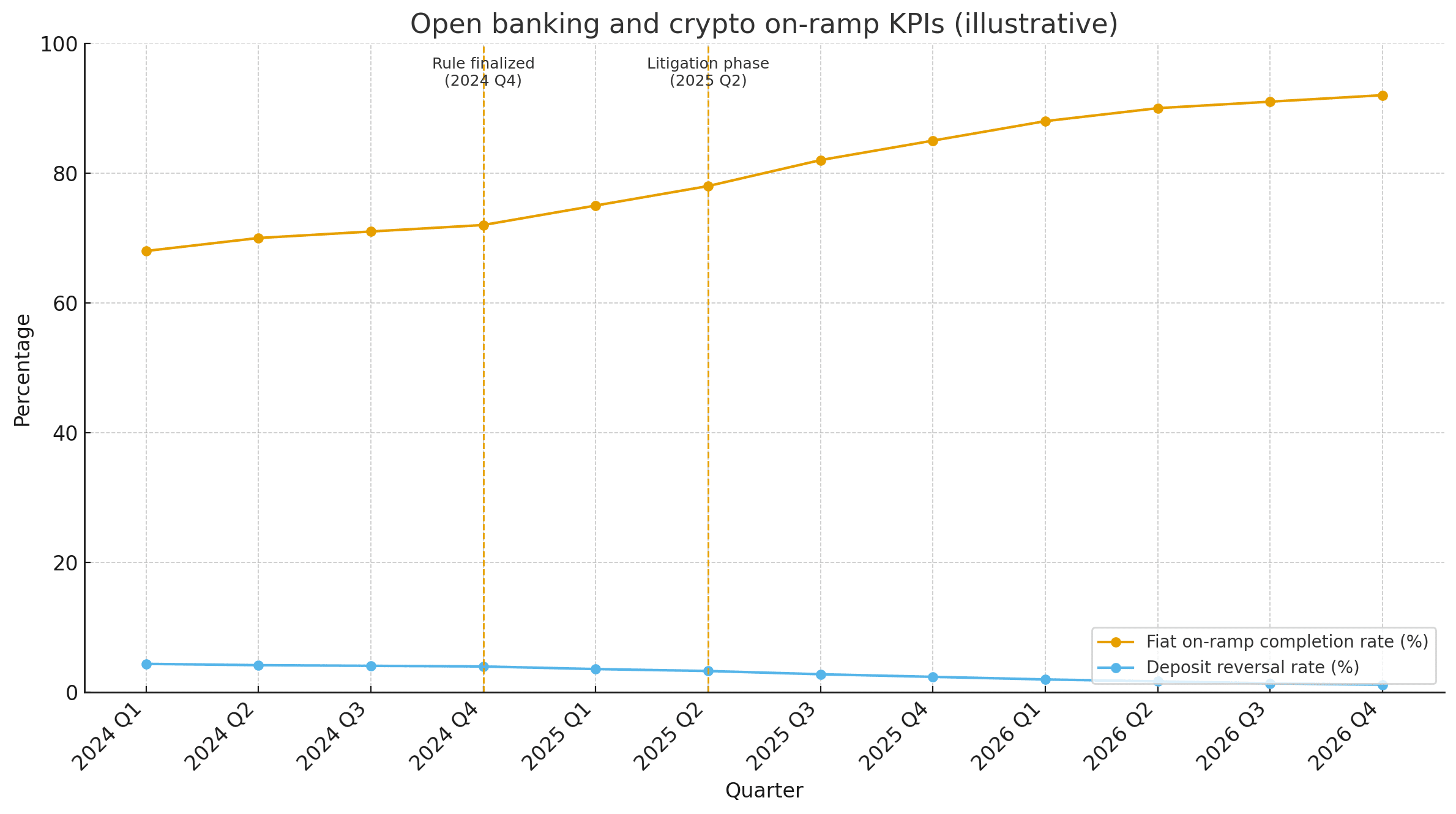
By centering consumer permission and standardized connections, 1033-style rules can cut manual verification loops and reduce failed deposits and chargeback disputes that frustrate onboarding.
Serious API rails also help exchanges and fintechs monitor fraud with consistent data feeds rather than brittle workarounds. The more standardized the pipe, the easier it is to apply strong authentication, minimize data retention, and respect revocation when a user turns off access. That is good security hygiene and a better business experience.
Wyoming shows the state-level blueprint
Policy momentum is not only federal. Wyoming has been laying cornerstones for years, and in 2024 advanced open banking amendments clarifying how banks can participate and how consent and data protection should work.


The state’s statute recognizes open banking participation and sets consumer consent requirements, reflecting a pragmatic approach for banks that want to support modern data-sharing without guesswork. The signal is clear: states can help set the guardrails that make innovation practical.
Where the rule stands today and what to watch next
The timeline has been bumpy. The October 2024 rule set a multi-year rollout, then lawsuits and leadership shifts created uncertainty. Industry commentary in 2025 emphasized that, regardless of litigation, the market trend favors API-based data sharing and consumer-permissioned access.
That means banks, fintechs, and crypto platforms continue preparing for a future where data portability is the norm and screen scraping fades away. The practical advice is to build for stable, revocable, and standardized access, because even if the final wording shifts, the direction of travel is set.
How open banking touches everyday crypto use cases
Consider a retail saver who wants a dollar-denominated return without giving up liquidity. If an insured bank account can push funds to a compliant stablecoin platform through a secure API, the frictions that usually stop first-timers start to melt away.
For independent creators who invoice clients, a wallet that reads verified bank data can reconcile cash flow faster, route funds through a regulated exchange account, and settle stablecoin payouts with fewer errors. For small businesses, permissioned access can power instant risk checks and reduce card fees by using account-to-account payment options. These are not distant hypotheticals. They are the next incremental steps once data flows improve.
Signals to monitor: crypto market indicators that intersect with open banking
Readers tracking digital assets should keep an eye on a few telltale indicators. Bank-to-exchange inflow stability tends to rise when onboarding improves, which can be proxied by fiat deposit completion rates and reduced reversal ratios.
Stablecoin supply growth, redemption latency, and on-chain settlement times reveal whether regulated on-ramps are scaling. Exchange net transfer volumes relative to spot volume can hint at healthier market depth or, if unstable, at lingering bottlenecks in fiat access. These metrics move with macro conditions, yet smoother data rails usually reduce noise and failure points.
On the policy side, watch litigation outcomes and any revised proposals that clarify liability allocation, consent standards, and the recognition process for technical standard-setting bodies. The recognition framework that emerged in 2024 set the stage for independent bodies to define how APIs should work. The more credible and interoperable those standards become, the more confident banks and crypto platforms will be in connecting at scale.
Security and privacy are the make-or-break
Opponents worry that wider data flows mean wider risk. That is a fair concern. The response is to build for least-privilege access, short-lived tokens, and explicit user consent. Strong API specifications help because they reduce hidden data scraping and let consumers see, authorize, and revoke connections inside familiar channels.
Lawsuits that focus on overreach should not distract from security improvements that come from replacing brittle practices with predictable and auditable interfaces. The net effect can be fewer surprises for banks and stronger protections for consumers.
State-federal coordination matters more than ever
The United States has a dual banking system. Federal guidance sets broad rights and obligations, while state regimes influence how community banks and credit unions participate in real life. Wyoming’s open banking provisions illustrate how local rules can encourage innovation while mandating consent and compliance.
Expect more states to reflect similar principles as they see local businesses benefit from data portability and as community institutions look for modern ways to serve customers who use digital assets.
What it means for investors, builders, and banks
For investors, open banking is a structural theme. It will not alter prices overnight, yet it reduces friction that has historically deterred mainstream users from trying crypto. For builders, it is a design constraint and an advantage. Products that respect revocation, disclose scopes clearly, and store less data will integrate faster with bank partners.
For banks, it is a strategic fork in the road. Participating with strong APIs keeps customers in the fold and unlocks revenue from partnerships. Sitting out cedes ground to institutions that meet customers where they already are.
Conclusion
The U.S. open banking push is ultimately about trust and choice. Section 1033 puts the consumer in control of their data. Secure APIs make that control meaningful. Litigation and rule rewrites will continue, but the direction is clear.
For crypto, better data rails mean cleaner on-ramps, safer payments, and more resilient market plumbing. For banks and fintechs, it means building around standards that make permissioned access normal. The winners will be the institutions that give people simple, transparent ways to connect the financial tools they want to the accounts they already use.
Frequently Asked Questions
What is Section 1033 and why does it matter for crypto
Section 1033 grants consumers the right to access and share certain financial data from their providers. When implemented through secure APIs, it enables reliable bank-to-exchange and bank-to-wallet connections that reduce friction at onboarding and during payments.
Did the United States already finalize an open banking rule
Yes. The agency finalized a rule in October 2024. Implementation timelines have been complicated by lawsuits and subsequent agency actions that sought to vacate and rework portions of the rule. The market trend still favors API data sharing.
How do state laws fit in
States can clarify participation and consent requirements for banks. Wyoming’s 2024 legislation is a notable example, signaling support for open banking while emphasizing explicit consumer consent and data protection.
Will open banking weaken privacy or security
If done poorly, risk rises. If done with strong standards, least-privilege access, and transparent consent, risk falls because screen scraping is replaced by auditable, revocable connections. Legal challenges focus on scope and liability, not on the value of moving to secure APIs.
Glossary of Key Terms
Open banking
A model where consumers permit secure, standardized data sharing between financial institutions and third-party providers, typically via APIs rather than screen scraping.
Data portability
The ability for a consumer to move personal financial information from one service to another in a usable format. It is the core right that Section 1033 operationalizes.
Standard-setting body recognition
A process by which the agency can recognize technical standard setters to guide implementation details for open banking APIs and data formats.
Stablecoin
A digital asset designed to maintain a stable value, often pegged to a fiat currency such as the U.S. dollar, and increasingly integrated with traditional payment rails.
Screen scraping
An older method where third-party apps log in on a user’s behalf and collect data by reading screens. Open banking seeks to replace this with secure, permissioned APIs.