This article was first published on TurkishNY Radio.
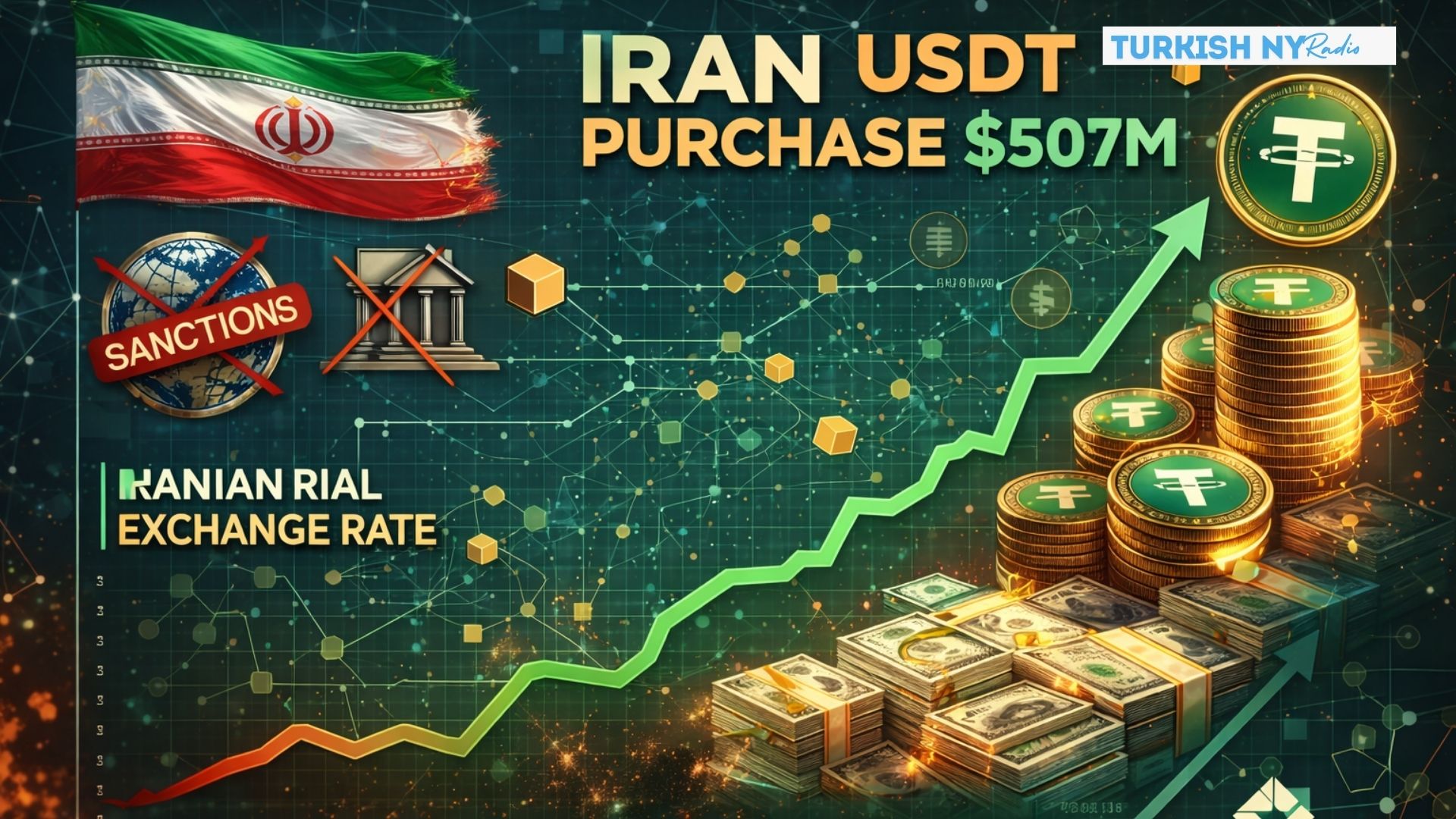
According to a report, the Iran-USDT purchase involved Iran’s Central Bank acquiring approximately $507 million in Tether’s USDT. The goal, as outlined in the publication, was to provide short-term support to the rial during a period of market stress and to maintain access to dollar-denominated liquidity despite ongoing sanctions.


The Iran USDT purchase sheds light on how digital assets are becoming tools for state-level financial management.
CryptoTimes’ Findings on the USDT Acquisition
In its article, CryptoTimes notes that blockchain tracing data revealed substantial USDT movement linked to Iranian entities over several months. The publication reports that the Iran USDT purchase was timed during periods of heightened currency pressure. By obtaining a large amount of stablecoin liquidity, officials aimed to moderate volatility and provide traders with a more predictable benchmark against foreign currencies.
Also read: Crypto flows in Iran slump 11% amid Israel clash and Nobitex breach


The article emphasizes that the Iran USDT purchase does not necessarily reflect a long-term policy shift, but rather a practical response to restricted access to traditional banking channels.
A Closer Look at the Economic Context
Iran’s economy has faced recurring currency shocks, and according to CryptoTimes, these pressures intensified in the second half of 2024. The Iran USDT purchase offered a temporary mechanism to bridge liquidity gaps that emerged in local markets. Financial observers interviewed by the publication noted that stablecoins, while not a substitute for foreign reserves, can help smooth daily foreign exchange operations.
One analyst quoted by CryptoTimes explained, “When traditional pathways are constrained, stablecoins can act like emergency hoses, limited in scope but useful for short-term stabilization.” This assessment aligns with the outlet’s interpretation of the Iran USDT purchase as a tactical rather than ideological move.
USDT’s Role in Restricted Financial Environments
The Iran USDT purchase highlights a broader pattern seen across several sanctioned economies. CryptoTimes points out that the transparency of blockchain transactions allows observers to track flows, even when the intent is to avoid traditional banking scrutiny. At the same time, the publication stresses that stablecoin issuers retain the ability to freeze assets if required, adding additional complexity for governments operating under financial restrictions.
Domestic Market Impact
According to CryptoTimes, a portion of the Iran USDT purchase appears to have circulated through Nobitex, a leading Iranian crypto exchange. This increased liquidity temporarily narrowed price gaps between the local crypto market and international markets. Traders interviewed by the publication described the impact as brief but noticeable.
One market participant told CryptoTimes, “There were days when access to USDT felt unusually smooth. Liquidity was clearly higher than usual.” Such insights provide additional context behind the Iran USDT purchase and its short-term influence on domestic trading conditions.
Conclusion
According to CryptoTimes, the Iran USDT purchase provides a clear illustration of how digital currencies might be useful in overcoming financial limitations. The episode highlights the growing significance of stablecoins in situations characterized by monetary pressure and restricted banking access, even though the long-term ramifications are still limited. Rather than an overhaul in policy, the Iran USDT purchase essentially represents a pragmatic response to a difficult economic environment.
Also read: South Africa’s Ezeebit Secures $2M to Scale Stablecoin Merchant Payments
Summary
According to CryptoTimes, Iran’s Central Bank purchased around $507 million in USDT to stabilize the rial amid a moment of heightened economic distress. The research demonstrates how stablecoins were utilized as a short-term solution for maintaining liquidity and lowering currency volatility.
The Iran USDT purchase also affected local currency rates and showed the larger function of digital assets in constrained financial systems. While transitory, the measure is a sensible reaction to continued budgetary constraints.
Glossary of Key Terms
USDT (Tether): A digital currency based on the United States dollar.
Stablecoin: Is a digital currency that was intended to provide pricing stability.
Rial: Is Iran’s national currency.
Blockchain tracing: Is the technique of evaluating activities registered on public ledgers.
Liquidity: Is the possession of commodities that can be quickly converted into cash or equivalents.
FAQs About Iran’s $507M USDT Purchase
1. What is the $507M Iran USDT purchase?
It refers to Iran reportedly buying $507 million in USDT, as reported by CryptoTimes.
2. Why did Iran buy USDT?
To access dollar-based liquidity and support the rial during market pressure.
3. Who reported the purchase?
The details were first covered by CryptoTimes using blockchain analysis.
4. Did it affect Iran’s currency?
It offered short-term stability but didn’t resolve deeper issues.
5. Was the purchase officially confirmed by Iran?
No official government statement has been issued.