The IOTA Foundation has introduced the new IOTA trust framework to help organizations manage identity, data, and digital assets with fewer barriers. It is designed for open networks. The framework follows more than a decade of work with firms across many sectors.
It aims to solve issues that come from identity checks, data integrity, and digital process control. These issues have pushed companies to search for systems with fewer intermediaries and fewer extra costs.


Core Features of the IOTA Trust Framework
The IOTA trust framework is open-source and free to use. It sits on the IOTA main network and allows firms to scale without licensing fees. It includes identity tools, access management, notarization, transaction support, and token creation.
Each part can work alone or with others. The foundation stated that the tools follow global rules for identity, data protection, and financial standards.
Also Read: Exodus Expands in Latin America With Acquisition of Grateful as Stablecoin Payments Surge
The IOTA trust framework uses a fast virtual machine that supports thousands of transactions per second. Block time stays under one second. Every action is verifiable.
The framework remains neutral under nonprofit governance. It avoids vendor lock-in and keeps commercial bias out of the system.
IOTA Identity Verifies People, Firms, and Devices
IOTA Identity is a core part of the IOTA trust framework. It gives each participant a trusted identity. This can include firms, individuals, or devices. It allows verified access without exposing private details. It also reduces dependence on centralized identity systems.
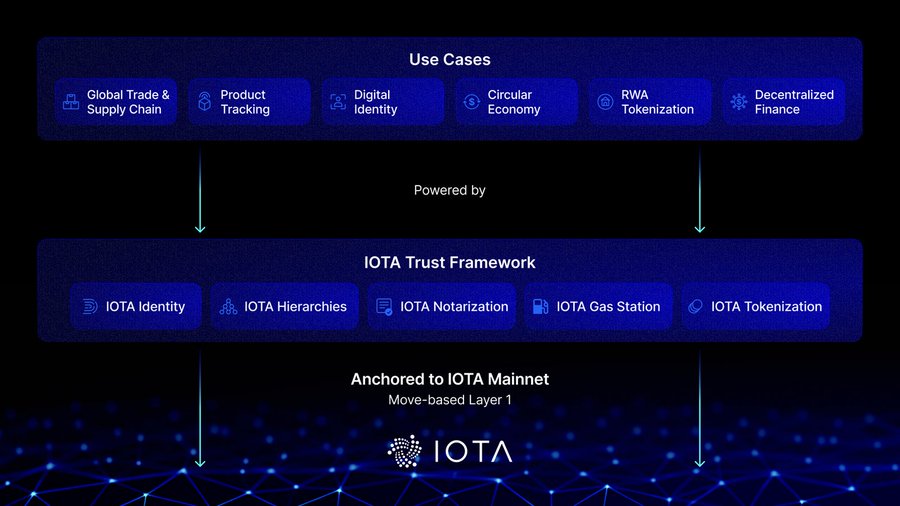
IOTA Hierarchies gives companies a way to manage access rights based on real organizational roles. It mirrors how teams work in workplaces. It lets firms set permissions for signing, approving, or managing tasks.
This makes internal processes easier to handle. It also strengthens control over digital operations within the IOTA trust framework.
IOTA Notarization Anchors Data Without Revealing Content
IOTA Notarization attaches proof of origin and time to data. It keeps the content hidden. This gives firms a way to verify records without exposing sensitive material.
The tool is suited for sectors that rely on strict data integrity. It is a key part of the IOTA trust framework for groups that handle health records, trade files, or regulatory documents.
IOTA Gas Station Enables Sponsored Transactions
IOTA Gas Station lets users interact with the network without holding tokens. A sponsor covers the transaction use. This helps firms onboard users who are not familiar with crypto assets.
It lowers entry barriers and supports enterprise use cases. It also improves usability for companies that want to simplify network interactions inside the IOTA trust framework.
IOTA Tokenization Creates Regulated Digital Assets
IOTA Tokenization allows firms to create digital units backed by real assets. These can include goods, rights, or regulated financial items.
Firms can set ownership rules, compliance steps, and transfer limits. This part of the IOTA trust framework supports use cases such as supply chain tracking, trade workflows, and RWA tokenization.
The IOTA trust framework runs on a high-speed virtual machine. It delivers fast settlement and high throughput. Firms can anchor thousands of actions in a short time. Each step stays verifiable. T
Early Adoption Across Regulated Industries
Several groups already use the IOTA trust framework. TWIN is moving from paper trade files to verifiable digital records. Orobo anchors sustainability checkpoints to meet EU rules. ObjectID is building identifiers for physical goods. Salus is creating digital units for mineral trades.
Conclusion
The IOTA trust framework offers a full set of tools for identity, data, and asset management. It removes licensing fees and reduces technical barriers. It also provides a neutral and verifiable foundation for Web3 use cases.
New adoption across trade, sustainability, and supply chains is growing. The framework may help firms connect real-world systems with decentralized digital tools.
Also Read: China Economic Slowdown Deepens as Factory Output and Retail Sales Falter
Frequently Asked Questions About IOTA trust framework
1- What is the IOTA trust framework?
It is a set of identity, access, data, and asset tools built on the IOTA network.
2- Is it free to use?
Yes. It is open-source with no licensing or usage fees.


3- Who can benefit from it?
Companies, developers, and organizations that need secure identity, notarization, tokenization, or access control systems.
4- Does it follow regulatory standards?
Yes. It follows rules for identity, data protection, and financial compliance.
Reference