
Crypto markets move fast, but price is often the last thing traders notice. Before a chart breaks higher, coins may already be leaving exchanges. Before panic selling hits the headlines, long-term holders may have started distributing supply. That is where on-chain data analysis becomes valuable. It helps traders, analysts, and investors look inside public blockchain activity instead of relying only on price candles, social media noise, or market rumors.
A blockchain is a distributed digital ledger that records transactions across a network, which means many crypto movements can be studied through wallet activity, transfers, supply behavior, and settlement patterns. This public transparency gives analysts a different lens on market trends, although it still needs careful interpretation and risk control.


What Makes On-Chain Data Different?
Traditional markets often depend on company reports, order books, macro data, and institutional disclosures. Crypto adds another layer because public networks show how assets move between wallets, exchanges, miners, validators, smart contracts, and long-term holders.
This does not mean every wallet owner is known. In fact, address identity is often unclear unless it is labeled through reliable research or compliance tools. Still, patterns can be meaningful. A sudden increase in exchange deposits may suggest that holders are preparing to sell. Rising active addresses may show stronger network usage. Higher transaction fees may point to demand for block space, especially on smart contract networks.
The key is not to treat one metric as a crystal ball. Good analysis compares several signals, checks whether they agree, and then connects them with price structure, liquidity, derivatives data, and market context.
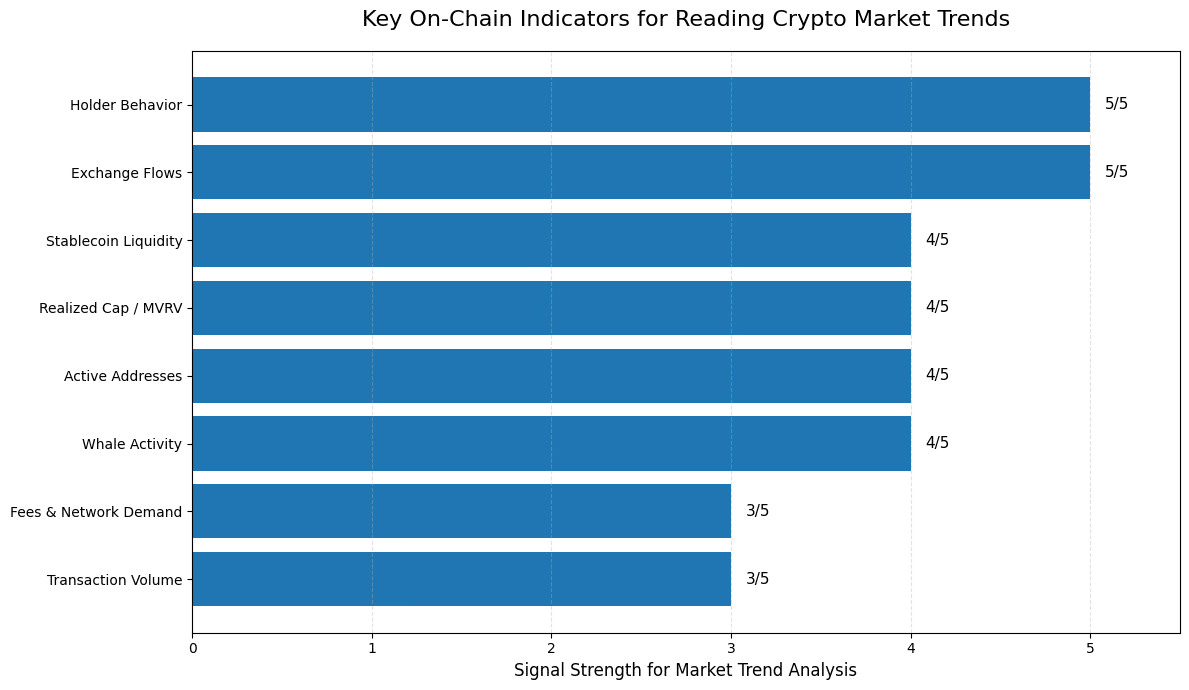
On-Chain Data Analysis for Crypto Market Trends
On-chain data analysis is the process of studying blockchain activity to understand investor behavior, network health, liquidity flows, and possible market direction. It does not replace technical analysis or macro research, but it can add a deeper layer of evidence.
For example, if Bitcoin rises while exchange balances fall, that may suggest reduced immediate sell pressure. If price rises while active addresses and transaction volume remain weak, the rally may be more speculative. If stablecoin supply moves rapidly into exchanges, traders may be preparing to buy risk assets. None of these signals is perfect, but together they can build a more balanced market view.
Professional platforms now combine spot, derivatives, and on-chain metrics because digital asset analysis often requires several data layers working together, not isolated charts.
Start With Active Addresses and Network Usage
Active addresses are one of the simplest indicators for reading blockchain demand. They show how many unique addresses are sending or receiving transactions during a specific period. Rising active addresses can suggest stronger user engagement, while falling activity may show weaker demand.
However, this metric needs caution. One user can control many addresses, and some networks create high activity through automated bots, airdrop farming, or low-cost transfers. That is why active addresses should be read beside transaction count, transfer volume, fees, and application usage.
A healthier signal appears when active addresses rise with meaningful transaction value, stronger fee demand, and broader ecosystem activity. In that case, market interest may be supported by actual usage rather than just speculative trading.
Watch Exchange Flows Before Price Reacts
Exchange inflows and outflows are among the most watched on-chain indicators. In simple terms, inflows show coins moving to exchanges, while outflows show coins leaving exchanges.
Large inflows may suggest that holders are preparing to sell, especially when they happen during a price rally. Large outflows may signal accumulation, cold storage movement, or institutional custody activity. The context matters, though. An exchange outflow is not always bullish, and an inflow is not always bearish. Sometimes funds move for custody changes, internal wallet management, or market-making needs.

Good on-chain data analysis studies exchange flows across several timeframes. A one-hour spike can be noise, while a 30-day trend may reveal a bigger change in supply pressure. When falling exchange reserves align with steady demand and higher spot volume, analysts often view that as a stronger setup than price action alone.
Study Whale Activity Without Overreacting
Whale wallets attract attention because large holders can move markets. When a wallet transfers thousands of BTC or ETH, traders naturally ask whether a sell-off is coming. But whale activity is easy to misread.
A large transfer to an exchange may suggest selling intent, but it may also be collateral movement, custody restructuring, or an over-the-counter transaction. A transfer between private wallets may look dramatic, yet it may not affect open market supply at all.
The safer approach is to track repeated whale behavior. Are large holders adding over several weeks? Are old coins waking up after years of dormancy? Are high-value wallets sending funds to exchanges during market strength? These patterns carry more weight than a single transaction screenshot circulating online.
Use Realized Cap, MVRV, and Profit Metrics Carefully
Market capitalization values all coins at the current market price. Realized capitalization takes a different approach by valuing coins based on the price when they last moved on-chain, which can help estimate the market’s aggregate cost basis.
MVRV, or market value to realized value, compares current market value with realized value. When MVRV becomes very high, the market may be sitting on large unrealized profits, which can increase the risk of distribution. When MVRV falls deeply, the market may be closer to capitulation or undervaluation, depending on the asset and cycle.
Still, these metrics work best on large, mature networks with long histories. On smaller tokens, wallet concentration, thin liquidity, and team-controlled supply can distort the picture. This is where on-chain data analysis should stay disciplined and avoid forcing Bitcoin-style cycle models onto every asset.
Read Holder Behavior and Coin Age
Coin age metrics show whether older coins are moving or staying dormant. Long-term holders often represent stronger conviction, while short-term holders tend to react more quickly to price moves.
When old coins begin moving during a strong rally, it may suggest experienced holders are taking profits. When long-term holders keep accumulating during weak markets, it can signal quiet confidence. Again, timing is rarely perfect. Long-term holder behavior can change months before price fully responds.
Supply distribution also matters. If more supply shifts into long-term holding wallets, liquid supply may tighten. If supply moves from long-term holders to short-term buyers near a strong price advance, the market may become more fragile because newer buyers often have weaker conviction.
Track Stablecoins and Liquidity Conditions
Stablecoins are an important part of crypto market structure because they often act as trading capital. When stablecoin balances rise on exchanges, it may show that buyers have dry powder ready. When stablecoins leave exchanges, capital may be moving into self-custody, decentralized finance, or outside active trading venues.
This indicator should not be used alone. A rise in exchange stablecoins does not guarantee a rally. Traders may be waiting, hedging, or preparing for volatility. But when stablecoin liquidity improves while risk assets hold support, the market may have better conditions for upside continuation.
For market trend analysis, liquidity is the oxygen in the room. Price can climb on hype for a while, but stronger liquidity often decides whether a move has legs.
Compare On-Chain Signals With Price and Volume
No serious analyst should read blockchain data in isolation. Price structure still matters. Volume still matters. News, regulation, macro policy, ETF flows, and liquidity cycles still matter.
For example, rising exchange outflows may look bullish, but if price keeps making lower highs and spot volume fades, the market may still be weak. Strong active addresses may look promising, but if token supply unlocks are coming, the chart can remain under pressure. This is why on-chain data analysis works best when it confirms or challenges what the price chart is already showing.
A useful framework is simple. First, check whether network activity is rising or falling. Then study supply movement. After that, review exchange flows, whale behavior, stablecoin liquidity, and profit metrics. Finally, compare everything with price action and broader market conditions.
Common Mistakes Analysts Should Avoid
One common mistake is treating every large transfer as a market signal. Another is assuming that wallet labels are always accurate. Analysts also overuse single metrics, especially when they already have a bias and want the data to agree with them.
Another issue is ignoring chain design. Bitcoin, Ethereum, Solana, and newer Layer 2 networks do not behave the same way. Low fees can create high transaction counts. Smart contract activity can inflate address numbers. Bridge movements can make liquidity appear stronger or weaker than it really is.
The goal is not to find one perfect indicator. The goal is to build a cleaner reading of market behavior, with enough humility to know when the data is mixed.
Why This Matters for Traders and Investors
Crypto markets are emotional. Fear spreads quickly, and euphoria can make weak signals look stronger than they are. On-chain research gives market participants a way to step back and ask what holders are actually doing.
For short-term traders, the value may come from exchange flows, stablecoin liquidity, and whale deposits. For long-term investors, realized value, holder behavior, and supply distribution may matter more. For risk teams, blockchain monitoring can also support compliance and fraud detection, especially when transaction patterns and address behavior are reviewed in real time.
Used properly, on-chain data analysis can help reduce guesswork. It does not remove risk, but it can make the market feel less like a foggy highway.
Conclusion
On-chain data analysis gives crypto traders and investors a practical way to study market trends from inside the blockchain economy. Active addresses, exchange flows, whale movements, realized value, stablecoin liquidity, and holder behavior all reveal different parts of the same picture.
The strongest insights usually appear when several indicators point in the same direction. A rally supported by falling exchange reserves, rising network activity, stronger liquidity, and long-term holder confidence carries more weight than a price spike driven by social noise. A market with rising inflows, weakening activity, and heavy profit-taking deserves caution.
In the end, on-chain metrics are not magic. They are evidence. The analyst’s job is to read that evidence with patience, context, and respect for risk.
Frequently Asked Questions
What is the main purpose of on-chain data analysis?
The main purpose is to study blockchain activity so analysts can understand market behavior, supply movement, network demand, and possible trend changes before they are fully reflected in price.
Can on-chain data predict crypto prices?
It can support better market judgment, but it cannot predict prices with certainty. Crypto prices are affected by liquidity, sentiment, regulation, macro news, leverage, and sudden events.
Which on-chain metric is best for beginners?
Exchange flows are often easier to understand because they show whether coins are moving toward or away from trading venues. Even then, they should be confirmed with price, volume, and broader market data.
Is whale tracking always reliable?
No. Whale transfers can be misleading because large wallets may move funds for custody, collateral, internal operations, or private deals rather than open-market selling.
How often should analysts review on-chain data?
Active traders may review it daily, while long-term investors may focus on weekly or monthly trends. Longer timeframes often reduce noise and give cleaner signals.
Glossary of Key Terms
Active Addresses: Unique blockchain addresses that send or receive transactions during a selected period.
Exchange Inflows: Crypto moving into exchange wallets, often watched as a possible sign of selling pressure.
Exchange Outflows: Crypto leaving exchange wallets, often viewed as possible accumulation or custody movement.
MVRV: A ratio comparing market value with realized value to estimate whether holders have large unrealized profits or losses.
Realized Cap: A valuation model that prices coins based on when they last moved rather than only the current market price.
Stablecoin Liquidity: The amount of stablecoin capital available for trading, often used to judge buying power in crypto markets.
Whale Wallet: A wallet holding a large amount of cryptocurrency, capable of influencing market sentiment or liquidity.
Sources
Disclaimer: This article is for educational and informational purposes only. It is not financial advice, investment advice, or a recommendation to buy, sell, or hold any crypto asset. Digital assets are volatile, and readers should conduct independent research or consult a qualified financial adviser before making investment decisions.