

This article was first published on TurkishNY Radio.
When Bitcoin prices fall, most companies pull back and protect cash. Strategy does the opposite. Strategy Bitcoin buying accelerates during market downturns, turning volatility into a deliberate accumulation window rather than a warning sign. This counter-cycle behavior raises a critical question for crypto learners and financial analysts alike.


How does a public company keep deploying billions into a volatile asset when prices slide, sentiment weakens, and capital becomes harder to secure? The answer lies in a carefully engineered mix of capital markets access, treasury design, and risk management that allows Strategy to keep buying when others hesitate.
The Foundation of a Bitcoin-Centered Balance Sheet
Strategy treats Bitcoin as a core treasury asset, not a speculative trade. This approach began in 2020 when the company adopted a treasury policy that placed Bitcoin at the center of excess capital management. Academic research from the National Bureau of Economic Research shows that firms holding alternative reserve assets often aim to hedge long-term currency dilution rather than seek short-term gains. Strategy aligns with that logic.
Instead of holding idle cash, the company converts capital into Bitcoin and measures progress through Bitcoin exposure per share. This framework shifts attention away from quarterly price swings. It emphasizes long-term ownership and disciplined Accumulation. Strategy Bitcoin buying follows this principle across cycles.
This treasury design explains why downturns do not halt purchases. The model does not depend on revenue surpluses. It depends on the company’s access to capital and investor demand for its securities.
Why Downturns Do not Stop Accumulation
Market downturns often reduce liquidity. Equity prices fall. Credit spreads widen. Many firms lose access to affordable capital. Strategy responds differently because its funding loop remains open as long as investors value Bitcoin exposure through public markets.
During drawdowns, Bitcoin prices decline. Strategy stock often declines faster. This creates pressure. Yet it also sustains demand from investors seeking leveraged Bitcoin exposure without holding the asset directly. Research shows that public companies holding Bitcoin often trade as proxies for spot exposure during volatile periods.
Strategy Bitcoin buying continues because the company converts this equity demand into Bitcoin purchases. The downturn becomes an inventory window rather than a warning signal.
Recent disclosures show this mechanism operating in real time. Strategy recently acquired 10,645 Bitcoin for approximately $980.3 million, at an average price near $92,098 per BTC, lifting total holdings to roughly 671,268 BTC. The purchase underscores how downturns translate into accumulation rather than retreat.
At-The-Market Equity Sales as the Primary Engine
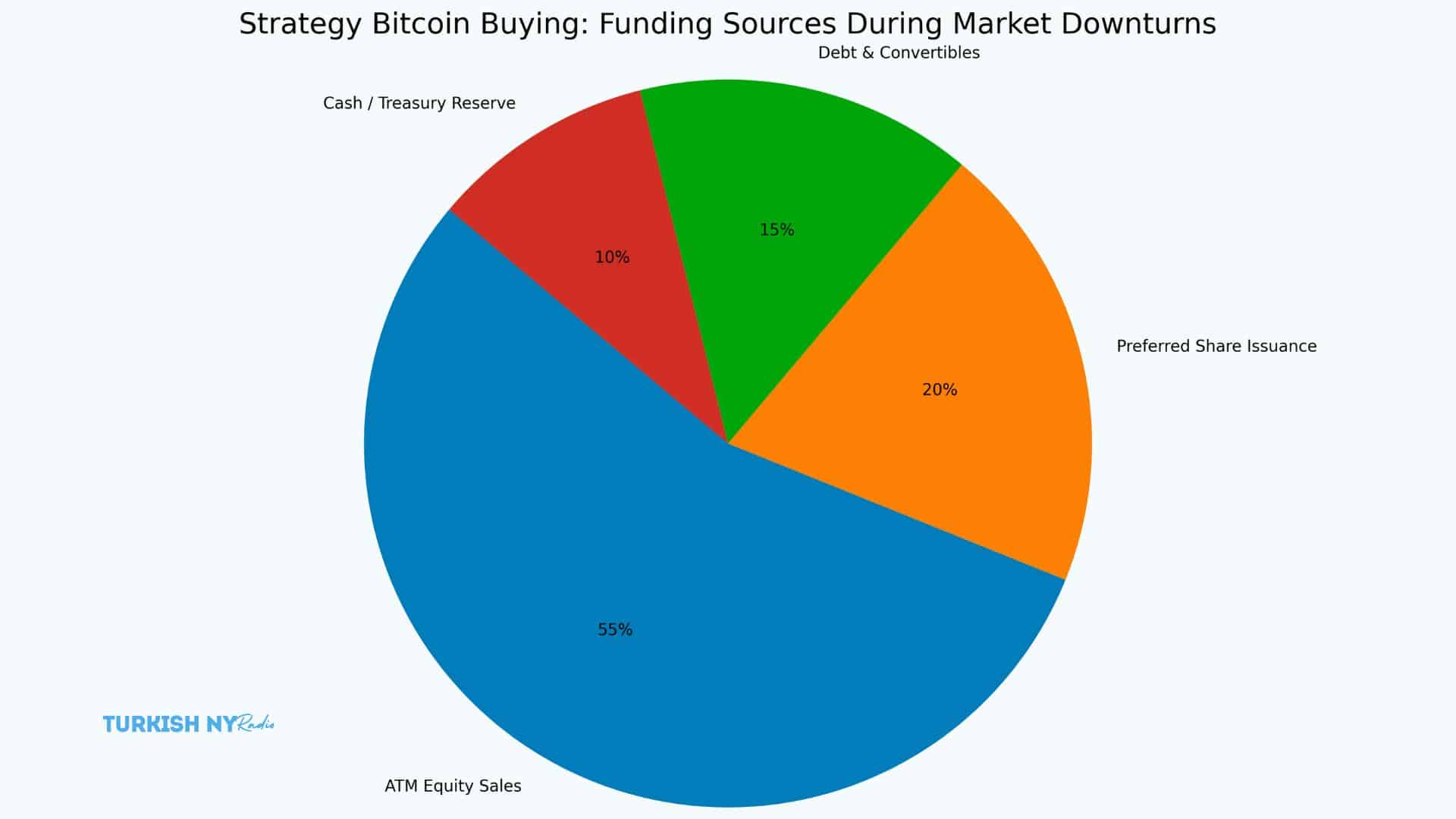
The most crucial funding tool is the at-the-market equity program. An ATM program allows shares to be sold gradually into the regular market. This avoids extensive, disruptive offerings. It also provides flexibility during volatile conditions.
Public filings show that Strategy regularly uses ATM proceeds to fund Bitcoin purchases. This method explains how buying continues even when macro conditions appear unfavorable. Capital flows directly from equity demand into Bitcoin ownership.
In the week tied to its latest Bitcoin purchase, Strategy reported selling approximately 4.79 million shares through its ATM program, generating about $888.2 million in net proceeds, illustrating how equity demand is rapidly converted into Bitcoin even during unfavorable macro conditions.
This approach creates dilution. Share counts rise over time. Strategy addresses this concern by tracking Bitcoin per share rather than raw holdings. Analysts often refer to this as a Bitcoin yield metric. It measures whether each share represents more Bitcoin over time despite dilution.
Strategy Bitcoin buying depends heavily on this mechanism. As long as equity markets remain open, Accumulation continues.
Preferred Shares and Layered Financing
Common equity is not the only funding source. Strategy also issues preferred shares. These instruments sit between equity and debt. They usually carry fixed dividend obligations. They also provide capital when common stock conditions weaken.
Preferred issuance adds flexibility. It expands the investor base. Income-focused investors often prefer predictable dividends over equity volatility. This creates another channel for capital during downturns.
However, preferred shares increase fixed costs. Dividends must be paid regardless of the Bitcoin price. This risk becomes central during prolonged market stress. Strategy addresses this risk through reserves and careful capital planning.
Studies from corporate finance journals note that layered capital structures improve funding resilience but raise long-term obligations. Strategy Bitcoin buying reflects this trade-off.
Debt and Convertibles as Long-Term Leverage
Debt and convertible notes form another layer. These instruments usually carry long maturities. They allow leverage without immediate equity dilution. Strategy has used convertibles when market conditions allowed favorable terms.
The logic remains consistent. If long-term Bitcoin appreciation exceeds the cost of capital, leverage enhances exposure to Bitcoin. This assumption carries risk. Bitcoin volatility can magnify losses during drawdowns. Yet long-dated maturities reduce short-term pressure.
Analysts often describe this structure as delayed leverage. It stretches risk across time rather than concentrating it. Strategy Bitcoin buying relies on this extended horizon.
The Role of the Bitcoin Treasury Reserve
Fixed obligations create concern during prolonged downturns. Dividends and interest do not pause. To address this risk, Strategy established a dedicated cash reserve totaling approximately $1.44 billion. This reserve is designed to cover dividend and interest obligations for more than a year, reducing concerns that the company could become a forced seller of Bitcoin during prolonged market downturns.
The reserve reduces the risk of forced Bitcoin sales. It sends a signal to investors. The company does not intend to liquidate holdings to meet short-term obligations. This reassurance supports confidence during market stress.


According to corporate treasury research published by the CFA Institute, liquidity buffers play a critical role in sustaining unconventional asset strategies. The Bitcoin treasury reserve strengthens the durability of Strategy Bitcoin buying during downturns.

Accounting Rules Amplify Volatility
Recent accounting changes affect reported earnings. Under updated U.S. guidance, qualifying crypto assets are subject to fair value accounting. Unrealized gains and losses flow through net income each quarter.
This change does not affect cash flow. It affects optics. A sharp Bitcoin move near quarter-end can dramatically swing reported earnings. Investors may misread this volatility as operational instability.
Academic accounting studies highlight that fair value treatment increases transparency but magnifies earnings noise. Strategy’s operations may remain stable while reported profits fluctuate wildly. Understanding this distinction is essential when evaluating the Strategy Bitcoin buying.
Market Sentiment and Reflexive Feedback Loops
The funding model is reflexive. When investor sentiment remains strong, equity trades at a premium. Issuance becomes easier. Bitcoin accumulation accelerates. This reinforces demand.
During sustained drawdowns, the loop tightens. Equity premiums compress. Issuance becomes more expensive. Accumulation slows. Strategy can still buy Bitcoin, but the pace depends on market appetite for its securities.
This dynamic reflects broader financial reflexivity theories discussed by economic researchers. Prices influence behavior. Behavior influences prices. Strategy Bitcoin buying exists within this loop rather than outside it.
Regulatory and Index-Related Pressures
Another constraint lies in classification. Index providers and regulators continue to evaluate how companies with large digital asset treasuries should be treated. Changes in index inclusion rules could affect demand for Strategy stock.
Consultations from major index providers highlight ongoing debates around classification and weighting. Regulatory clarity also shapes institutional participation. European MiCA rules and U.S. disclosure requirements increasingly influence investor behavior.
These factors do not stop Strategy Bitcoin buying directly. They influence the cost and availability of capital that supports it.
Risk Remains Part of the Model
No treasury strategy removes risk. Bitcoin remains volatile. Capital markets can close. Investor sentiment can shift sharply. Dilution can erode per-share value if premiums collapse.
Responsible analysis requires clarity. Strategy Bitcoin buying does not guarantee profit. It represents a structured approach to long-term exposure. Financial education research emphasizes understanding leverage, liquidity, and market cycles before evaluating such strategies.
This article is for informational purposes only and does not constitute financial advice. Readers should conduct independent research before making financial decisions.
Why the Model Continues to Attract Attention
Despite risks, the model remains compelling. It combines transparency, discipline, and scale. It transforms market downturns into accumulation phases rather than crises.
For financial students, the case illustrates capital structure design. For developers, it highlights how digital assets integrate into corporate finance. For analysts, it offers a live study in reflexive markets.
Strategy Bitcoin buying persists because structure replaces emotion. Downturns test that structure. So far, it continues to function.
Conclusion
Strategy’s ability to buy Bitcoin during downturns does not rely solely on belief. It depends on capital markets, layered financing, liquidity buffers, and investor demand. Each component carries risk. Each element also adds resilience.
The long-term question remains open. Can the cost of capital stay manageable through extended stress? Can investor demand remain stable amid persistent volatility? The answers will shape the next phase of Strategy Bitcoin buying.
For now, the model stands as one of the clearest examples of how corporate finance and digital assets intersect during market stress.
Glossary
Bitcoin treasury: A corporate approach that treats Bitcoin as a reserve asset on the balance sheet.
ATM equity program: A method that allows gradual sales of shares into the open market.
Bitcoin per share: A metric measuring Bitcoin backing each diluted share.
Preferred shares: Securities with fixed dividends and priority over common equity.
Convertible notes: Debt instruments that may convert into equity under specific conditions.
Fair value accounting: Reporting assets at current market value each period.
Capital dilution: Reduction in ownership percentage due to new share issuance.
Liquidity reserve: Cash set aside to meet fixed obligations.
FAQs About Strategy Bitcoin Buying
Why does Strategy keep buying Bitcoin during downturns?
The company uses capital markets rather than operating cash flow. Downturns do not halt this access.
Does dilution harm shareholders?
Dilution increases share count. Strategy tracks Bitcoin per share to evaluate long-term exposure.
Can Strategy be forced to sell Bitcoin?
The company maintains a reserve to cover dividends and interest payments, reducing the risk of forced sales.
Is this Strategy risk-free?
No. It carries market, financing, and regulatory risks. Understanding these risks is essential.