![BitTorrent [New]](https://s2.coinmarketcap.com/static/img/coins/64x64/16086.png)




This article was first published on TurkishNY Radio.
Japan is at a watershed moment when it comes to the regulation of digital assets. Now, after years of hacks, bankruptcies and regulatory maneuvers that have undermined public confidence, the country seeks to institute some of the toughest oversight in the world.


The new Japan crypto rules are an attempt to stockpile liability reserves of every licensed crypto platform, giving them a cushion of safety in the event of emergencies. The change reflects a move to better investor protection, more transparency and resilience in the market structure. It also serves as a road map for other areas grappling with the same problems.
“Liability reserves” may sound technical, but its consequences reach deep into the heart of digital finance. This idea impacts exchange solvency, user confidence, and overall the stability of global crypto markets.
To grasp why Japan is going this route, it’s helpful to look at the pattern of data breaches and consumer losses that informed the country’s view.
Japan’s Regulatory Turning Point and Why the Government Is Tightening Oversight
Japan became one of the earliest movers in digital asset regulation after suffering several high-profile failures. Analysts point to incidents where significant asset losses occurred despite strict controls. These setbacks revealed structural gaps and hinted that even cold wallets and custody requirements could not prevent every threat. They revealed how exposed rank-and-file users were when a crypto exchange failed or was targeted by criminals.
These events were closely watched by Japan’s Financial Services Agency (FSA). The FSA already has some of the world’s tightest standards around licensing, custody, cyber security and auditing for companies under the Payment Services Act, industry analysts have noted.
Yet these Japanese crypto rules lacked one critical layer: a fund set aside to repay customers in the event of breaches or unauthorized transfers.
The new liability reserve requirement steps into this gap. It forces every registered crypto exchange to store emergency capital dedicated solely to customer reimbursement. These funds act as a safety net when systems fail, staff make errors, or malicious actors attack.
How Liability Reserves Work and Why They Matter for Users
Liability reserves function as a financial shield. They offer a clear path for compensation when losses occur on a crypto platform. Traditional financial institutions have used similar systems for decades. Japan’s securities firms maintain reserve requirements to cover investor claims in the event of unforeseen failures.
This concept is now extended under Japan crypto rules, ensuring digital asset users benefit from the same protective measures. The approach limits damage and restores confidence quickly.
Crypto exchanges, however, operate with very different risk structures. Price volatility creates liquidity pressure and raises insolvency risks. Smart contract vulnerabilities can expose internal systems. A single unauthorized transfer can drain millions in minutes.

By requiring exchanges to maintain dedicated reserves, regulators aim to shorten the timeline between loss and compensation. Instead of a lengthy legal process or bankruptcy hearing, customers receive funds directly from reserve pools. This reduces stress and uncertainty at the worst possible moment.
Crypto researchers highlight that reserves also improve operational discipline. Exchanges adopt stronger security frameworks when they feel the weight of financial liability. The presence of a reserve signals that a platform can withstand shocks without collapsing. In the fast-moving digital asset market, this reduces systemic risk and builds a more predictable ecosystem for long-term participants.
Japan’s Plan to Benchmark Crypto Reserves to Securities Industry Standards
Japan intends to fashion the crypto reserve structure after its well-established securities model. The country’s securities regulatory framework sets reserve thresholds based on a firm’s size, risk profile, and transaction volume. Crypto actors may face similar treatment under the evolving Japan crypto rules. Although the final numbers are still under discussion, the outline suggests a tiered system that adjusts to each platform’s market footprint.
This approach aims to keep the burden fair. Large platforms with higher transaction activity would carry larger reserves. Smaller exchanges could hold lower amounts or purchase insurance to meet their obligations. Industry observers believe this hybrid model will help newer exchanges survive while ensuring that customer funds remain safe.
The possibility of insurance offers another path. Under the draft concept, approved insurance policies could supplement or even replace a portion of the required reserve. This allows firms to spread risk across global insurers and reduce pressure on their balance sheets. Insurers also benefit from the arrangement because they gain new clients in a growing sector.
How Liability Reserves Fit Into a Larger Regulatory Transformation
Japan is not stopping at liability reserves. The new Japan crypto rules sit within a broader restructuring of digital asset oversight. The FSA plans to extend regulation to third-party wallet providers, custodians, and trading system operators. These actors support the industry’s operational backbone, and regulators want them to meet uniform compliance standards.
Another significant development involves asset classification. Some digital assets may soon fall under the scope of securities laws. This shift would require more detailed disclosures, auditing, and consumer reporting. It also changes how tokens are offered to the public, potentially limiting riskier forms of fundraising.
Regulators also plan to improve insolvency procedures. Many past failures dragged on for years due to legal disputes and challenges in asset recovery. With new frameworks, customers could receive compensation faster and with fewer obstacles. Liability reserves form the base layer of this new architecture. Insolvency reform strengthens the structure and delivers a more predictable outcome in the event of disasters.
Why Global Regulators Are Watching Japan’s Approach Closely
Japan’s move comes at a critical time for the international crypto industry. Policy makers around the world are under pressure to keep innovation in balance with investor protection. Disclosures by international organisations including FATF Report and BIS Research highlight the necessity for more robust mitigation measures and improved transparency. Japan’s liability reserve system might be a model to change.
The European Union’s MiCA framework already pushes uniform licensing, reserve backing, and consumer protection. Several analysts note that Japan’s plan aligns with these principles, although it introduces an even stricter reserve mechanism. Observers expect global regulators to study Japan’s experience to understand whether reserves reduce market failures or encourage healthier competition.
Regulators outside Asia also track user sentiment. Market analysts on social communities highlight growing interest in networks such as Solana, where performance metrics and developer activity continue to rise.
Stricter global oversight could accelerate institutional adoption of high-speed networks, as transparency and broader security frameworks build corporate confidence.
What Liability Reserves Mean for Crypto Exchanges in the Future
These Japan crypto rules reshape how exchanges operate. Every decision, from liquidity management to infrastructure investment, must now account for reserve obligations. Firms need more robust accounting systems and stronger cybersecurity, as errors can trigger financial consequences directly tied to their reserve pool.
Some analysts predict industry consolidation. If they have enough capital, strong compliance teams and proven infrastructure, then firms will be competitive. Smaller actors may merge or exit. Yet this outcome can benefit consumers. A more stable market with fewer weak operators reduces the risk of sudden failures. It also improves industry reputation.
Crypto exchanges must improve their transparency as well. To demonstrate compliance, they may report reserve ratios or provide periodic solvency updates. Some blockchain experts feel that this could nudge the industry toward more standardized reports and promote the use of cryptographic proofs to verify customer assets.
If widely applied, these approaches could help to restore confidence for an industry that has long suffered from reputation issues.
Impact on Users and Why Liability Reserves Provide Market Stability
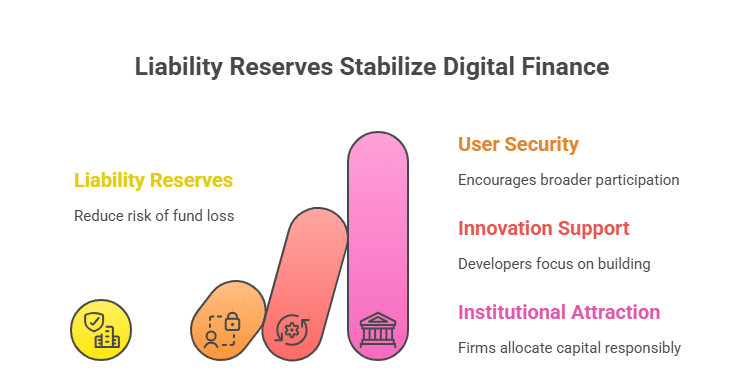
Users stand to gain from these reforms. Liability reserves reduce the risk of losing funds during unforeseen events. They also shorten the path to recovery. This gives everyday investors a sense of security and may encourage broader participation in digital finance.
A safer environment also supports innovation. Developers gain confidence that exchanges can support long-term projects. Analysts studying social trends note that communities backing networks like Solana or Ethereum benefit from a predictable exchange infrastructure. When core trading platforms stabilize, developers can focus on building tools, decentralized apps, and new use cases without fearing unexpected market shocks.
A stronger regulatory framework also attracts institutional players. Firms in banking, asset management, and insurance need predictable rules to allocate capital responsibly. Liability reserves create a system that mirrors certain safeguards used in traditional finance. This parallel reduces uncertainty and supports healthier growth for the digital asset economy.
Key Indicators That Analysts Watch in the Global Crypto Market
Professional analysts track several indicators to evaluate market conditions. They monitor trading volume to understand liquidity patterns, assess network fees to gauge demand, and review hash rates or validator counts to measure network strength. They also analyze developer activity through repositories such as GitHub or blockchain explorers. These indicators show how active a network is and how committed its developers remain.
Price stability is another key factor. Lower volatility often signals a more mature asset class. Sentiment analysis from social media also plays a role. Crypto communities usually discuss performance trends, especially during periods of rapid network expansion, such as on Solana.


Analysts use these online conversations as complementary signals to assess market momentum. When networks show rising engagement, vigorous developer activity, and favorable regulation, analysts consider these conditions positive for broader market health.
Conclusion
Japan’s planned liability reserve rule sets a new standard for digital asset regulation. These Japan crypto rules aim to protect users and create a safer trading environment. The rule is designed to expand upon long-standing vulnerabilities and to ensure that exchanges keep up a financial buffer strong enough to withstand unexpected shocks.
The wider regulatory changes are indicative of Japan’s commitment to redoubling trust and establishing a robust digital finance system.
The world now watches Japan. The nation’s approach may shape the next era of crypto governance. It reflects a growing belief that digital assets will benefit from strong oversight rooted in transparency, financial security, and user protection. With the transformation of global markets, liability reserves can lay the groundwork for a more secure and resilient digital future.
Disclaimer: This article is for informational purposes only and isn’t financial advice. Readers are encouraged to do their own research prior to making any investment decisions.
Glossary of Key Terms
Liability Reserve: An exchange’s pool of money kept aside to refund customers in the event of a hack or unauthorized outflow.
Custody: The process of holding and securing digital assets on behalf of users.
Cold Wallet: Offline storage designed to reduce cyberattack risks.
Liquidity: The ability to trade assets quickly without affecting price.
Market Volatility: Rapid price movement caused by market sentiment or external factors.
Hash Rate: The amount of computing power behind a blockchain network.
Decentralized Application (dApp): A program that operates on a blockchain rather than a centralized server.
MiCA: Towards a single European regime for the regulation of digital assets.
Proof of Reserves: A method to verify an exchange’s asset backing.
Insolvency Procedure: A legal process in which a company cannot meet its financial obligations.
FAQs About Japan Crypto Rules
1. What are liability reserves?
Liability reserves are financial cushions from which exchanges can draw to compensate users in the event of hacks or operational issues.
2. Why is Japan making these rules now?
Japan is looking to beef up consumer protection and curb market risks by regulating crypto exchanges through the same guidelines as traditional financial firms.
3. Will small exchanges struggle with these new requirements?
Smaller operators may face higher costs, but insurance options ease the burden and support compliance.
4. How will users benefit from these changes?
Users gain stronger protection, faster compensation processes, and greater trust in the stability of crypto platforms.