
• Home
  • About Us
  • Terms and Conditions
  • Privacy Policy
  • Disclaimer
  • Contact
18 July Saturday, 2026
  • tr Türkçe
  • en English
TurkishNY Radio
No Result
View All Result
  • Home
  • Cryptocurrency
  • Business
  • Economy
  • Home
  • Cryptocurrency
  • Business
  • Economy
No Result
View All Result
  • tr Türkçe
  • en English
TurkishNY Radio
No Result
View All Result
Bitcoin Bitcoin (BTC) $64,703.63 ↑ 1.25%
Ethereum Ethereum (ETH) $1,860.58 ↑ 1.20%
Tether USDt Tether USDt (USDT) $1.00 ↓ -0.01%
BNB BNB (BNB) $569.69 ↑ 0.46%
USDC USDC (USDC) $1.00 ↑ 0.00%
XRP XRP (XRP) $1.09 ↑ 0.44%
Solana Solana (SOL) $75.39 ↑ 0.69%
TRON TRON (TRX) $0.33 ↑ 0.90%
Hyperliquid Hyperliquid (HYPE) $60.23 ↑ 0.89%
Dogecoin Dogecoin (DOGE) $0.07 ↓ -0.12%
Zcash Zcash (ZEC) $557.04 ↑ 2.64%
UNUS SED LEO UNUS SED LEO (LEO) $9.80 ↓ -0.06%
Stellar Stellar (XLM) $0.19 ↑ 1.58%
Monero Monero (XMR) $335.10 ↑ 1.44%
Chainlink Chainlink (LINK) $8.34 ↑ 1.30%
Cardano Cardano (ADA) $0.17 ↑ 0.61%
Canton Canton (CC) $0.12 ↓ -2.69%
Dai Dai (DAI) $1.00 ↓ 0.00%
Bitcoin Cash Bitcoin Cash (BCH) $220.07 ↑ 0.28%
World Liberty Financial USD World Liberty Financial USD (USD1) $1.00 ↑ 0.02%
Gram (prev. Toncoin) Gram (prev. Toncoin) (GRAM) $1.48 ↓ -1.10%
Ethena USDe Ethena USDe (USDe) $1.00 ↑ 0.00%
Litecoin Litecoin (LTC) $46.78 ↑ 3.83%
Global Dollar Global Dollar (USDG) $1.00 ↓ 0.00%
Sui Sui (SUI) $0.74 ↑ 0.77%
DeXe DeXe (DEXE) $35.41 ↓ -2.67%
Hedera Hedera (HBAR) $0.07 ↑ 1.53%
PayPal USD PayPal USD (PYUSD) $1.00 ↓ -0.01%
Avalanche Avalanche (AVAX) $6.58 ↑ 0.23%
Cronos Cronos (CRO) $0.06 ↓ -0.93%
NEAR Protocol NEAR Protocol (NEAR) $1.93 ↑ 0.54%
Tether Gold Tether Gold (XAUt) $4,006.37 ↑ 0.06%
Shiba Inu Shiba Inu (SHIB) $0.00 ↑ 0.19%
Uniswap Uniswap (UNI) $3.56 ↓ -0.12%
Bittensor Bittensor (TAO) $195.48 ↑ 1.04%
World Liberty Financial World Liberty Financial (WLFI) $0.06 ↓ -0.05%
PAX Gold PAX Gold (PAXG) $4,004.06 ↑ 0.01%
OKB OKB (OKB) $81.37 ↑ 0.46%
Ondo Ondo (ONDO) $0.35 ↓ -6.14%
Aster Aster (ASTER) $0.62 ↓ -0.35%
MemeCore MemeCore (M) $1.24 ↓ -1.07%
Ripple USD Ripple USD (RLUSD) $1.00 ↑ 0.01%
USDD USDD (USDD) $1.00 ↑ 0.00%
Sky Sky (SKY) $0.06 ↑ 4.46%
Polkadot Polkadot (DOT) $0.84 ↓ -1.65%
Mantle Mantle (MNT) $0.42 ↓ -1.36%
Aave Aave (AAVE) $89.81 ↓ -0.37%
Worldcoin Worldcoin (WLD) $0.37 ↓ -3.43%
Internet Computer Internet Computer (ICP) $2.18 ↑ 2.00%
Bitget Token Bitget Token (BGB) $1.65 ↑ 0.73%
Pepe Pepe (PEPE) $0.00 ↑ 1.21%
Ethereum Classic Ethereum Classic (ETC) $6.99 ↓ -0.51%
United Stables United Stables (U) $1.00 ↓ -0.02%
Morpho Morpho (MORPHO) $2.02 ↑ 2.78%
Pi Pi (PI) $0.09 ↑ 6.66%
KuCoin Token KuCoin Token (KCS) $6.67 ↑ 0.51%
Stable Stable (STABLE) $0.04 ↓ -0.09%
Polygon (prev. MATIC) Polygon (prev. MATIC) (POL) $0.08 ↓ -2.09%
JUST JUST (JST) $0.10 ↑ 0.68%
Cosmos Cosmos (ATOM) $1.50 ↓ -0.60%
Ethena Ethena (ENA) $0.08 ↓ -0.72%
Quant Quant (QNT) $63.84 ↓ -2.36%
Render Render (RENDER) $1.48 ↑ 0.58%
Kaspa Kaspa (KAS) $0.03 ↓ -0.61%
Algorand Algorand (ALGO) $0.08 ↑ 0.72%
Audiera Audiera (BEAT) $2.37 ↓ -0.69%
GateToken GateToken (GT) $6.72 ↑ 0.75%
币安人生 币安人生 (币安人生) $0.69 ↓ -1.14%
Pump.fun Pump.fun (PUMP) $0.00 ↓ -0.21%
Jupiter Jupiter (JUP) $0.19 ↓ -0.43%
Filecoin Filecoin (FIL) $0.75 ↓ -1.66%
XDC Network XDC Network (XDC) $0.03 ↑ 0.89%
Flare Flare (FLR) $0.01 ↑ 0.36%
Arbitrum Arbitrum (ARB) $0.09 ↓ -2.00%
Lighter Lighter (LIT) $2.24 ↓ -1.58%
Venice Token Venice Token (VVV) $11.76 ↑ 5.67%
Injective Injective (INJ) $5.14 ↑ 0.90%
Aptos Aptos (APT) $0.61 ↓ -1.30%
TrueUSD TrueUSD (TUSD) $1.00 ↓ -0.12%
Nexo Nexo (NEXO) $0.76 ↑ 0.90%
PancakeSwap PancakeSwap (CAKE) $1.41 ↑ 0.25%
Midnight Midnight (NIGHT) $0.03 ↓ -1.51%
ether.fi ether.fi (ETHFI) $0.45 ↑ 3.61%
Aerodrome Finance Aerodrome Finance (AERO) $0.45 ↓ -4.23%
Dash Dash (DASH) $34.05 ↑ 0.15%
EURC EURC (EURC) $1.14 ↓ -0.06%
VeChain VeChain (VET) $0.00 ↑ 0.36%
Virtuals Protocol Virtuals Protocol (VIRTUAL) $0.62 ↓ -0.95%
Pudgy Penguins Pudgy Penguins (PENGU) $0.01 ↑ 4.78%
OFFICIAL TRUMP OFFICIAL TRUMP (TRUMP) $1.62 ↑ 5.23%
Pyth Network Pyth Network (PYTH) $0.05 ↑ 0.42%
Artificial Superintelligence Alliance Artificial Superintelligence Alliance (FET) $0.16 ↓ -0.95%
Sun [New] Sun [New] (SUN) $0.02 ↑ 0.62%
First Digital USD First Digital USD (FDUSD) $1.00 ↑ 0.01%
Sei Sei (SEI) $0.05 ↓ -0.47%
Celestia Celestia (TIA) $0.36 ↓ -3.81%
Curve DAO Token Curve DAO Token (CRV) $0.21 ↓ -2.22%
SPX6900 SPX6900 (SPX) $0.34 ↓ -3.15%
Terra Classic Terra Classic (LUNC) $0.00 ↓ -0.47%
Stacks Stacks (STX) $0.17 ↓ -0.04%
Home Economy

How Gas Fee Optimization Works Across Blockchains

Jonathan Swift by Jonathan Swift
18 July 2026
in Economy, Cryptocurrency, News
Reading Time: 5 mins read
0
How Gas Fee Optimization Works Across Blockchains

Blockchain fees still shape how people trade, lend, mint tokens, and move funds. On Ethereum, costs rise when many users compete for limited block space. Gas fee optimization is now central to whether decentralized applications can serve millions of users without making routine actions too costly or unpredictable.

Table of Contents

Toggle
  • Why Blockchain Gas Fees Rise
    • YOU MAY BE INTERESTED
    • Blockchain Interoperability Solutions: Why Polkadot, Cosmos and Avalanche Matter in 2026
    • TradFi vs DeFi Debate Grows as Ark Invest Challenges a16z Crypto
  • Gas Fee Optimization Starts With Layer 2 Scaling
  • Smarter Contracts Cut Wasted Work
  • Wallets, Timing, and Better Routing
  • Compression Improves Rollup Economics
  • Beyond Ethereum: Different Technical Models
  • Key Indicators to Watch
  • Conclusion
  • Frequently Asked Questions
    • What makes Ethereum gas fees rise?
    • Do Layer 2 networks remove fees?
    • Can wallets reduce transaction costs?
    • Are low-fee blockchains always better?
      • Glossary of Key Terms

Why Blockchain Gas Fees Rise

A gas fee pays a network to process a transaction or smart contract instruction. On Ethereum, every action consumes a measured amount of computational work called gas. The final charge depends on gas used and the price of gas at that moment.


YOU MAY BE INTERESTED

Why Blockchain Interoperability Solutions Across Polkadot Cosmos Avalanche Matter in 2026

Blockchain Interoperability Solutions: Why Polkadot, Cosmos and Avalanche Matter in 2026

18 July 2026
TradFi vs DeFi

TradFi vs DeFi Debate Grows as Ark Invest Challenges a16z Crypto

17 July 2026

Failed transactions may also cost money because validators performed work before the action reverted.

Ethereum changed its fee market through EIP-1559. It introduced a base fee that is burned and a priority fee that rewards validators. The base fee adjusts with demand, which improves estimation but does not guarantee cheap transactions during heavy use.

Gas Fee Optimization Starts With Layer 2 Scaling

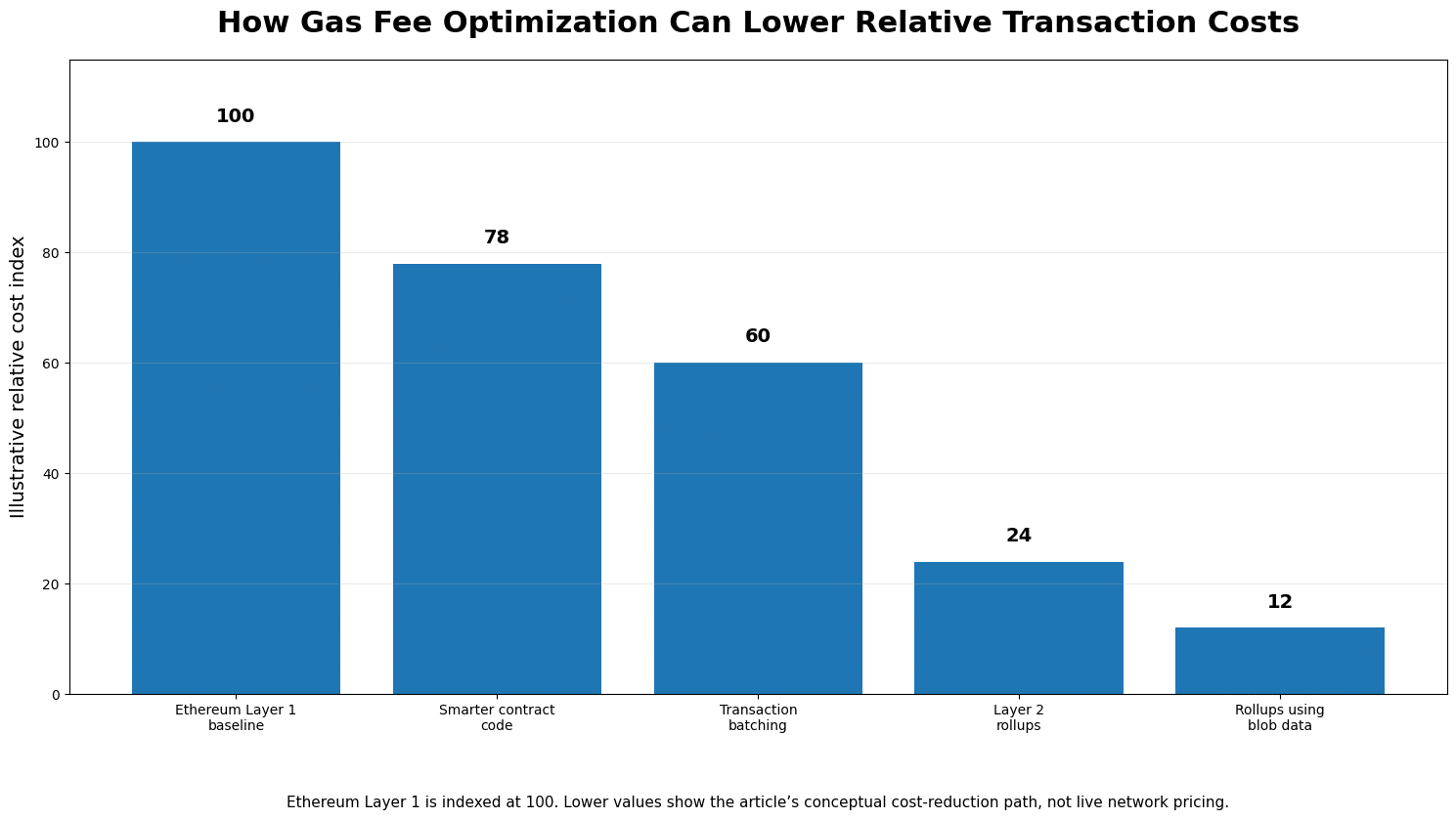
The leading gas fee optimization method on Ethereum is moving activity from the main network to Layer 2 rollups. These networks execute many transactions away from Ethereum, compress the results, and publish data or proofs back to the base layer.
How Gas Fee Optimization Works Across Blockchains

Optimistic rollups treat transactions as valid unless challenged. Zero-knowledge rollups use cryptographic proofs to confirm batches. Both models spread Ethereum settlement costs across many users, reducing the amount each person pays.

EIP-4844 added blob transactions, giving rollups a separate, more efficient place to publish temporary data. This reduced reliance on expensive calldata. Rollup fees still include execution and Ethereum data charges, while blob pricing can become an important part of the total.

Smarter Contracts Cut Wasted Work

Applications can support gas fee optimization through careful engineering. Contracts become cheaper when they use fewer storage writes, avoid repeated calculations, pack data efficiently, and remove unnecessary external calls.

Batching is another useful fix. Instead of sending several transactions, a wallet or application can group compatible actions into one request. A trading platform might combine approval and swap logic, while a treasury contract may pay several recipients in one call.

Permit signatures, account abstraction, and sponsored transactions can also improve the experience. They do not erase network costs, but they may remove duplicate steps or let an application pay on behalf of a user. EIP-7702 gives regular Ethereum accounts access to smart-account features such as batching, custom authorization, recovery tools, and flexible fee payment.

Wallets, Timing, and Better Routing

Wallets play a quiet role in gas fee optimization as a well-designed wallet estimates the base fee, suggests a suitable priority fee, warns about likely failures, and explains whether faster confirmation is necessary.

Some wallets also simulate transactions before broadcast, reducing the chance that a user pays for an action that will fail.

Routing tools can compare decentralized exchanges, bridges, and Layer 2 networks. Yet the cheapest quoted swap may not be the cheapest complete route once approval fees, bridge costs, slippage, and withdrawal charges are included. Gas fee optimization should therefore measure the full transaction path rather than one visible number.
ADVERTISEMENT

How Gas Fee Optimization Works Across Blockchains

Compression Improves Rollup Economics

Rollups lower fees by turning many user actions into compact batches. Compression removes repeated information, while batch submitters choose when and how to publish data. Operators may use blobs or calldata depending on pricing and availability. OP Stack guidance states that sequencers can switch between the two when both methods are secured by Ethereum.

Further gas fee optimization may come from stronger compression, shared sequencing, proof aggregation, and improved data availability. Some rollups use external data availability systems to reduce expenses. That can lower fees, but users then rely on a different security model. Price alone is not enough. Data access, censorship resistance, withdrawal safety, and operator risk still matter.

Beyond Ethereum: Different Technical Models

Other blockchains pursue gas fee optimization through parallel execution, shorter block times, specialized virtual machines, or app-specific capacity.

Some systems charge small fixed fees. Others use dynamic markets or separate prices for computation, storage, and data. Specialized designs can improve efficiency because unrelated applications do not always compete for the same resources.

Still, low fees do not automatically make a network stronger. Users should review decentralization, validator requirements, outages, liquidity, bridge security, and the cost of exiting to another chain.

Key Indicators to Watch

Several indicators show whether gas fee optimization is working. Average transaction fee reveals the broad cost trend, while median fee limits the impact of extreme spikes. Gas used per transaction helps measure contract efficiency. Block utilization shows how close a network is to capacity.

Layer 2 users should watch blob fees, data availability costs, batch size, failed transaction rates, and the share of fees paid to Ethereum.

A useful assessment compares cost with security, liquidity, finality, and reliability. Cheap block space with weak settlement guarantees may save money today but create larger losses later.

Conclusion

Gas fee optimization is advancing across several layers. Ethereum improved fee estimation, expanded rollup capacity, and added blob transactions for cheaper data publishing. Layer 2 networks spread settlement costs across large batches, while wallets and contracts reduce waste through simulation, batching, permits, and efficient code.

The lowest fee, however, does not always provide the best network. Sustainable gas fee optimization must preserve security, data availability, and user control while making blockchain activity affordable for ordinary use.

Frequently Asked Questions

What makes Ethereum gas fees rise?

Fees rise when users compete for limited block space, especially during volatile markets, token launches, or heavy smart contract activity.

Do Layer 2 networks remove fees?

No. They reduce costs by batching transactions and sharing settlement and data expenses across many users.

Can wallets reduce transaction costs?

Wallets can improve estimates, simulate transactions, batch actions, and route activity through cheaper networks.

Are low-fee blockchains always better?

No. Security, decentralization, liquidity, reliability, bridge risk, and withdrawal options also matter.

Glossary of Key Terms

Gas: A unit that measures computational work on a blockchain.

Base fee: The minimum Ethereum fee required for block inclusion and burned under EIP-1559.

Priority fee: An optional payment that encourages faster inclusion.

Rollup: A Layer 2 network that batches transactions and settles results on another blockchain.

Blob: Temporary data space designed for efficient rollup publishing.

Calldata: Transaction data processed on Ethereum and historically used by rollups.

Account abstraction: Wallet technology that enables batching, recovery, and sponsored fees.

Data availability: The ability of participants to access and verify transaction information.

Sources

ethereum/org

optimism/io

Disclaimer: This article is for educational purposes only and does not provide financial, investment, legal, or technical advice. Fees and network conditions can change quickly. Users should verify current costs, security assumptions, and transaction details before moving digital assets.


Tags: blockchainEthereum feeGas feeGas Fee Optimizationwallet
ShareTweetSharePinSend
Previous Post

Blockchain Interoperability Solutions: Why Polkadot, Cosmos and Avalanche Matter in 2026

Jonathan Swift

Jonathan Swift

A crypto journalist with an understanding of blockchain technology. Skilled in simplifying complex topics for diverse audiences, from beginners to experts. Because I believe in words as they are the children of mind.

SIMILAR NEWS

Why Blockchain Interoperability Solutions Across Polkadot Cosmos Avalanche Matter in 2026
Cryptocurrency

Blockchain Interoperability Solutions: Why Polkadot, Cosmos and Avalanche Matter in 2026

18 July 2026
TradFi vs DeFi
Cryptocurrency

TradFi vs DeFi Debate Grows as Ark Invest Challenges a16z Crypto

17 July 2026
Japan Passes Crypto Reform, but Why 20% Tax Relief May Wait
Economy

Japan Passes Crypto Reform, but Why 20% Tax Relief May Wait

17 July 2026

Leave a Reply Cancel reply

Your email address will not be published. Required fields are marked *

Search

No Result
View All Result
DMCA
PROTECTED

Categories

  • Business
  • Cryptocurrency
  • Economy
  • en
  • News
  • Politics
  • World

Recent Posts

  • How Gas Fee Optimization Works Across Blockchains
  • Blockchain Interoperability Solutions: Why Polkadot, Cosmos and Avalanche Matter in 2026
  • TradFi vs DeFi Debate Grows as Ark Invest Challenges a16z Crypto
  • Japan Passes Crypto Reform, but Why 20% Tax Relief May Wait
  • UAE Crypto Approval Moves Revolut Closer to Dubai VASP License
TurkishNY Radio

Site Navigation

  • Home
  • About Us
  • Terms and Conditions
  • Privacy Policy
  • Disclaimer
  • Contact

TurkishNY Radio

Banner 1
Banner 2
No Result
View All Result
  • Home
  • Cryptocurrency
  • Business
  • Economy
  • tr Türkçe
  • en English

  • English