This article was first published on TurkishNYR.
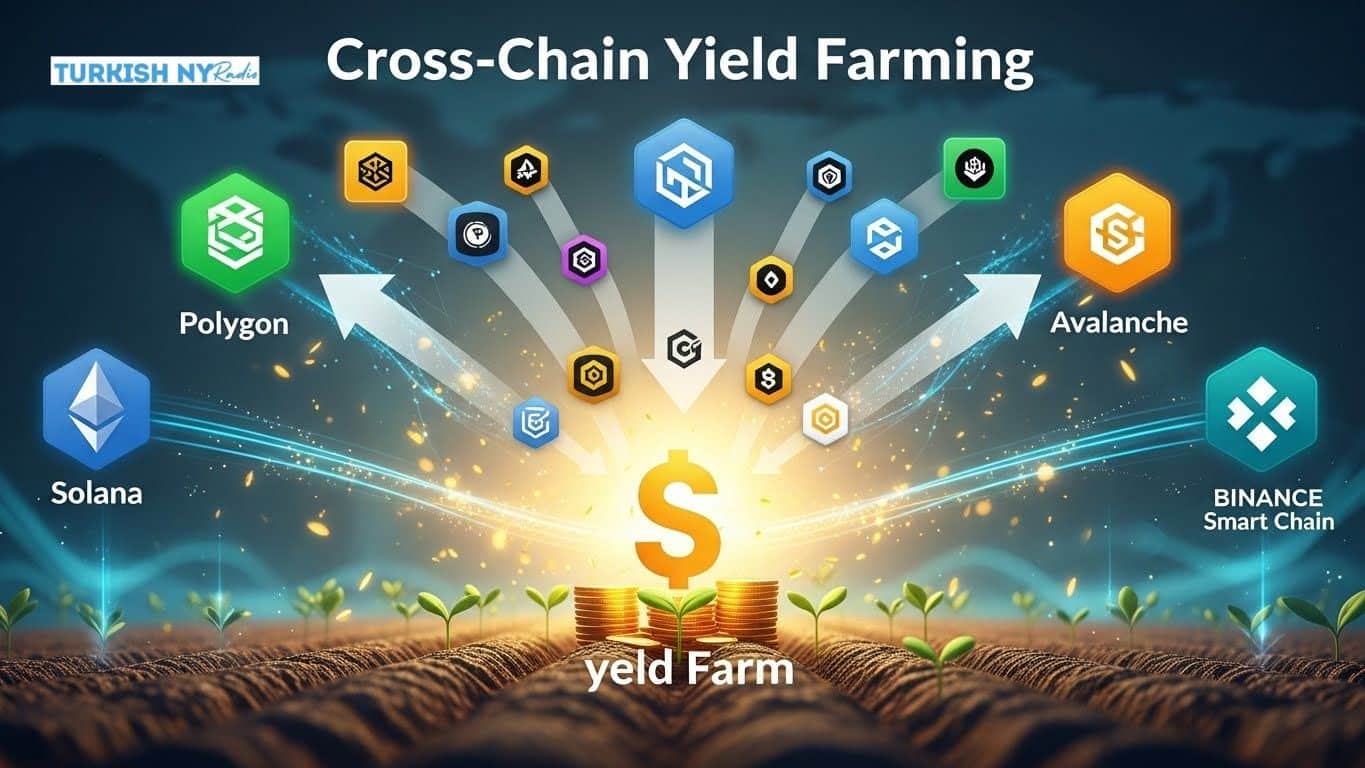
Cross-chain yield farming is a developing DeFi trend, which adds the high-APY attractions of liquidity pools to blockchain interoperability.


In traditional yield farming, one would lock up tokens in a liquidity pool on one chain (for example Ethereum) and receive fees or governance tokens.
Cross-chain yield farming takes this to the next level by utilizing bridges and multi-chain protocols to farm on several chains without needing to move assets across manually. This enables farmers to hedge across various chains, optimize returns, and leverage pools with the highest yields.
What Is Cross-Chain Yield Farming?
Yield farming, or liquidity mining, is when users supply (token pairs) liquidity to DeFi pools for rewards. A liquidity pool is just a smart contract that contains some tokens one can trade against.
Farmers usually get trading fees and bonus tokens. Cross-chain yield farming implements this process one step further by using cross-chain bridges and protocols. Farmers no longer have to be committed to one blockchain, and can move assets into pools on any supported network.
As TokenMetrics explains, cross-chain yield farming is “a burgeoning trend that facilitates operations on multiple blockchain networks, and thus allows users to diversify and access opportunities from a variety of platforms”.
In real terms, a cross-chain yield farmer could bridge ETH to Avalanche or Solana and deposit it into some high-yield pool there, all from one dashboard or platform.
How Liquidity Pools Functions in Yield Farming
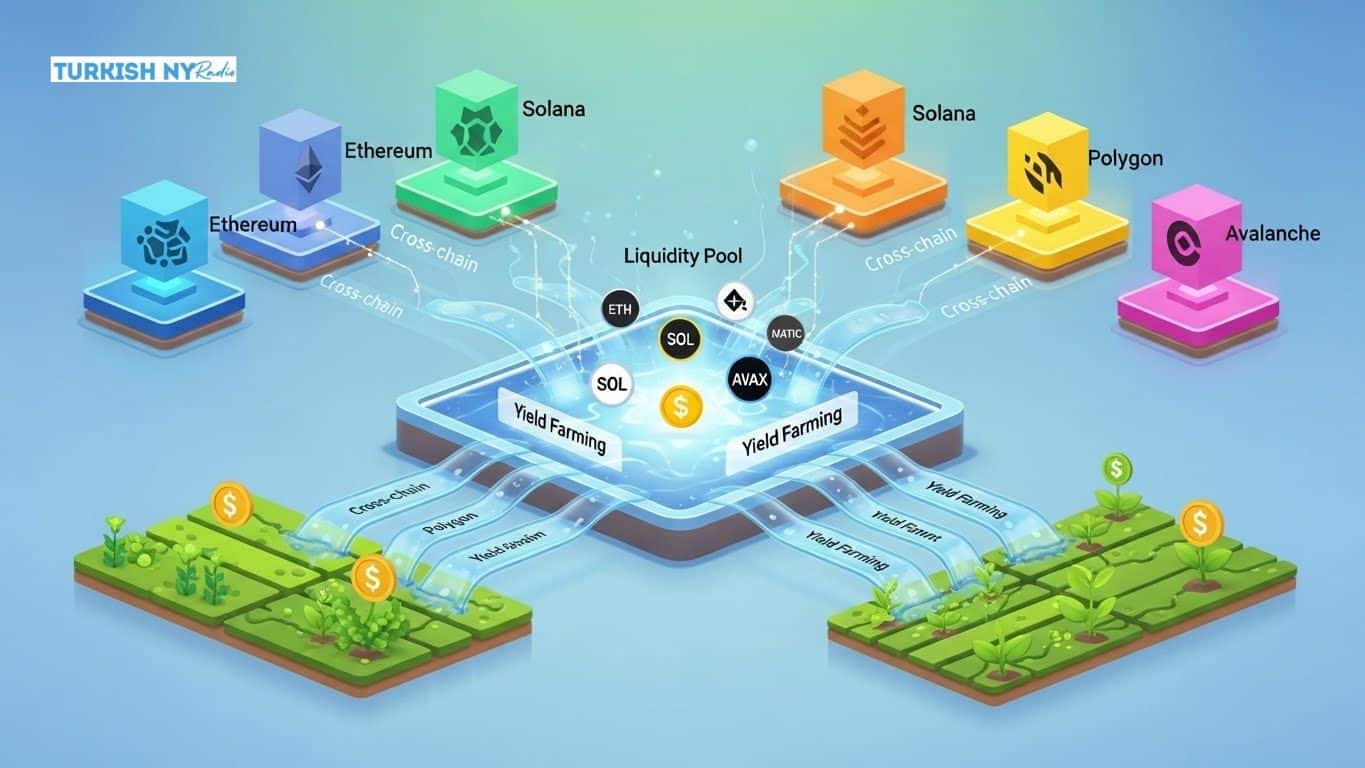
Yield farming is fueled by liquidity pools, which pool together tokens for algorithmic trading. According to Hacken’s security guide, a liquidity pool is a number of cryptocurrency tokens…locked in a smart contract.
These pools act as the base for a decentralized trading, lending and other financial operations. In such a pool, Liquidity Providers (LPs) put in matched tokens, say ETH/USDC, and the pool employs an AMM formula to set prices.
LPs receive portion of trading fees, plus any additional yield rewards. LPs get share of fees + some platform tokens.
Liquidity pools draw massive deposits because the yields can be high. The total value of locked DeFi reached more than $128.6 billion by 2025. But a lot of that TVL is siloed across chains (Ethereum, BNB Chain, Arbitrum etc.)
Cross-chain yield farming leverages bridges to access all that locked liquidity. For instance, a user can transfer a stablecoin between chains to easily access pools on each chain.
In this way, it’s the liquidity pools that bring the returns, while cross-chain tools enable farmers to tap into whatever pool they want no matter which chain it’s on.
How Cross-Chain Yield Farming Works
Cross-chain yield farming uses bridges and multi-chain protocols to transport capital. A cross-chain bridge is a technology that enables assets to be transferred securely across two different blockchains.
Most bridged assets are locked on the source chain and a wrapped version is minted on the destination. Bridges are the “connective tissue” between blockchains, and facilitate smooth value transfer, according to Chainalysis. Once bridged, the asset can be traded on that chain using a liquidity pool or DeFi protocol.
For instance, a farmer could begin with USDC on Ethereum, bridge it through a protocol like Stargate or Synapse and yield USDC on Arbitrum.
They can then deposit that into an Arbitrum liquidity pool to earn yields. Some cross-chain protocols (such as Symbiosis Finance) even combine swaps into a single step: plug in wallet and instantly transform “USDT on Ethereum” into “USDT on BNB Chain.”
This “cross-chain liquidity mobility” is what enables these new opportunities to be unlocked for participation in the DeFi sector, not only yield farming and lending, but also arbitrage and staking.
New platforms are being created to make these flows easier. For instance, Egg. Fi prioritizes access to the safer farms, bridges and DEXs across different blockchains in a single interface.
This could allow a farmer, for example, to select the top pool on any chain and have the platform take care of all the bridging and staking in the background.
In very short: Cross-chain farming is the automatic routing of assets through bridges into the best-yielding pools a cross networks managed by smart contracts or aggregation engines.
Trends and Top Sites
Cross-chain farming is a must-have capability for 2025 according to industry analysts. This corresponds to a monthly cross-chain bridge volume of around $1.5-3 billion (2024); an indication of wide user adoption.
There is nearly $128billion in value locked in DeFi but it’s siloed across hundreds of chains, making interoperability a necessity. A few example protocols include:
| Protocol | Chains Supported | Key Feature (2025) |
| Stargate | 40+ (EVM and non-EVM) | Unified, native-asset liquidity pools |
| Symbiosis | Major L1 & L2 (EVM and non-EVM) | Cross-chain AMM DEX pooling multi-chain liquidity |
| THORChain | 16 major chains | True native crypto swaps (BTC, ETH, etc) |
| Hop | Ethereum L2 (Arbitrum, Optimism, Polygon) | Fast/cheap Layer-2 transfers |
| cBridge (Celer) | Major EVM chains | Robust dev-friendly bridge with state-guardian security |
Each of these shows bridges and liquidity pools coming together. For instance; Stargate’s “unified liquidity pools across 40+ chains” means yield farmers can deposit stablecoins once and earn fees anywhere without juggling bridges.
With Symbiosis’s multi-chain pools, one can deposit a single token and it will be deployed on all integrated chains. Leading DeFi aggregators in 2025 leverage cross-chain strategies to achieve optimal yields; AI or on-chain analytics automatically directs assets toward the most favorable pools.
Experts, then, consider cross-chain yield farming a progression of DeFi. It weaves together liquidity that would be stuck in silos, allowing it to increase APYs and efficiency.
However, reports point out that security should be front of mind: “The best protocols have learned from [bridge hacks] and built significantly better security models.” Farmers should use only well-audited bridges and stay vigilant.
Benefits of Cross-Chain Yield Farming
Cross-chain yield farming has several major advantages:
Higher APYs and Diversification: Farming across chains enables farmers to chase the absolute best APYs. Cross-chain farming, as ChainSpot notes, gives access to the best farming pools irrespective of the network, and could mean bigger returns than when only operating on a single chain. Diversity also means spreading risk; a bad event on one chain does not destroy all of a farmer’s capital.
Efficient and Cost Effective: no human bridging is used by farmers. There is no need to transfer assets between wallets or interfaces. Most cross-chain solutions are routing-tuned, minimizing gas and slippage. Experts observe that this means cheaper fees: cross-chain aggregators reduce fees by finding the most efficient routes for bridging and swapping.
Mobility Of Capital: The fragmentation of liquidity is diminished. Rather than leaving assets stranded on one chain, capital can move to where demand and yields are highest; allowing users to access opportunities across ecosystems”.
One-Stop Management: Cross-chain dashboard to manage farms across networks in one place. That is a huge timesaver when managing multiple DeFi accounts.
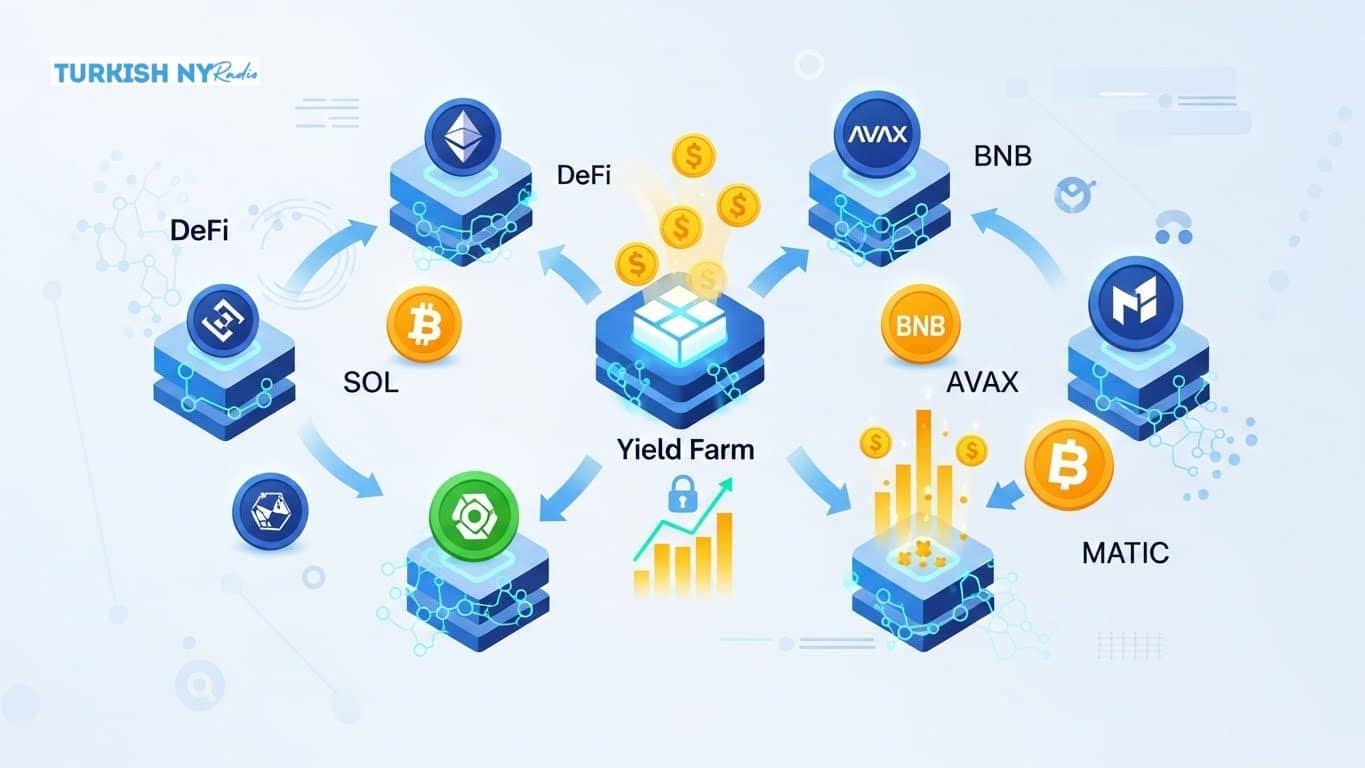
Reports find that with DeFi reaching 100+ chains by 2025, bridges providing “speed, security and capital efficiency” are increasingly important for arbitrage, yield farming, and portfolio rebalancing.
Challenges and Risks
Cross-chain yield farming, though attractive, does suffer from its own set of obstacles:
Bridges have long been a significant attack surface. Experts caution that cross-chain bridges could bring new security challenges. A small bug can be leveraged to compromise the entire network, causing a massive loss of assets.


It is difficult to manage assets across chains. Any bridge or protocol can impose any kind of fee. There is usually a downside to bridging, like high fees, security risks or slow confirmation times. The more chains one cross, the more transaction costs pile up.
Sometimes, when one supplies liquidity, there can be impermanent loss due to price movement. If one token in a pair starts making more money than the other, LPs can withdraw to find they have less of the valuable token versus if they’d just held it. Cross-chain doesn’t negate this risk in pools.
This is DeFi, there can be bugs or scams. A coding error in a cross-chain farm or bridge could be devastating. One example; Harvest Finance lost $33.8M to a flash loan exploit in 2020. It could also be rug-pulled by malicious pools, as with AnubisDAO when it drained $60M.
To reduce these risks, experts emphasize the importance of using audited protocols, commencing with small sums and diversifying across bridges. And of course, do your due diligence before joining.
Conclusion
Cross-chain yield farming is a way for most users to make the most of their returns by supplying liquidity all over different blockchains with bridges to everywhere. This can hugely boost APYs and diversify risk as farmers tap high-yield opportunities on different networks.
However, this also adds some complexity: transaction fees, lag between bridging assets and risk on bridges and smart contracts.
Overall, the innovations being developed are going to improve cross-chain farming, making it smoother and more secure in the future. Farmers mulling over cross-chain plans will have to weigh the pros of better yields against thorough research and risk management.
Glossary
Cross-Chain Bridge: A system, such as a protocol, that transfers tokens between different blockchains (e.g., Ethereum to Binance Smart Chain), by locking funds in one chain and creating an equivalent amount of tokens on another.
Yield Farming: Known as liquidity mining, it’s the act of putting cryptocurrencies into DeFi protocols to generate returns (trading fees or tokens).
Liquidity Pool: It’s a smart contract where paired tokens are stored (for example, ETH/USDC), which is used to leverage automated trading. Providers receive fees and incentives for contributing to the pool.
APY (Annual Percentage Yield): The annual return on an investment, when the interest earned is reinvested and compounded. DeFi yields are quoted with this annual percentage yield (APY) comparison in mind.
Impermanent Loss: A form of risk that liquidity providers face when the price of tokens diverge. If one asset becomes more valuable than the other, LPs withdraw less of the higher-price token than if holding them separately.
AMM (Automated Market Maker): An exchange that uses algorithms to price assets in liquidity pools rather than order books, regulating continuous liquidity.
Frequently Asked Questions About Cross-Chain Yield Farming and Liquidity Pools
What is cross-chain yield farming?
It’s a DeFi technique where one provides liquidity to pools across different blockchain networks. This is where bridges or multi-chain platforms come in. They allow one to bring their assets to any chain, allowing them to farm rewards (fees or tokens) on the originating network without having to transfer funds manually.
How do liquidity pools yield?
Token pairs for trading are stored in such liquidity pools. Providers then deposit tokens and earn a portion of the trading fees along with token rewards. In yield farming, platforms also typically give additional incentives (such as governance tokens) in addition to fees.
Which blockchains support cross-chain farming?
Pretty much any chain with ties to other chains. Examples include Ethereum, BNB Chain, Arbitrum, Optimism, Polygon, Avalanche and Solana. Chain bridges such as Stargate or Synapse link many EVM and non-EVM chains.
Is cross-chain yield farming safe?
It is riskier than single-chain farming. Bridges have been attacked before thus make sure to use well-audited bridges. Keep an eye out for impermanent loss and rug pulls in any liquidity pool. Start with a small investment; diversify and, if one is using an exchange or trading platform, make sure users say they are reputable.
How can one do cross-chain farming?
Start with a proven multi-chain platform. For instance, depositing a token into a cross-chain farm or vault (such as a multi-chain yield aggregator). The platform will then connect the asset to every targeted chain and farm it. Send funds to a chain on your own using a trusted bridge and stake locally in a pool.