
This article was first published on TurkishNYR.
The contest between the digital yuan and the U.S. dollar is no longer a distant topic for academics. For policymakers, multinationals, and crypto traders, the emerging Yuan vs US Dollar story in global trade is really about who owns the rails of digital money.


China has spent years rolling out the e-CNY, a central bank digital currency used in retail pilots and cross-border experiments. At the same time, the dollar still prices most global trade and dominates financial markets. The gap between a rising programmable currency and the long-established reserve unit is what gives the Yuan vs US Dollar debate its weight.
Why the dollar still anchors most global trade
By almost every major metric, the dollar remains the backbone of global commerce. It accounts for a majority of trade invoicing, a large share of central bank reserves, and most cross-border payment traffic. Oil, metals, and many manufactured goods are still billed in dollars, which gives firms strong reasons to keep their books and hedging strategies in the same currency.
This power carries over into digital markets. Dollar-pegged stablecoins connect banks, exchanges, and DeFi platforms, so prices for Bitcoin, Ethereum, and many altcoins are effectively quoted against the dollar. Even when traders stay inside crypto, they live in a dollar-based universe, which keeps the Yuan vs US Dollar balance tilted toward Washington for now.
What makes the digital yuan different
The digital yuan, or e-CNY, is money issued directly by the People’s Bank of China in digital form. It can settle payments instantly, work without traditional card networks, and embed rules such as spending limits or time-based incentives. Inside China, users are already testing it in transport systems, consumer spending, and public service payouts.
For global trade, the key experiments involve cross-border use with partners in Asia and the Middle East. Multi-CBDC projects aim to let central banks and commercial banks settle directly in their own digital currencies on shared platforms.
In that setting, an importer could pay in local digital money that converts into digital yuan on a common ledger, without routing through dollars. If enough trade lanes operate this way, the practical meaning of Yuan vs US Dollar shifts from headline market share to who runs the underlying settlement architecture.
Geopolitics and sanctions in the background
Currency design is also about power. The dollar system gives the United States an ability to impose sanctions, freeze assets, and restrict access for banks that depend on dollar clearing. Recent crises have reminded many governments that reliance on a single currency network can become a strategic vulnerability.

China’s push for wider digital yuan use is partly a hedge against this risk. If more energy contracts, infrastructure projects, and critical raw material deals settle in renminbi or e-CNY, the Yuan vs US Dollar equation starts to include questions of political alignment and resilience, not only liquidity and convenience.
Where crypto and stablecoins fit into the picture
Crypto provides a real time lab for digital money. Today, most stablecoins track the dollar, and DeFi pools, derivatives, and NFT markets usually quote values in USD terms. On-chain finance, therefore, runs on a digital dollar standard, even when users sit in countries where local currencies dominate daily life.
China has taken a sharply different path. It restricts public crypto trading and mining but promotes its own state backed digital currency. Policymakers are now exploring ideas such as yuan-linked stablecoins or tokenized deposits that would circulate on regulated platforms.
If these gain traction in Asia or along Belt and Road trade routes, the Yuan vs US Dollar story inside crypto could evolve from pure dollar dominance to a more mixed landscape where renminbi-based liquidity matters during key trading sessions.
Key indicators to watch
Behind the headlines, analysts focus on a few practical signals: how much trade is invoiced in each currency, payment volumes, reserve holdings, and activity in CBDCs and stablecoins. They also watch how much value flows through alternative payment systems that sit outside legacy dollar rails.
If large supply contracts and infrastructure projects begin to settle in digital yuan at scale, the shift in currency power will first appear in trade and payments data, not in speeches. When that happens, the change in the Yuan vs US Dollar balance will be visible in shipping invoices and settlement records long before it appears in political slogans.
Scenarios for the next decade
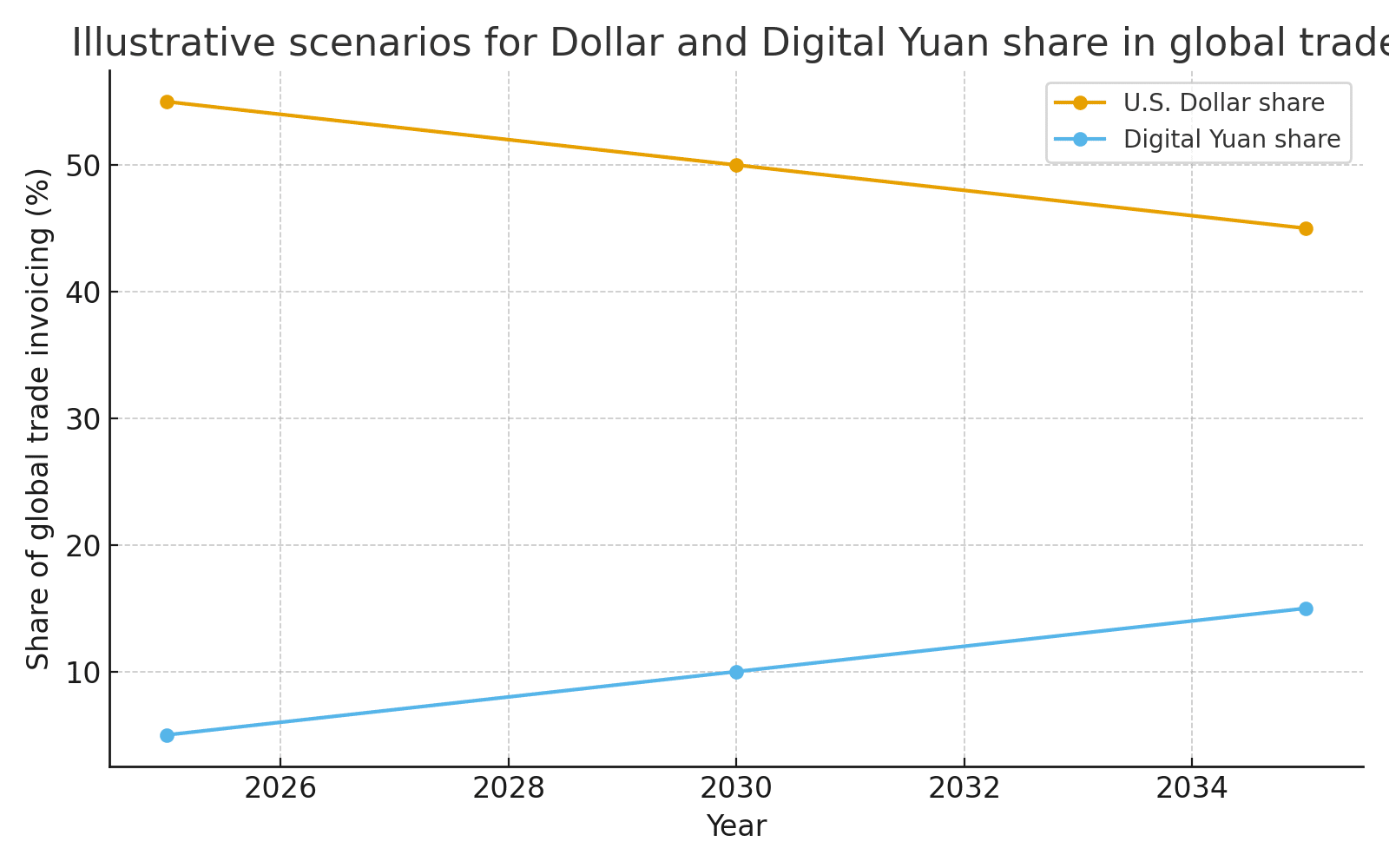
Most specialists expect slow motion change rather than a dramatic flip. The dollar is likely to remain the primary global currency because it offers deep markets, legal predictability, and a long track record. At the same time, the share of trade and finance handled in renminbi and e-CNY is likely to rise, especially in Asia and in countries that rely heavily on Chinese investment.
In a moderate scenario, the digital yuan becomes a serious regional settlement currency while the dollar keeps its position as global anchor. In a more ambitious scenario, technical advances and greater openness convince more partners to diversify away from near total reliance on the dollar.
In either case, the Yuan vs US Dollar discussion in global trade is turning into a set of practical choices that treasurers, trade finance desks, and even crypto exchanges have to make.
Conclusion
Digital money is beginning to shift a currency order that once felt fixed. The digital yuan gives China a direct channel to plug its trade and finance networks into a programmable monetary system, while the U.S. dollar still powers most invoices, reserves, and on-chain liquidity.
For now, Yuan vs US Dollar is less about a winner and more about optionality. The more that firms and governments can choose which currency and which rails to use for a given transaction, the more global trade will look like a multi-currency operating system instead of a single dominant standard.
Frequently Asked Questions
What is the digital yuan?
The digital yuan, or e-CNY, is China’s central bank digital currency. It is issued by the People’s Bank of China and designed for everyday payments and selected cross-border pilots.
Why does the dollar still dominate global trade?
The dollar dominates because it combines deep capital markets, high liquidity, and a long record as the main unit for pricing commodities, trade contracts, and international debt.
Can the digital yuan replace the dollar?
A full replacement is very unlikely in the near term. The more realistic outlook is gradual diversification, with the digital yuan gaining share in certain regions while the dollar keeps its global lead.
How does this shift affect crypto markets?
Because most stablecoins are dollar-linked, crypto remains dollar-centric. If renminbi-based instruments grow, exchanges and DeFi platforms may eventually quote more pairs in yuan units alongside familiar dollar pairs.
Glossary of key terms
Central bank digital currency (CBDC)
A digital form of a country’s official money, issued and controlled by the central bank and intended to function as legal tender for payments and settlement.
Digital yuan (e-CNY)
China’s central bank digital currency, used in domestic pilots and cross-border experiments and often referred to as digital renminbi.
Trade invoicing
The choice of currency that buyers and sellers use to price and settle cross-border contracts, which shapes long term demand for that currency and its role in global trade.
Stablecoin
A crypto asset that aims to track the value of a reference asset, usually a fiat currency such as the U.S. dollar, and is widely used for payments, trading, and DeFi liquidity.