
• Home
  • About Us
  • Terms and Conditions
  • Privacy Policy
  • Disclaimer
  • Contact
9 August Sunday, 2026
  • tr Türkçe
  • en English
TurkishNY Radio
No Result
View All Result
  • Home
  • Cryptocurrency
  • Business
  • Economy
  • Home
  • Cryptocurrency
  • Business
  • Economy
No Result
View All Result
  • tr Türkçe
  • en English
TurkishNY Radio
No Result
View All Result
Bitcoin Bitcoin (BTC) $64,845.57 ↓ -0.17%
Ethereum Ethereum (ETH) $1,920.27 ↑ 0.12%
Tether USDt Tether USDt (USDT) $1.00 ↓ -0.02%
BNB BNB (BNB) $602.90 ↑ 1.42%
USDC USDC (USDC) $1.00 ↓ -0.01%
XRP XRP (XRP) $1.04 ↓ -0.05%
Solana Solana (SOL) $76.39 ↑ 2.02%
TRON TRON (TRX) $0.33 ↑ 0.27%
Hyperliquid Hyperliquid (HYPE) $54.51 ↓ -0.34%
Dogecoin Dogecoin (DOGE) $0.07 ↓ -0.43%
UNUS SED LEO UNUS SED LEO (LEO) $9.75 ↑ 0.45%
Zcash Zcash (ZEC) $525.38 ↑ 3.79%
Cardano Cardano (ADA) $0.20 ↓ -1.30%
Monero Monero (XMR) $381.31 ↑ 0.33%
Chainlink Chainlink (LINK) $8.31 ↑ 0.02%
Stellar Stellar (XLM) $0.16 ↓ -0.74%
Dai Dai (DAI) $1.00 ↑ 0.02%
Bitcoin Cash Bitcoin Cash (BCH) $216.23 ↓ -0.36%
World Liberty Financial USD World Liberty Financial USD (USD1) $1.00 ↓ -0.03%
Ethena USDe Ethena USDe (USDe) $1.00 ↓ -0.02%
Canton Canton (CC) $0.10 ↑ 7.43%
Gram (prev. Toncoin) Gram (prev. Toncoin) (GRAM) $1.34 ↓ -1.46%
Litecoin Litecoin (LTC) $46.15 ↑ 1.29%
Global Dollar Global Dollar (USDG) $1.00 ↓ 0.00%
Hedera Hedera (HBAR) $0.07 ↑ 0.63%
Sui Sui (SUI) $0.69 ↓ -0.18%
PayPal USD PayPal USD (PYUSD) $1.00 ↑ 0.00%
Avalanche Avalanche (AVAX) $6.48 ↓ -1.07%
Shiba Inu Shiba Inu (SHIB) $0.00 ↓ -1.43%
Tether Gold Tether Gold (XAUt) $4,328.75 ↑ 0.05%
Uniswap Uniswap (UNI) $4.00 ↑ 0.34%
Cronos Cronos (CRO) $0.05 ↑ 4.64%
Bittensor Bittensor (TAO) $204.96 ↑ 4.41%
NEAR Protocol NEAR Protocol (NEAR) $1.62 ↑ 0.83%
OKB OKB (OKB) $93.47 ↑ 0.50%
PAX Gold PAX Gold (PAXG) $4,344.49 ↑ 0.11%
Ondo Ondo (ONDO) $0.35 ↓ -1.50%
World Liberty Financial World Liberty Financial (WLFI) $0.05 ↑ 1.01%
Aster Aster (ASTER) $0.60 ↓ -0.16%
Ripple USD Ripple USD (RLUSD) $1.00 ↑ 0.00%
USDD USDD (USDD) $1.00 ↓ -0.02%
MemeCore MemeCore (M) $1.12 ↓ -3.15%
Aave Aave (AAVE) $91.23 ↑ 1.17%
Mantle Mantle (MNT) $0.42 ↓ -0.84%
Polkadot Polkadot (DOT) $0.81 ↓ -1.33%
Sky Sky (SKY) $0.05 ↑ 0.64%
Internet Computer Internet Computer (ICP) $2.18 ↑ 3.41%
United Stables United Stables (U) $1.00 ↓ -0.02%
Pepe Pepe (PEPE) $0.00 ↑ 0.02%
Bitget Token Bitget Token (BGB) $1.63 ↓ -0.95%
Worldcoin Worldcoin (WLD) $0.31 ↑ 1.11%
Audiera Audiera (BEAT) $3.13 ↑ 25.60%
Ethereum Classic Ethereum Classic (ETC) $6.49 ↓ -0.56%
Pi Pi (PI) $0.09 ↓ -1.85%
Pump.fun Pump.fun (PUMP) $0.00 ↑ 9.34%
Morpho Morpho (MORPHO) $1.92 ↑ 1.00%
KuCoin Token KuCoin Token (KCS) $6.71 ↑ 1.06%
Ethena Ethena (ENA) $0.09 ↓ -3.28%
JUST JUST (JST) $0.10 ↑ 1.34%
Polygon (prev. MATIC) Polygon (prev. MATIC) (POL) $0.08 ↑ 3.18%
Stable Stable (STABLE) $0.03 ↓ -0.04%
Algorand Algorand (ALGO) $0.09 ↓ -0.67%
Kaspa Kaspa (KAS) $0.03 ↓ -1.18%
Cosmos Cosmos (ATOM) $1.38 ↓ -0.66%
GateToken GateToken (GT) $6.74 ↑ 0.40%
Quant Quant (QNT) $58.94 ↓ -0.21%
Render Render (RENDER) $1.33 ↑ 0.28%
Jupiter Jupiter (JUP) $0.19 ↑ 1.06%
Lighter Lighter (LIT) $2.34 ↑ 1.29%
Filecoin Filecoin (FIL) $0.71 ↓ -0.88%
XDC Network XDC Network (XDC) $0.03 ↑ 1.07%
Venice Token Venice Token (VVV) $11.24 ↓ -0.03%
Flare Flare (FLR) $0.01 ↑ 1.19%
币安人生 币安人生 (币安人生) $0.51 ↑ 0.61%
Arbitrum Arbitrum (ARB) $0.08 ↓ -1.92%
Aptos Aptos (APT) $0.60 ↓ -0.56%
TrueUSD TrueUSD (TUSD) $1.00 ↓ -0.04%
Nexo Nexo (NEXO) $0.73 ↑ 1.49%
PancakeSwap PancakeSwap (CAKE) $1.44 ↑ 1.56%
EURC EURC (EURC) $1.15 ↓ -0.07%
Injective Injective (INJ) $4.42 ↓ -0.38%
VeChain VeChain (VET) $0.00 ↑ 1.79%
Aerodrome Finance Aerodrome Finance (AERO) $0.42 ↓ -3.38%
Dash Dash (DASH) $31.65 ↑ 1.05%
Pudgy Penguins Pudgy Penguins (PENGU) $0.01 ↑ 2.81%
ether.fi ether.fi (ETHFI) $0.39 ↑ 2.26%
Virtuals Protocol Virtuals Protocol (VIRTUAL) $0.56 ↓ -1.52%
OFFICIAL TRUMP OFFICIAL TRUMP (TRUMP) $1.48 ↓ -0.24%
First Digital USD First Digital USD (FDUSD) $1.00 ↓ -0.02%
Curve DAO Token Curve DAO Token (CRV) $0.23 ↑ 1.66%
Sun [New] Sun [New] (SUN) $0.02 ↑ 0.55%
Pyth Network Pyth Network (PYTH) $0.04 ↑ 7.32%
LayerZero LayerZero (ZRO) $0.85 ↑ 2.76%
Midnight Midnight (NIGHT) $0.02 ↓ -2.11%
Sei Sei (SEI) $0.04 ↓ -0.44%
Artificial Superintelligence Alliance Artificial Superintelligence Alliance (FET) $0.14 ↓ -1.54%
Celestia Celestia (TIA) $0.33 ↓ -0.52%
SPX6900 SPX6900 (SPX) $0.32 ↓ -3.14%
Bitcoin SV Bitcoin SV (BSV) $14.44 ↑ 2.38%
Gnosis Gnosis (GNO) $106.45 ↑ 0.19%
Home Cryptocurrency

Geopolitical Tensions Spotlight the On-chain Finance Shift

Victoria James by Victoria James
4 March 2026
in Cryptocurrency, Economy, News, World
Reading Time: 5 mins read
0
Onchain Finance Shift

Iran Crisis Shows Why the Onchain Finance Shift Is Accelerating

This article was first published on TurkishNY Radio.

Recent geopolitical tensions involving Iran have once again drawn attention to how digital asset markets function when traditional financial systems pause.


Table of Contents

Toggle
    • YOU MAY BE INTERESTED
    • Patrick Witt Questions Why Banks Still Oppose the CLARITY Act
    • South Korea’s Crypto Rules Could Change Stablecoins and Taxes
  • Onchain Finance Shift Strengthens With 24/7 Blockchain Trading
  • Onchain Finance Shift Expands Across Financial Services
  • Geopolitical Uncertainty Could Accelerate the Onchain Finance Shift
    • Summary
  • Glossary of Key Terms
  • FAQs About Onchain Finance Shift
    • 1. What does the Onchain Finance Shift mean?
    • 2. Why do crypto markets stay open during global events or crises?
    • 3. How does the Onchain Finance Shift benefit investors?
    • 4. Will blockchain finance replace traditional financial systems completely?
      • References

YOU MAY BE INTERESTED

Patrick Witt CLARITY Act

Patrick Witt Questions Why Banks Still Oppose the CLARITY Act

30 July 2026
South Korea stablecoin regulation

South Korea’s Crypto Rules Could Change Stablecoins and Taxes

30 July 2026

The episode has renewed debate around the Onchain Finance Shift, a term describing the gradual migration of financial activity to blockchain-based networks.

According to Matt Hougan, chief investment officer at Bitwise Asset Management, the recent weekend events offered a real-time example of how cryptocurrency markets remain accessible when traditional markets are closed.

Hougan explained that while global equity and commodity exchanges operate on fixed trading schedules, crypto markets continue functioning without interruption.

“Crypto markets remained open while traditional financial systems paused, allowing investors to react immediately to global developments,”

Hougan said in a public commentary.

The incident has added momentum to discussions surrounding the Onchain Finance Shift, particularly as investors increasingly view blockchain infrastructure as an always-available financial environment.

Onchain Finance Shift Strengthens With 24/7 Blockchain Trading

One of the core features supporting the Onchain Finance Shift is the constant operation of blockchain networks. Digital asset markets do not rely on centralized trading hours, which means they remain active at all times.

Transaction data from the Ethereum Foundation shows that blockchain networks process activity continuously. Tools such as Etherscan confirm that transactions occur every minute of the day, including weekends and holidays.

This structure allows investors to respond to sudden geopolitical or economic developments immediately, rather than waiting for the next trading session.

Crypto markets remain open
Iran Crisis Shows Why the Onchain Finance Shift Is Accelerating

Analysts say this constant accessibility is becoming increasingly relevant during unpredictable global events. When news breaks outside traditional market hours, crypto markets frequently become the only venue where financial positions can be adjusted.

For many observers, this operational difference represents a key driver behind the Onchain Finance Shift, as market participants gradually become accustomed to financial systems that never close.

Onchain Finance Shift Expands Across Financial Services

The Onchain Finance Shift is not limited to trading activity alone. Several financial services that traditionally relied on banks or brokers are already operating through blockchain infrastructure.

Data from analytics platforms such as DefiLlama and Token Terminal shows that decentralized finance protocols manage tens of billions of dollars in assets. These platforms support lending, borrowing, derivatives trading, and tokenized assets directly on-chain.

Unlike conventional systems, blockchain transactions can settle within minutes. Traditional financial transfers, by contrast, often require several business days for full settlement.

Supporters of blockchain-based systems argue that faster settlement, lower operational costs, and transparent record-keeping make decentralized networks increasingly attractive for financial infrastructure.

These developments are often cited as evidence that the Onchain Finance Shift is gradually gaining traction across global markets.
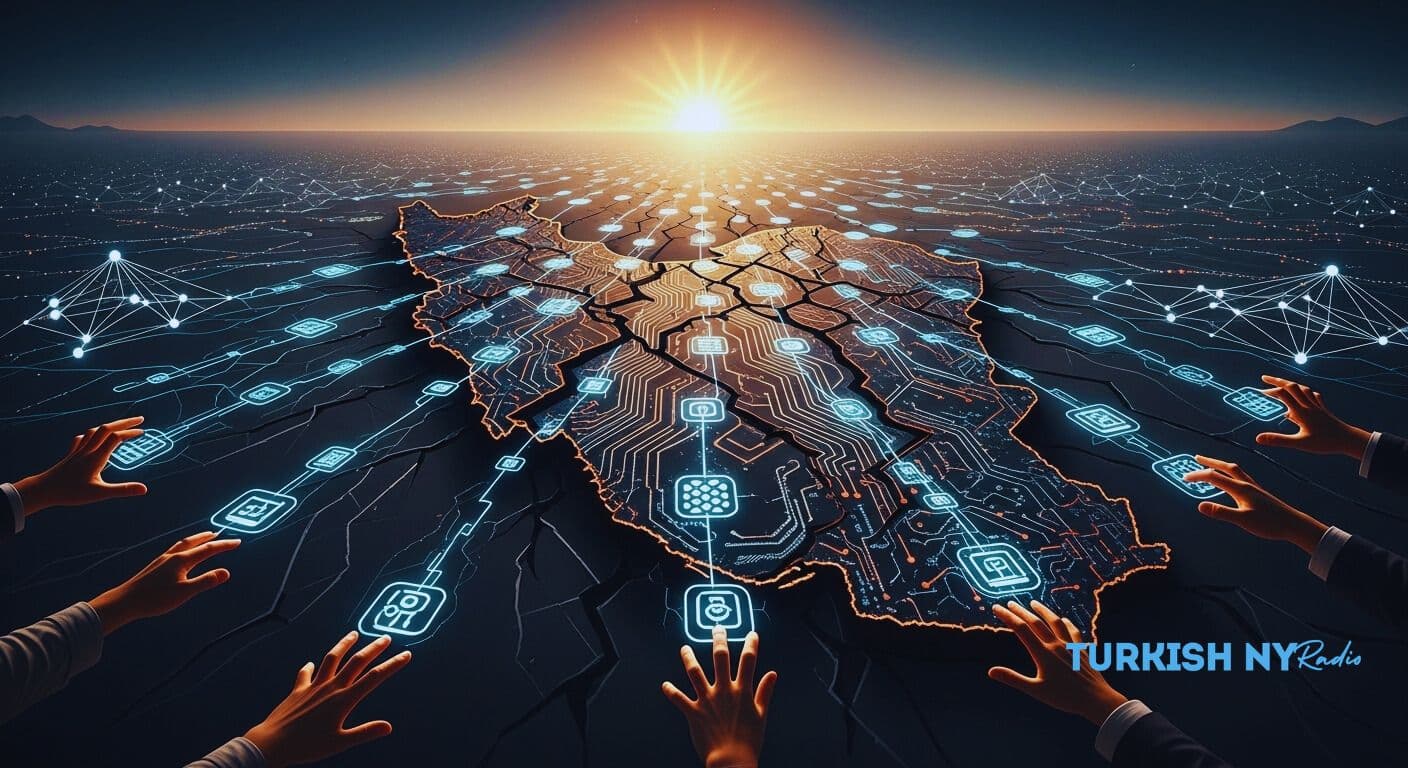
Blockchain financial infrastructure
Iran Crisis Shows Why the Onchain Finance Shift Is Accelerating

Geopolitical Uncertainty Could Accelerate the Onchain Finance Shift

Hougan believes that global crises may further accelerate adoption of blockchain-based financial systems. During uncertain periods, investors often prioritize liquidity and immediate market access.

“The ability to access markets during periods of global disruption is one of crypto’s most powerful structural advantages,”

Hougan noted.

While traditional financial institutions still dominate global markets, analysts increasingly expect blockchain infrastructure to play a larger role in areas such as payments, trading, and asset settlement.

The Onchain Finance Shift therefore represents a longer-term transformation rather than a sudden replacement of existing systems.

Financial institutions, technology firms, and regulators are continuing to evaluate how blockchain technology can integrate with traditional finance.

For now, the recent geopolitical developments have provided another example of how decentralized financial systems function when traditional markets are temporarily unavailable.

As global markets continue to operate across different time zones and political environments, the Onchain Finance Shift is likely to remain a central topic in discussions about the future of financial infrastructure.

Summary

  • Recent tensions involving Iran showed how cryptocurrency markets stay open even when traditional financial markets close for weekends or holidays.
  • Bitwise CIO Matt Hougan said this highlights the growing Onchain Finance Shift, where financial activity gradually moves to blockchain networks.
  • Blockchain systems allow nonstop trading, faster transaction settlement, and transparent records.
  • Analysts believe global uncertainty could speed up blockchain adoption.
  • As a result, crypto markets may increasingly become the first place investors react to major global events.

Glossary of Key Terms

1. Onchain Finance Shift
The move of financial activities like payments, trading, and lending from traditional banks and exchanges to blockchain networks that operate directly online.

2. Blockchain
A digital record system that stores transactions in connected blocks. Think of it as an online ledger where every transaction is recorded and cannot easily be changed.

3. Cryptocurrency Market
Online platforms where people buy and sell digital currencies such as Bitcoin and Ethereum. Unlike stock markets, these markets stay open all day, every day.

4. Decentralization
A system where control is shared across many computers instead of being managed by a single company or authority, similar to how the internet works globally.

5. Transaction Settlement
The step where a financial transfer is fully completed between two parties. On blockchain networks, this often happens much faster than in traditional banking systems.

6. Decentralized Finance (DeFi)
Financial services built on blockchain that allow people to lend, borrow, or trade without needing banks or traditional financial institutions as intermediaries.

7. Smart Contract
A digital agreement stored on a blockchain that automatically carries out actions—such as sending funds—when certain conditions are met.

8. Liquidity
Liquidity describes how easily an asset can be bought or sold. A market with high liquidity means trades happen quickly without causing big price changes.

ADVERTISEMENT

FAQs About Onchain Finance Shift

1. What does the Onchain Finance Shift mean?

The Onchain Finance Shift refers to the growing move of financial activities such as trading, payments, and lending from traditional systems to blockchain networks that operate continuously.

2. Why do crypto markets stay open during global events or crises?

Crypto markets run on decentralized blockchain networks that never shut down. This allows trading to continue 24/7, even when traditional stock or commodity markets are closed.

3. How does the Onchain Finance Shift benefit investors?

It provides faster settlements, constant market access, transparent transaction records, and fewer intermediaries, making financial activity more efficient compared with many traditional systems.

4. Will blockchain finance replace traditional financial systems completely?

Most analysts believe blockchain will work alongside traditional finance. Over time, banks and institutions may adopt blockchain technology to improve payments, trading, and settlement processes.


References

tokenterminal

ethereum

DefiLlama

Tags: 24/7 crypto tradingBlockchain financial infrastructureCrypto markets remain openOnchain Finance Shift
ShareTweetSharePinSend
Previous Post

Australia Digital Finance Could Unlock A$24B, But Only A$1B Realized

Next Post

Prediction Market Prices CLARITY Act 2026 at 72% After Trump Push

Victoria James

Victoria James

I offer insightful, well-researched, and engaging news coverage writing. Helping readers cut through the noise with ideas about market movements, blockchain technologies, regulatory developments, and more.

SIMILAR NEWS

Patrick Witt CLARITY Act
Cryptocurrency

Patrick Witt Questions Why Banks Still Oppose the CLARITY Act

30 July 2026
South Korea stablecoin regulation
World

South Korea’s Crypto Rules Could Change Stablecoins and Taxes

30 July 2026
Apple App Store fake Bitcoin wallet
Cryptocurrency

Apple App Store Fake Bitcoin Wallet Scam Sparks $1.8M Lawsuit

29 July 2026

Leave a Reply Cancel reply

Your email address will not be published. Required fields are marked *

Search

No Result
View All Result
DMCA
PROTECTED

Categories

  • Business
  • Cryptocurrency
  • Economy
  • en
  • News
  • Politics
  • World

Recent Posts

  • Patrick Witt Questions Why Banks Still Oppose the CLARITY Act
  • South Korea’s Crypto Rules Could Change Stablecoins and Taxes
  • Apple App Store Fake Bitcoin Wallet Scam Sparks $1.8M Lawsuit
  • Crypto Clarity Act Delayed as U.S. Senate Shifts Legislative Priorities
  • KB Kookmin Bank Cross-Border Payments Bring 24/7 Global Settlements
TurkishNY Radio

Site Navigation

  • Home
  • About Us
  • Terms and Conditions
  • Privacy Policy
  • Disclaimer
  • Contact

TurkishNY Radio

Banner 1
Banner 2
No Result
View All Result
  • Home
  • Cryptocurrency
  • Business
  • Economy
  • tr Türkçe
  • en English

  • English