![Sun [New]](https://s2.coinmarketcap.com/static/img/coins/64x64/10529.png)



The FDIC stablecoin regulation discussion heated up during the past week as the Federal Deposit Insurance Corporation (FDIC) approved a key proposal under the GENIUS Act that outlined tight control for bank-affiliated stablecoin issuers. The decision is a watershed event in the approach taken by the United States to digital asset stewardship.
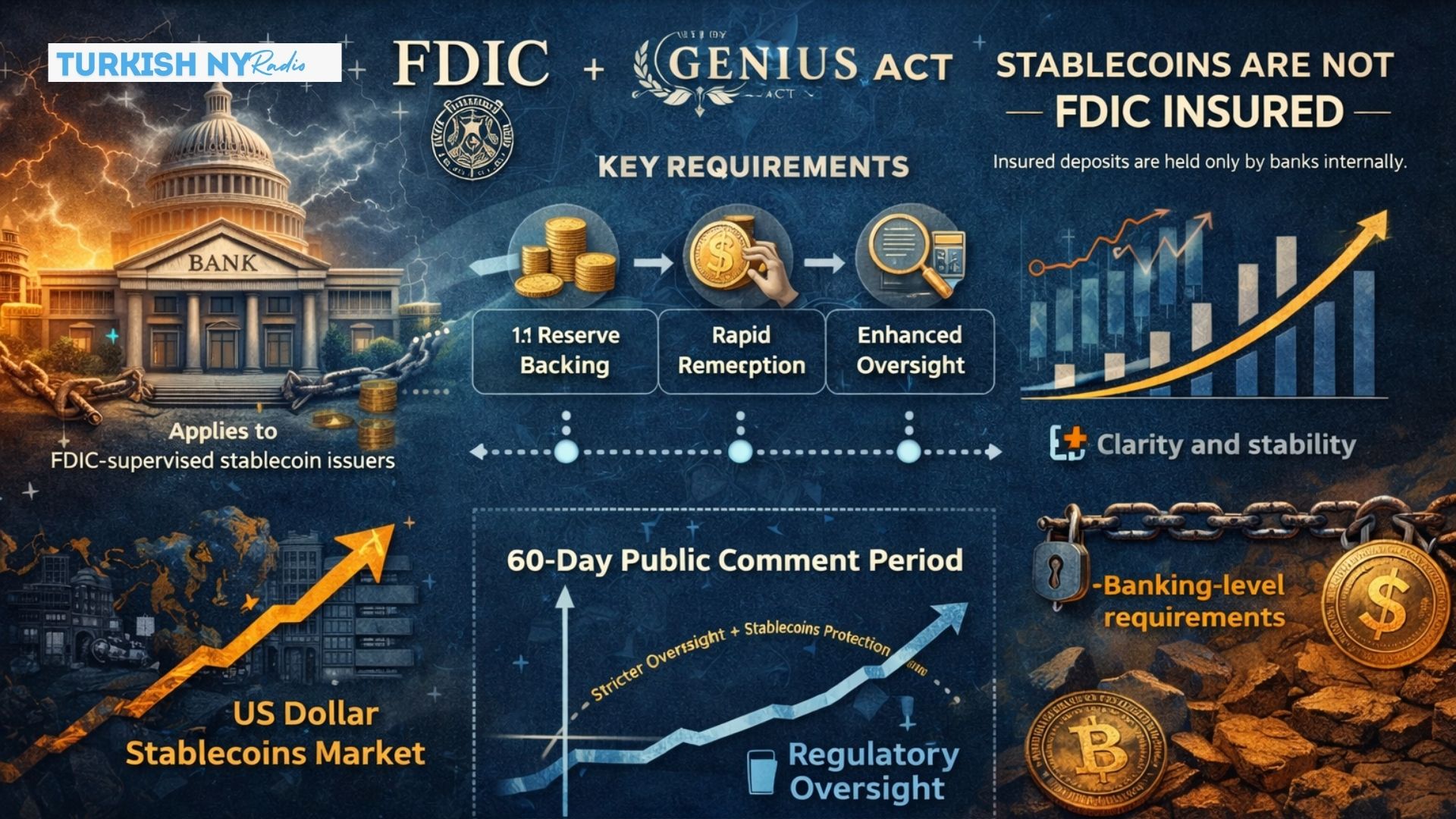
The proposed FDIC stablecoin regulation framework, which includes requirements for 1:1 reserves, speedy redemptions, and strengthened risk controls, has the potential to change how monetary-backed tokens operate in financial institutions.


FDIC Proposal Introduces New Standards
The newly released proposal establishes prudential standards for all FDIC-supervised institutions that issue payment stablecoins. This includes robust capital, liquidity, and operational frameworks.
The proposed FDIC stablecoin regulation requires issuers to keep fully reserved assets equivalent to the amount of the tokens in circulation, ensure that customers may redeem cryptocurrencies for dollars within a couple of working days.
Authorities noted that the GENIUS Act empowers federal financial regulators to develop a single framework for stablecoin monitoring. Accreditation is supposed to lower systemic risks while increasing customer trust.
Clear Distinction on Deposit Insurance
A key part of the FDIC stablecoin regulation clarifies that stablecoin holders themselves are not insured by the FDIC. Only deposits held by issuers inside insured banks are covered, not the digital tokens consumers hold.
“Stablecoins should not be understood as insured deposits under any circumstance,” an FDIC spokesperson said in a briefing. This distinction aims to prevent confusion similar to what occurred during past crypto-market disruptions.
Industry Response and Market Impact
Financial institutions and fintech businesses have had diverse responses. Supporters claim that the FDIC stablecoin regulation provides clarity and credibility to the market, possibly increasing institutional growth.
However, some crypto-native firms say the proposal places banking-level requirements on companies that may not operate like traditional financial institutions.
One industry analyst remarked:
“The FDIC’s framework is strict but predictable. Markets crave stability, and the FDIC stablecoin regulation could ultimately boost trust.”
Digital asset advocates are also watching how the rules interact with non-bank stablecoin issuers, as the GENIUS Act primarily covers entities under federal supervision.
Public Comment Window Opens
The FDIC will seek public input for 60 days. During this time, parties ranging from financial institutions to blockchain developers are asked to provide feedback on how the FDIC stablecoin regulation may effect creativity, competitiveness, and customer access.


Conclusion
The suggested FDIC stablecoin rule is the most complete government framework for overseeing dollar-backed digital resources in the United States. While it increases monitoring and customer safeguards, it also sets additional compliance requirements for issuers.
As officials finalize the FDIC stablecoin regulation, its long-term consequences will be determined by how well it balances innovation and risk management. One thing is certain: the US stablecoin ecosystem is approaching a new phase of regulatory stability.
Summary
The FDIC has made a significant suggestion under the GENIUS Act, which marks a watershed moment in US monitoring of digital currency tokens. The new FDIC stablecoin regulation mandates complete reserve backing, stringent risk management criteria, and two-day redemption periods for FDIC-supervised issuers. It further underlines that owners of stablecoin do not have FDIC insurance. While the initiative intends to improve stability and customer safety, industry opinions have been divided. A 60-day public feedback process will help develop the FDIC’s final stablecoin regulation structure.
Glossary of Key Terms
FDIC: AnUnited States government institution that guarantees bank deposits and supervises financial strength.
Stablecoin: A digital document with a fixed value, typically pegged to the US dollar.
GENIUS Act: A contemporary United States law that establishes a legal structure for payment stablecoin supervision.
Reserve Backing: Refers to assets kept by the issuer to ensure that stablecoins may be exchanged for cash.
Redemption Window: The duration limit for redeeming stablecoins returns to US dollars.
FAQs for FDIC Stablecoin Regulation
1. Were stablecoins now guaranteed by the FDIC?
No, as well as the FDIC stablecoin policy expressly specifies that stablecoin assets are not FDIC insured.
2. What exactly might the GENIUS Act accomplish?
It provides authorities the power to monitor payment stablecoin providers and create prudential guidelines.
3. What is the reason is the FDIC interested with stablecoins?
Banks regulated by the FDIC may produce stablecoins, which need regulation to safeguard customers and the system of finance.
4. How will these laws impact non-bank stablecoin issuers?
By indirect means. The FDIC’s stablecoin law applies to FDIC-supervised banks, although Business procedures may change significantly.
5. Whenever do the new rules take into effect?
The FDIC is accepting public opinions for 60 days. The final rules will be issued following changes.