
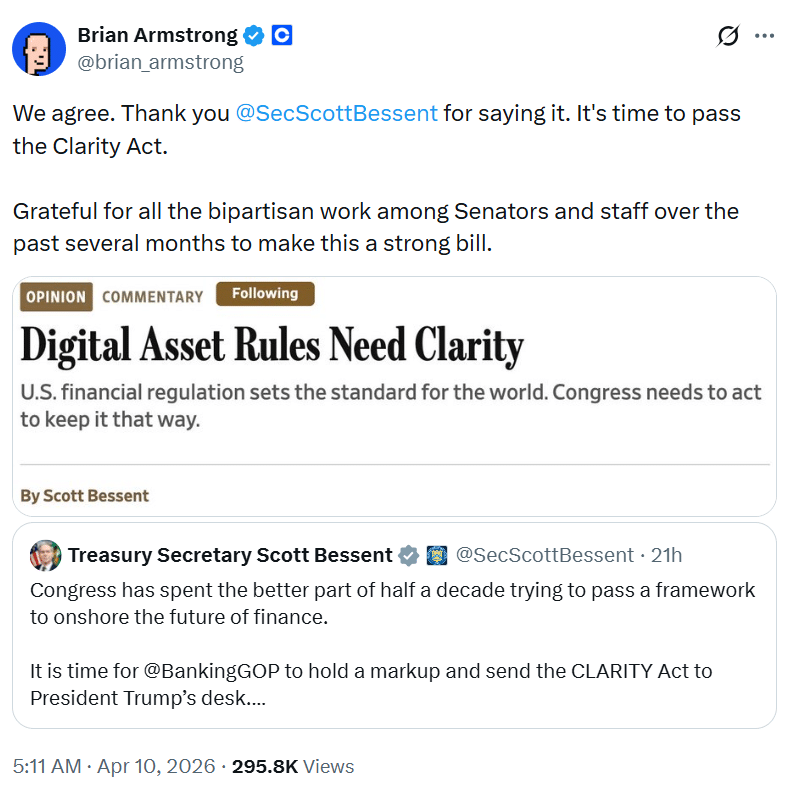
The CLARITY Act received renewed momentum after Coinbase CEO Brian Armstrong publicly endorsed the bill. His support was a major turnaround after months of resistance from one of the crypto industry’s biggest companies.
The timing mattered. Treasury Secretary Scott Bessent had recently implored the Senate to advance the bill, making it more difficult for lawmakers to delay action as the legislative window shrinks.


Armstrong Reversal Gives CLARITY Act New Life
Armstrong’s endorsement changed the mood around the CLARITY Act. Coinbase had lobbied against the bill in the Senate for much of 2026, and it was one of the biggest obstacles to its passage.
The exchange had previously expressed concerns about certain portions of the draft, particularly wording regarding stablecoin rewards. Those concerns had already short-circuited momentum twice this year.
And there was a steady drumbeat of support from Washington. SEC chair Paul Atkins, former White House crypto adviser David Sacks, and many senators were all sugarcoating to get something done in that timeframe.
The CLARITY Act seeks to establish a federal framework for digital asset markets within the U.S. It would also split oversight between the SEC and the CFTC and clear up legal boundaries for the crypto sector.
And that clarity has been one of the industry’s biggest asks. Many companies say that the murky rules have slowed product launches, increased legal risk, and forced innovation out of the United States.
The bill passed the House with bipartisan support in July 2025. But changes made to the text made the Senate version more controversial.
Why Armstrong’s Shift Matters
Armstrong’s support carries weight because Coinbase is not just another crypto firm. It is the largest publicly traded U.S. crypto exchange and one of the industry’s strongest voices in Washington.
When Coinbase withdrew support earlier this year, the bill lost momentum fast. Many in the industry saw that move as a sign that the Senate draft had drifted too far from what crypto companies could accept.
Now the opposite is true. Armstrong’s backing gives the CLARITY Act a much stronger path than it had only weeks ago.
What Triggered the Change
Several factors appear to have pushed Coinbase toward support. One was a stronger political push from the White House and senior regulators.
Bessent argued that the United States cannot afford to fall behind other countries with clearer crypto rules. He linked the bill to competitiveness, national strategy, and long-term financial leadership.
Another factor was the growing sense that time is running out. Lawmakers have warned that if the bill does not advance soon, the 2026 midterm cycle could delay action for much longer.

Stablecoin Rewards Became the Core Fight
The sharpest dispute centered on stablecoin rewards. Coinbase had pushed back against Senate language that could limit how exchanges offer returns or incentives on stablecoin balances.
That issue mattered because stablecoin-related income is important to Coinbase’s business. Any rule that sharply restricts passive yield could force the company to change how it handles parts of its USDC rewards model.
Banks had pushed for tighter restrictions. They argued that crypto platforms should not offer yield-like benefits that could pull deposits away from traditional financial institutions.
Coinbase’s Opposition Shaped the Timeline
The conflict started early in the year. In January, Armstrong said Coinbase could not support the Senate Banking draft as written and listed multiple objections.
He criticized the bill over stablecoin reward limits, DeFi concerns, and what he saw as an imbalance in regulatory authority. His message was blunt and became the defining line of the debate: no bill was better than a bad bill.
That stance helped freeze progress. The Senate Banking Committee postponed its markup, and the CLARITY Act lost the momentum it had built after passing the House.
A Brief Period of Hope Followed
In February, the tone improved for a short time. Armstrong spoke more positively about behind-the-scenes talks and suggested a compromise might still be possible.
That optimism lifted expectations. Some market observers began to believe the bill could pass by the end of April if lawmakers and industry groups settled the stablecoin issue.
But Coinbase did not fully restore support during that period. The company softened its public posture, yet it still stopped short of formally backing the Senate text.
March Brought Another Setback
A revised compromise appeared in March. It aimed to ban passive yield on stablecoin balances while allowing limited activity-based rewards such as promotions or loyalty programs.
Coinbase reviewed that draft and again declined to support it. That second rejection reinforced the view that the stablecoin issue remained unresolved.
The market noticed. Coinbase shares fell, other crypto-linked equities weakened, and frustration spread across parts of the crypto community.
Washington’s Message Turned More Unified
By April, the tone from Washington had become much more coordinated. Bessent called for swift action, and Atkins said regulators were ready to implement market structure rules once Congress moved.
Lawmakers also added pressure. Senator Cynthia Lummis and Senator Bill Hagerty both signaled that April could be the key month for committee action.
That unified messaging mattered. Crypto policy debates in Washington are often fragmented, but this time several major figures appeared aligned around the same goal.
What the Bill Would Actually Do
The CLARITY Act would do more than settle one dispute over stablecoin rewards. It would create a broader structure for how digital assets are regulated in the United States.
It would help define which assets should be treated as securities and which should be treated as commodities. It would also set clearer rules for exchanges, brokers, and other market participants.
That legal certainty is what many firms have wanted for years. Supporters say it would reduce the risk of regulation by enforcement and make it easier for institutions to participate at scale.
What Coinbase Could Lose and Gain
Coinbase still faces trade-offs. If the final bill limits passive stablecoin rewards, the company may need to redesign part of its current offering.
But the company also stands to gain something larger. The CLARITY Act could give Coinbase and the wider industry a federal framework that replaces years of uncertainty with written rules.
That appears to be the new calculation. A compromise bill may now look better than another long cycle of delay, lawsuits, and unclear authority.
What Happens Next
The next step is Senate Banking Committee action. If the bill clears that stage, it would move closer to a full Senate vote, where bipartisan support would still be necessary.
Several issues remain open. Stablecoin reward language, DeFi treatment, token classification, and regulator authority could still shape the final outcome.
The path is clearer than before, but it is not guaranteed. The bill has regained momentum, yet it still needs political discipline and industry alignment to cross the finish line.
Conclusion
The CLARITY Act is back in motion after Brian Armstrong’s sudden reversal. His support removed one of the biggest barriers that had slowed the bill for months. The timing could prove decisive.
If lawmakers act soon, the United States may finally move toward a national crypto market structure law. However, if they do not, the same uncertainty that has defined the sector for years may continue.
Appendix: Glossary of Terms
SEC: short for Securities and Exchange Commission, the federal agency that oversees securities markets.
CFTC: government agency that regulates commodities and derivatives markets
Stablecoin: A cryptocurrency whose value is intended to remain static.
Stablecoin Yield: rewards or returns received for holding stablecoins
Digital Asset: Crypto tokens or coins that are based on blockchain.
Senate Markup: the committee stage, where lawmakers review and make changes to a bill.
Regulation by Enforcement: A policy approach molded around legal actions.
Frequently Asked Questions About CLARITY Act
1- What is the CLARITY Act?
The CLARITY Act is a U.S. crypto market structure bill. It is meant to create clearer federal rules for digital assets and divide oversight between the SEC and CFTC.
2- Why did Brian Armstrong change his position?
Several factors likely influenced the shift. These include growing political pressure, ongoing negotiations, and the risk of missing the current legislative window.
3- Why was Coinbase against the bill before?
Coinbase objected mainly to language tied to stablecoin rewards. The company also raised concerns about DeFi provisions and regulatory balance.
4- Has the CLARITY Act already passed?
The House passed the bill in July 2025. The Senate is still working through its version.
Reference