• Home
  • About Us
  • Terms and Conditions
  • Privacy Policy
  • Disclaimer
  • Contact
12 June Friday, 2026
  • tr Türkçe
  • en English
TurkishNY Radio
No Result
View All Result
  • Home
  • Cryptocurrency
  • Business
  • Economy
  • Home
  • Cryptocurrency
  • Business
  • Economy
No Result
View All Result
  • tr Türkçe
  • en English
TurkishNY Radio
No Result
View All Result
Bitcoin Bitcoin (BTC) $63,618.13 ↑ 0.33%
Ethereum Ethereum (ETH) $1,667.29 ↑ 0.00%
Tether USDt Tether USDt (USDT) $1.00 ↑ 0.05%
BNB BNB (BNB) $604.67 ↑ 0.26%
USDC USDC (USDC) $1.00 ↑ 0.01%
XRP XRP (XRP) $1.14 ↓ -0.27%
Solana Solana (SOL) $67.09 ↑ 0.63%
TRON TRON (TRX) $0.32 ↓ -0.18%
Hyperliquid Hyperliquid (HYPE) $59.19 ↑ 0.44%
Dogecoin Dogecoin (DOGE) $0.09 ↑ 0.43%
UNUS SED LEO UNUS SED LEO (LEO) $9.61 ↑ 1.18%
Zcash Zcash (ZEC) $416.71 ↓ -2.37%
Monero Monero (XMR) $348.68 ↓ -10.48%
Stellar Stellar (XLM) $0.19 ↓ -1.43%
Canton Canton (CC) $0.16 ↓ -0.32%
Cardano Cardano (ADA) $0.17 ↑ 0.68%
Chainlink Chainlink (LINK) $7.90 ↑ 0.26%
Dai Dai (DAI) $1.00 ↑ 0.00%
Toncoin Toncoin (TON) $1.69 ↑ 0.10%
Ethena USDe Ethena USDe (USDe) $1.00 ↑ 0.03%
World Liberty Financial USD World Liberty Financial USD (USD1) $1.00 ↑ 0.18%
Bitcoin Cash Bitcoin Cash (BCH) $202.68 ↓ -1.04%
MemeCore MemeCore (M) $3.06 ↑ 5.09%
Hedera Hedera (HBAR) $0.08 ↓ -1.91%
Litecoin Litecoin (LTC) $43.36 ↑ 2.08%
Sui Sui (SUI) $0.75 ↑ 0.26%
Shiba Inu Shiba Inu (SHIB) $0.00 ↑ 0.75%
Avalanche Avalanche (AVAX) $6.60 ↓ -0.47%
PayPal USD PayPal USD (PYUSD) $1.00 ↑ 0.01%
Cronos Cronos (CRO) $0.06 ↓ -1.60%
Global Dollar Global Dollar (USDG) $1.00 ↑ 0.03%
NEAR Protocol NEAR Protocol (NEAR) $2.01 ↓ -2.01%
Tether Gold Tether Gold (XAUt) $4,200.19 ↑ 0.72%
Bittensor Bittensor (TAO) $213.63 ↑ 0.76%
Audiera Audiera (BEAT) $7.54 ↓ -13.26%
PAX Gold PAX Gold (PAXG) $4,208.47 ↑ 0.65%
World Liberty Financial World Liberty Financial (WLFI) $0.06 ↓ -0.32%
Mantle Mantle (MNT) $0.54 ↓ -0.64%
Ondo Ondo (ONDO) $0.36 ↓ -2.13%
Aster Aster (ASTER) $0.63 ↑ 0.33%
Ripple USD Ripple USD (RLUSD) $1.00 ↓ -0.01%
Polkadot Polkadot (DOT) $0.96 ↑ 1.63%
Worldcoin Worldcoin (WLD) $0.48 ↓ -5.26%
DeXe DeXe (DEXE) $19.29 ↓ -8.70%
Uniswap Uniswap (UNI) $2.50 ↓ -0.07%
OKB OKB (OKB) $74.00 ↑ 2.52%
Pi Pi (PI) $0.13 ↓ -0.20%
USDD USDD (USDD) $1.00 ↑ 0.06%
Internet Computer Internet Computer (ICP) $2.37 ↑ 5.10%
Sky Sky (SKY) $0.06 ↓ -0.84%
Bitget Token Bitget Token (BGB) $1.79 ↑ 1.32%
Pepe Pepe (PEPE) $0.00 ↑ 1.33%
Ethereum Classic Ethereum Classic (ETC) $7.17 ↓ -0.76%
Cosmos Cosmos (ATOM) $2.02 ↑ 1.27%
United Stables United Stables (U) $1.00 ↑ 0.13%
Morpho Morpho (MORPHO) $1.98 ↑ 1.51%
Aave Aave (AAVE) $64.44 ↑ 0.57%
KuCoin Token KuCoin Token (KCS) $6.69 ↓ -0.09%
Render Render (RENDER) $1.68 ↑ 3.14%
Kaspa Kaspa (KAS) $0.03 ↓ -0.11%
Stable Stable (STABLE) $0.04 ↑ 5.49%
Quant Quant (QNT) $66.20 ↓ -5.16%
Polygon (prev. MATIC) Polygon (prev. MATIC) (POL) $0.07 ↑ 0.12%
Algorand Algorand (ALGO) $0.09 ↓ -1.72%
Humanity Humanity (H) $0.26 ↑ 3.47%
Ethena Ethena (ENA) $0.08 ↓ -1.31%
GateToken GateToken (GT) $6.57 ↑ 1.46%
币安人生 币安人生 (币安人生) $0.69 ↑ 3.71%
Venice Token Venice Token (VVV) $14.49 ↓ -1.37%
Flare Flare (FLR) $0.01 ↑ 5.36%
JUST JUST (JST) $0.08 ↑ 1.94%
XDC Network XDC Network (XDC) $0.03 ↓ -1.19%
Filecoin Filecoin (FIL) $0.76 ↑ 0.43%
Midnight Midnight (NIGHT) $0.03 ↑ 5.50%
Jupiter Jupiter (JUP) $0.17 ↑ 3.44%
Aptos Aptos (APT) $0.65 ↑ 0.24%
OFFICIAL TRUMP OFFICIAL TRUMP (TRUMP) $2.25 ↑ 28.87%
Pump.fun Pump.fun (PUMP) $0.00 ↑ 5.12%
Arbitrum Arbitrum (ARB) $0.08 ↑ 1.61%
Nexo Nexo (NEXO) $0.80 ↓ -0.68%
Injective Injective (INJ) $5.14 ↓ -5.07%
TrueUSD TrueUSD (TUSD) $1.00 ↑ 0.00%
PancakeSwap PancakeSwap (CAKE) $1.32 ↓ -0.04%
Dash Dash (DASH) $34.58 ↓ -2.25%
EURC EURC (EURC) $1.16 ↓ -0.05%
VeChain VeChain (VET) $0.01 ↑ 1.84%
Pudgy Penguins Pudgy Penguins (PENGU) $0.01 ↓ -0.40%
Artificial Superintelligence Alliance Artificial Superintelligence Alliance (FET) $0.19 ↓ -1.96%
Terra Classic Terra Classic (LUNC) $0.00 ↑ 3.99%
Stargate Finance Stargate Finance (STG) $0.61 ↑ 4.26%
Virtuals Protocol Virtuals Protocol (VIRTUAL) $0.61 ↑ 4.22%
Bonk Bonk (BONK) $0.00 ↑ 0.08%
Lighter Lighter (LIT) $1.53 ↓ -1.93%
Sei Sei (SEI) $0.05 ↑ 6.19%
Curve DAO Token Curve DAO Token (CRV) $0.24 ↓ -6.60%
Kite Kite (KITE) $0.19 ↑ 2.30%
Aerodrome Finance Aerodrome Finance (AERO) $0.36 ↑ 1.17%
siren siren (SIREN) $0.47 ↓ -18.31%
First Digital USD First Digital USD (FDUSD) $1.00 ↑ 0.07%
Stacks Stacks (STX) $0.18 ↓ -1.08%
Home News

Experts Warn Quantum Computing Could Break Bitcoin’s Encryption

Areeba Rashid by Areeba Rashid
3 November 2025
in News, Cryptocurrency, Economy
Reading Time: 5 mins read
0
Quantum Computing

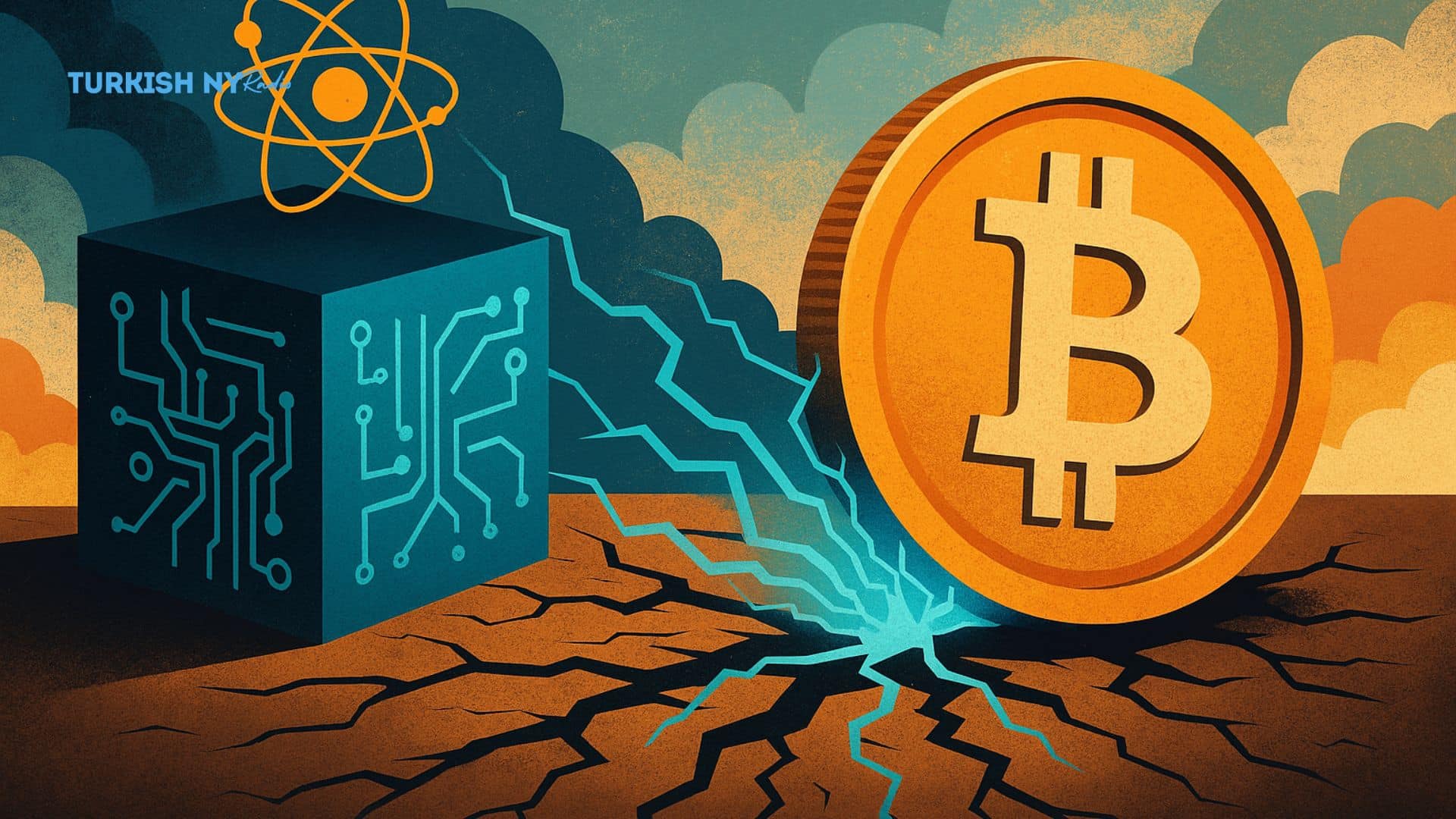
Quantum computing is no longer an abstract theory. It is fast becoming a real risk to global finance. Experts warn that it could break the cryptographic foundations that protect Bitcoin. 

It was once viewed as a distant, futuristic idea. Today, it has become a real threat to digital assets. A report from the Human Rights Foundation (HRF) warns that this technology could disrupt the foundations of cryptocurrency security. 

Table of Contents

Toggle
    • YOU MAY BE INTERESTED
    • Binance Wallet Subscription Draws $557M for Tokenized SpaceX Exposure
    • Onchain Advertising Network From LG and Arbitrum Targets Digital Ad Transparency
  • Quantum Computing Puts Billions in Bitcoin at Stake
  • The Growing Quantum Computing Threat
  • How Quantum Attacks Work
  • Bitcoin’s Upgrade Dilemma
  • Divisions Over the Fix
  • Building Quantum-Resistant Solutions
  • The Global Coordination Challenge
  • Conclusion
  • Appendix: Glossary of Key Terms
  • Frequently Asked Questions Quantum Computing
    • 1- What makes quantum computing dangerous for Bitcoin?
    • 2- How much Bitcoin is in immediate danger due to quantum attacks?
    • 3- What are quantum-resistant addresses?
    • 4- What can users do to protect their coins from quantum attacks?

YOU MAY BE INTERESTED

Tokenized SpaceX shares

Binance Wallet Subscription Draws $557M for Tokenized SpaceX Exposure

12 June 2026
Onchain advertising network

Onchain Advertising Network From LG and Arbitrum Targets Digital Ad Transparency

12 June 2026

Quantum Computing Puts Billions in Bitcoin at Stake

The HRF report clarifies in its own way: Bitcoin is not only an investment. For activists and journalists, who have to live under dictatorial authorities, it is a tool to preserve their money.

This is the only way for them to save up money and make donations without the government’s view.. But it is possible solely thanks to cryptography. Quantum computing technology can overcome such a barrier. So far, up to $690 million of Bitcoin could be stolen.

Also Read: The $100B Bitcoin Mystery: Why Satoshi’s Wallet Still Sleeps

It is the Bitcoin equivalent of about 6.5 million coins. However, it is possible to save about 4,49 million of them. The money moved to the subroutine addresses might indeed be untouchable.

The Growing Quantum Computing Threat

Quantum computing works differently from traditional computing. It uses quantum bits, or qubits, to process massive amounts of data at once. This makes it capable of solving complex problems that would take normal computers centuries. 

Bitcoin’s entire network depends on private and public key cryptography. Quantum computing could, in theory, calculate private keys from public ones. That would allow attackers to steal funds directly.

How Quantum Attacks Work

The HRF report identifies two types of quantum attacks. Long-range attacks target old or reused Bitcoin addresses. These attacks use exposed public keys to recover private keys. Short-range attacks are more dangerous. 

They exploit active transactions, stealing funds before the network confirms them. Both forms could become possible once quantum computing reaches sufficient power.

Bitcoin’s Upgrade Dilemma

Bitcoin’s decentralized nature makes it strong, but also slow to adapt. Unlike centralized systems, Bitcoin cannot issue quick updates. Every change must go through global consensus. That process can take years.

Crypto analyst Nic Carter said that quantum computing is Bitcoin’s biggest threat. He noted that most financial systems could patch their software easily. Bitcoin cannot. Developer Jameson Lopp added that apathy could be an even greater danger. If users ignore the risk, no upgrade will matter.

Divisions Over the Fix

The community is split on how to respond. Some argue that developers should “burn” or freeze coins that are vulnerable. Others say this would violate Bitcoin’s principles of property rights and decentralization. The debate shows how complex this challenge is.

Quantum computing forces Bitcoin to balance between innovation and ideology. Protecting the network may require decisions that go against its founding philosophy of neutrality and freedom.

Building Quantum-Resistant Solutions

Developers are working on new cryptographic systems. The HRF highlights two main solutions: lattice-based and hash-based signatures. Both are designed to resist quantum computing attacks. But they come with trade-offs.

Lattice-based signatures are ten times larger than current ones. Hash-based signatures are even heavier, about 38 times bigger. 

These larger signatures would slow the network, increase blockchain size, and require stronger hardware. That means wallet upgrades, software changes, and retraining for node operators.

The Global Coordination Challenge

Quantum computing will force the Bitcoin ecosystem to cooperate like never before. Developers, miners, wallet makers, and users will need to work together. Even small upgrades in Bitcoin take years to complete. Quantum-proofing the entire network will be a far greater task.

The HRF warns that without global coordination, millions of coins could be lost. Education and outreach are critical. Many holders still don’t know that their coins are vulnerable. The transition to quantum-resistant systems must happen before practical quantum computers arrive.

Quantum computing is advancing faster than many expected. Governments and tech giants are investing billions in its development. The timeline for a functional quantum computer is uncertain, but the risk is real. Every year without preparation increases the danger. Bitcoin’s future depends on proactive defense, not denial.

Conclusion

Quantum computing is both an innovation and a danger. For Bitcoin, it is bound to be an existential threat and a contradiction to the values ​​on which Bitcoin was built. The HRF calls on the planet to act before the late upcoming of the innovative breakthrough. 

Bitcoin preservation needs improved technical measures, client knowledge, and the coming together of its society. Otherwise, the most famous currency on the Earth would be open to a kind of secretive debacle never seen before.

Also Read: Private vs Public Keys in Crypto: Protecting Digital Assets the Right Way

Appendix: Glossary of Key Terms

Quantum Computing – A sophisticated form of computing employing quantum bits to complete tasks at a pace vastly exceeding that of traditional computers.

Cryptography – The science of ensuring digital data via mathematical algorithms, which are used for safeguarding information exchange and transactions.

Quantum Attack – A type of cyberattack that takes advantage of a quantum computer’s ability to crack existing encryption schemes and expose private keys.

Quantum-Resistant Address – A cryptocurrency address that has been created to maintain security even when subjected to a quantum cyberattack.

Long-Range Attack – A quantum-related attack that pursues vulnerable, old, or reused wallet addresses, whose public keys have already been made public.

Frequently Asked Questions Quantum Computing

1- What makes quantum computing dangerous for Bitcoin?

It poses a threat because it can break the cryptographic keys that form the foundation of Bitcoin wallets and transactions.

ADVERTISEMENT

2- How much Bitcoin is in immediate danger due to quantum attacks?

Approximately 6.5 million coins can become vulnerable to quantum attacks.

3- What are quantum-resistant addresses?

The addresses utilize entirely new cryptographic systems that are robust to quantum computing due to the result of quantum safe-cryptography research.

4- What can users do to protect their coins from quantum attacks?

Once quantum safe wallets are available, users are urged to move all their funds to these wallets from old or reused addresses.


Tags: bitcoin cryptography riskbitcoin security riskblockchain vulnerability analysiscrypto security futurecryptocurrency encryption dangerdigital asset protectionquantum attack preventionquantum computing threatquantum resistant blockchain
ShareTweetSharePinSend
Previous Post

US-China Trade Deal Sparks Global Market Rally as Bitcoin Eyes $120K

Next Post

Will the U.S. Send Tomahawks to Ukraine? Trump’s Latest Statement Explained

Areeba Rashid

Areeba Rashid

SIMILAR NEWS

Tokenized SpaceX shares
World

Binance Wallet Subscription Draws $557M for Tokenized SpaceX Exposure

12 June 2026
Onchain advertising network
Cryptocurrency

Onchain Advertising Network From LG and Arbitrum Targets Digital Ad Transparency

12 June 2026
DeFi Stock Trading
World

SEC Tokenized Stocks May Open New Path for Blockchain-Based Equity Trading

12 June 2026

Leave a Reply Cancel reply

Your email address will not be published. Required fields are marked *

Search

No Result
View All Result
DMCA
PROTECTED

Categories

  • Business
  • Cryptocurrency
  • Economy
  • en
  • News
  • Politics
  • World

Recent Posts

  • Binance Wallet Subscription Draws $557M for Tokenized SpaceX Exposure
  • Onchain Advertising Network From LG and Arbitrum Targets Digital Ad Transparency
  • SEC Tokenized Stocks May Open New Path for Blockchain-Based Equity Trading
  • South Korea Crypto Trading Volumes Fall as Investors Rethink Risk
  • MetaMask Agent Wallet Brings AI Agents Into DeFi With User-Controlled Guardrails
TurkishNY Radio

Site Navigation

  • Home
  • About Us
  • Terms and Conditions
  • Privacy Policy
  • Disclaimer
  • Contact

TurkishNY Radio

Banner 1
Banner 2
No Result
View All Result
  • Home
  • Cryptocurrency
  • Business
  • Economy
  • tr Türkçe
  • en English

  • English