Ethereum price has hit a crossroads. After a strong run upward, it now seems to be catching its breath rather than charging onward. The bulls need more than hope, they need a clean breakout above key resistance. The bears, on the other hand, smell opportunity.
As of now, Ethereum price is trading above its short-term moving averages, supported by rising MACD momentum and RSI values over 50, signs that buyers still have life.


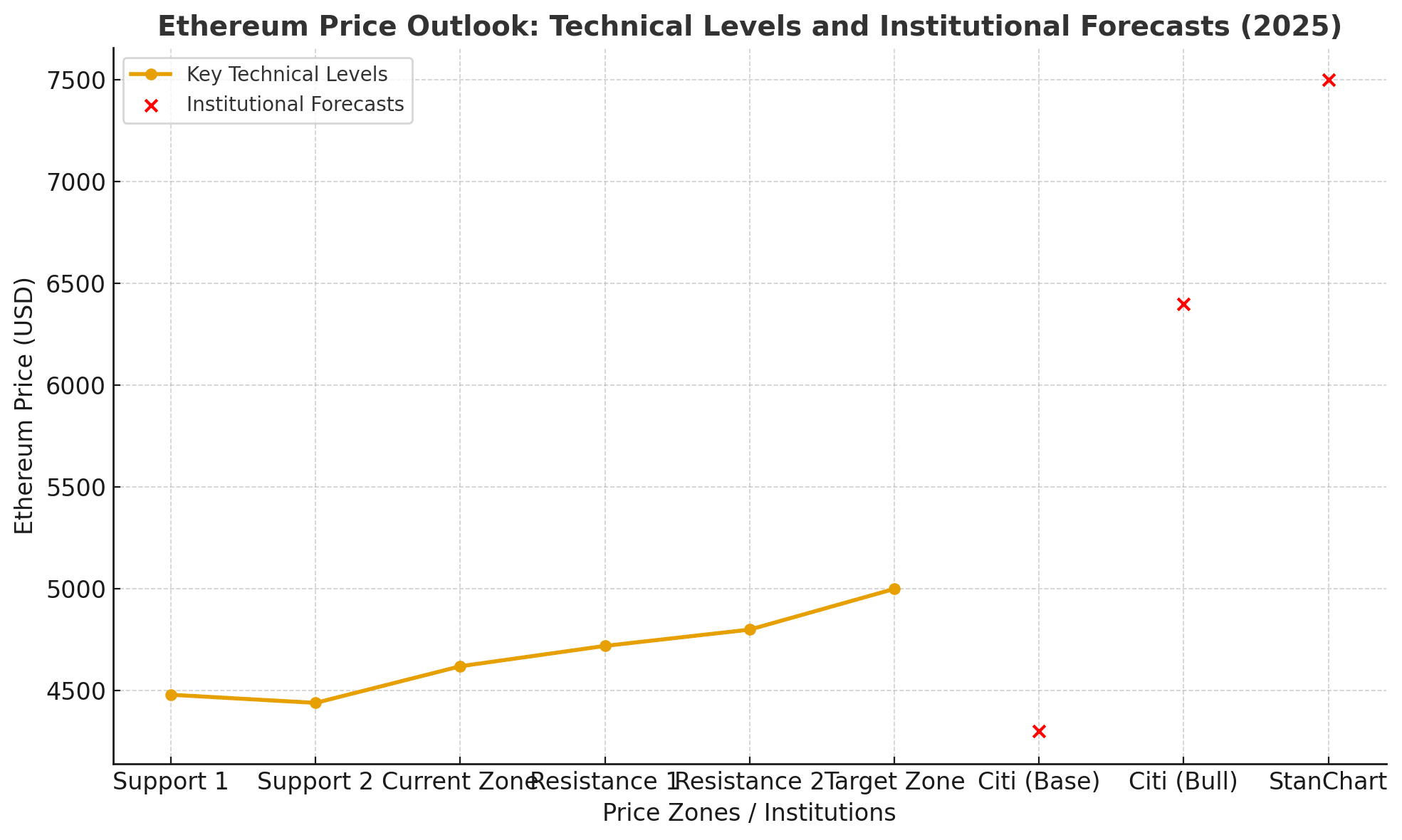
But technicals also show a tight resistance band between $4,560 and $4,620. A decisive break above that would clear the way toward $4,720 or $4,800 territory. Fail that, and the price could slip back toward $4,480, then $4,440, or worse, $4,350.
Seen through wider lenses, the forces tugging on the Ethereum price go far beyond charts. Institutional flows, macro trends, and network activity all play starring roles.
Institutional Forecasts: A Tale of Two Visions
Two major Wall Street names offer narratives as divergent as they are revealing. Citigroup recently raised its year-end target for Ethereum to $4,500, citing inflows from ETFs and digital asset treasuries. (But in earlier forecasts, Citi had flagged $4,300 as a more cautious base case.)
Yet in parallel, Standard Chartered has gone bold: it now projects Ethereum price reaching $7,500 by year-end. The bank argues that institutional demand, growth in stablecoin issuance, and upcoming protocol scaling could push ETH far past previous highs.
In Citigroup’s own notes, its bull case reaches $6,400 if fundamentals catch up with sentiment, while its bearish scenario warns of a crash toward $2,200 in a macro downturn.
Under the Hood: What’s Driving (or Holding Back) the Rally
The story isn’t just candlesticks. Several real-world dynamics are shaping the next chapter of the Ethereum price.
1. ETF and treasury inflows
ETFs have become a powerful narrative in crypto capital markets. Strong inflows into ETH-backed products lend legitimacy and upward pressure. But Citi warns the inflow tailwinds may be weaker than seen in Bitcoin.
2. Network activity vs. sentiment
Citi and others argue Ethereum’s on-chain metrics (gas usage, base layer transfers) must justify its price. They suggest much of the current momentum is sentiment, not usage, a risk if sentiment wavers.


3. Options markets = caution flags
Despite the rally, derivatives data show traders holding back their exuberance. Implied volatility and open interest haven’t blown past historical norms, hinting that many are watching from the sidelines.
4. Whale behavior and supply shifts
Recent whale moves, large ETH transfers, or sales have triggered localized selling pressure. Combined with institutional allocations, these moves underscore a delicate balance between accumulation and profit taking.
What To Watch (Next 48–72 Hours)
-
Volume during any push above $4,620 (a weak breakout is useless).
-
Macro shocks: Fed decisions, dollar strength, bond yields.
-
ETF flow reports and institutional announcements.
-
Behavior around support: losing $4,480 with gusto could invite a slide.
If Ethereum price holds above support and breaks resistance, the path to $5,000 becomes real. If it crumbles, the slide may test mid-$4,000s or worse.
Conclusion
Ethereum price sits at a key inflection point. The charts suggest waiting, not rushing. Institutions paint wildly different futures, Citi leans cautious, Standard Chartered turned bullish. The truth likely lies somewhere in between.
It’s not a bet on magic. It’s a bet on momentum meeting fundamentals. And until that collision happens, every candle counts.
Frequently Asked Questions
Q1: What’s the most important resistance level to watch?
The zone between $4,560 and $4,620 is the gatekeeper. A clean rally above that could ignite further upside.
Q2: Can ETH price fall back sharply now?
Yes. If $4,480 or $4,440 fail as support, the downward momentum could carry ETH toward $4,350 or beyond.
Q3: Why do forecasts differ so dramatically?
Because they rely on different priors: one emphasizes network metrics and risk; the other emphasizes macro flows, legislation, and adoption.
Q4: What technical indicators are most trusted here?
Traders lean on MACD, RSI, volume confirmation, and moving averages (e.g. 100-hour SMA) as guardrails — but none work alone.
Glossary of Key Terms
Resistance: A price level where selling pressure tends to emerge, blocking upward moves.
Support: A price level where buyers tend to step in, cushioning declines.
MACD (Moving Average Convergence Divergence): A momentum indicator that highlights trend strength and reversals.
RSI (Relative Strength Index): A metric showing whether an asset is overbought or oversold.
ETF Inflow: Capital entering an Exchange-Traded Fund tied to an asset, indicating institutional demand.
Whale: A person or entity holding a large amount of cryptocurrency whose moves can sway the market.