![Sun [New]](https://s2.coinmarketcap.com/static/img/coins/64x64/10529.png)



The Ethereum Foundation has come under fresh market focus after selling 3,750 ETH worth about $8.3 million from a planned 5,000 ETH conversion into stablecoins. The funding will go toward research, development, and grants or donations.
Why it matters: The platform is still one of the most scrutinized entities in the crypto space. Its treasury decisions are sometimes interpreted as signals regarding priorities within the Ethereum ecosystem and, at times, on sentiment around ETH itself.


ETH Sale From Ethereum Foundation Coincides With Larger Exodus
On-chain tracker Lookonchain said 3,750 ETH had already been sold at an average of $2,214. The other 1,250 ETH ($2.77 million) is still likely to be converted.
The Ethereum Foundation called the transaction standard treasury management. Even so, major ETH sales linked to the project’s founding institution tend to attract close scrutiny, particularly when those transfers occur amid mixed signals in the market.

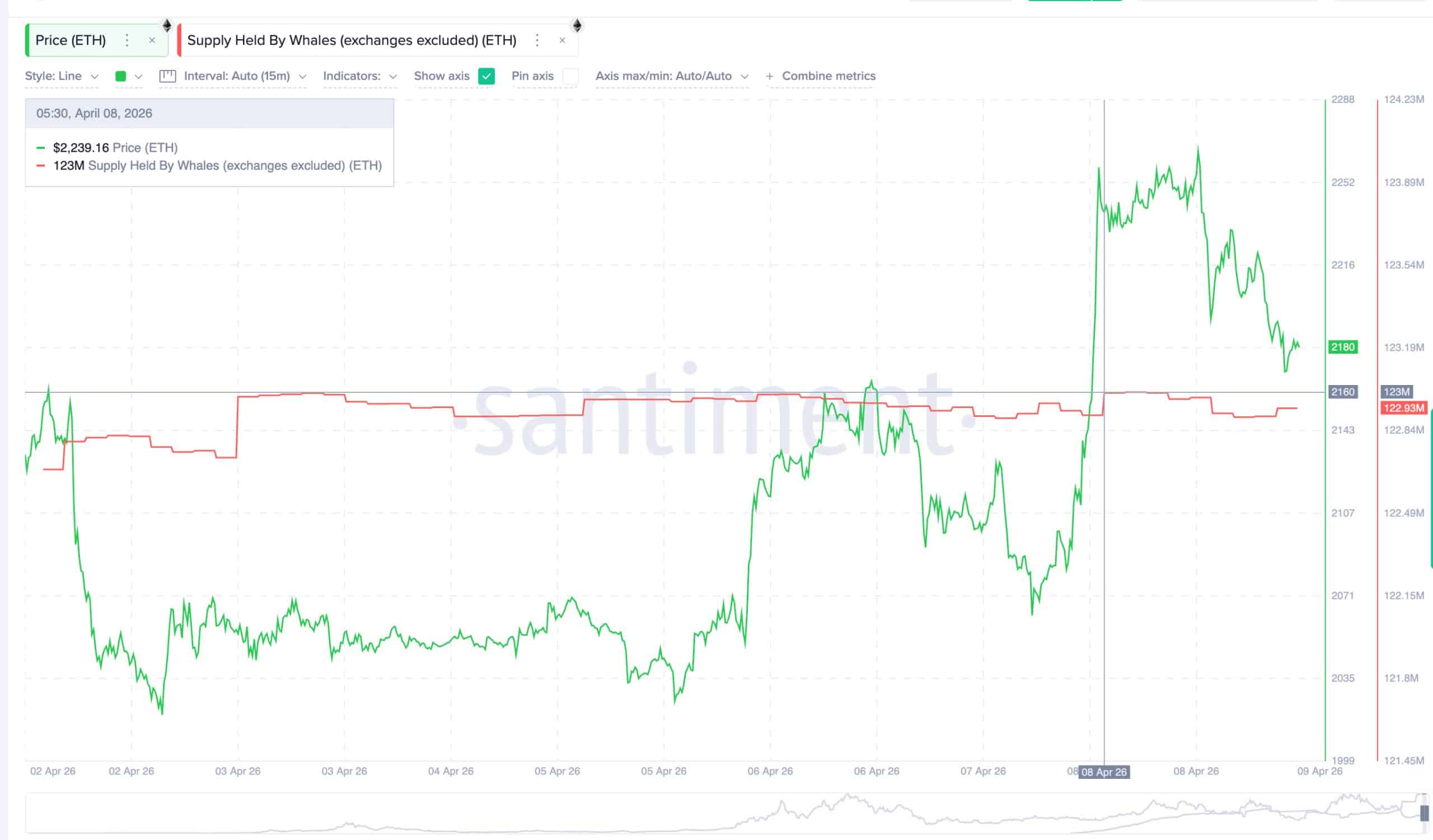
On April 6, US spot ETH ETFs had an influx of 38,769 ETH before reversing the next day with an outflow of 24,311 ETH. At the same time, data from Santiment showed whale-held supply outside exchanges decreasing from roughly 123 million ETH to 122.93 million ETH.
That overlap put the Ethereum Foundation, ETF investors, and large holders all in the same conversation. When numerous large groups cut exposure at such close intervals, traders regard it as more than just another day of treasury activity.
Ethereum Foundation Treasury Move Comes Into Focus
The Ethereum Foundation said the sale was tied to operational funding needs. That includes support for research teams, grants, and donations across the wider ecosystem.
This framing matters. The platform is not a trading desk chasing short-term gains. Its role is to fund work that supports Ethereum’s long-term development, even when market conditions are less favorable.
Market Watches Every Large ETH Sale Closely
Any major transfer linked to the platform tends to attract attention. That is partly because of the group’s standing inside the Ethereum ecosystem and partly because token sales are often read as a sign of caution.
In practice, the picture is more nuanced. Treasury management does not always point to bearish expectations. In many cases, it reflects a need to protect spending plans from price swings.
Stablecoins Offer Budget Certainty
The decision to shift part of the treasury into stablecoins gives the platform more clarity over future spending. That matters for research programs, developer support, and nonprofit initiatives that depend on steady funding.
A treasury held entirely in ETH can rise sharply in value, but it can also fall just as fast. Stablecoins give organizations a more predictable base for budgeting, especially when grants and operations stretch across months or years.
ETF Flow Reversal Added Pressure
The sale also landed during a sharp reversal in ETF activity. After a strong inflow on April 6, US spot ETH ETFs recorded a notable outflow one day later.
That quick swing changed the tone of the market. Institutional demand had looked supportive, then weakened almost immediately. In that setting, the foundation sale drew even more attention than it might have in calmer conditions.
Whale Activity Deepened the Market Debate
Santiment data added another layer. Whale-held ETH outside exchanges declined slightly after peaking near 123 million ETH around April 8.
The drop was not huge on its own, but traders often focus on timing as much as size. With whales trimming holdings near the same window as the foundation sale and ETF outflows, the market saw a broader pattern of reduced exposure.


Why the Sale Does Not Necessarily Signal Weakness
Some traders view any ETH sale by a large holder as bearish. That response is typical in crypto, where optics can move short-term sentiment quickly.
Still, context matters. The platform sale was tied to funding needs, not distress. If the goal is to continue supporting builders and researchers throughout volatile market cycles, converting part of a treasury into stablecoins may be an appropriate action.
Funding Public Goods Remains Central
The platform has consistently played a role by supporting technical research, public goods, and ecosystem growth. Such efforts often need reliable reserves, not speculative exposure.
And that is why this sale might be better construed as a funding decision than as a call on the market. The platform seems to be focused on continuity, enabling mission-critical work to proceed irrespective of near-term ETH volatility.
What the move signals for the broader market
For the wider market, the sale is a reminder that crypto foundations need to balance mission with money. While a sizable token reserve might be appropriate from the perspective of a long-run belief in a network’s success, it becomes risky when expenses should be calculated in stable terms.
The Ethereum is lifting uncertainty around its commitments by converting part of ETH into stablecoins. That might not soothe short-term traders, but it puts the long-term structure around Ethereum development on solid footing.
Conclusion
Ethereum Foundation sale prompts debate due to the fact that it came amid ETF outflows and softer whale positioning. That mix gave cause for concern about supply pressure in the near term.
But the underlying decision seems less a product of panic and more a result of planning. The platform is raising funds for bet, grants, and donations while minimizing exposure to market fluctuations.
Appendix: Glossary of Key Terms
Stablecoins: Digital assets that are aimed at maintaining a stable value.
Treasury management: Managing reserve and operational funds.
ETF flows: Money going in/out of exchange-traded funds
Whales: People or institutions that have a lot of crypto.
On-chain data: When we look at what is happening on the blockchain, specifically in terms of transactions or wallets.
Ecosystem grant: Grants for developers, research, and projects from the base committee.
Frequently Asked Questions About Ethereum Foundation
1- What did the Ethereum Foundation sell?
The Ethereum Foundation sold 3,750 ETH worth about $8.3 million from a planned 5,000 ETH conversion into stablecoins.
2- Why did the Ethereum Foundation sell ETH?
The platform said the funds would support research, development, ecosystem grants, and donations.
3- Is the sale bearish for ETH?
Some traders may see it that way, but the sale was presented as routine treasury management rather than a warning about Ethereum’s outlook.
4- Why convert ETH into stablecoins?
Stablecoins offer more predictable value, which helps with budgeting and long-term funding commitments.