The way Americans interact with money has changed more in ten years than in the previous fifty. Checking a balance, sending a payment or opening an account now happens on a screen, not at a teller window.
At the same time, cryptocurrencies have moved from niche forums into mainstream debate, with banks, regulators and tech firms all testing how far digital assets can fit inside the existing financial system. The U.S. market now sits at a turning point where digital banking is standard, while crypto adoption is real but uneven.


Mobile banking becomes the main front door to money
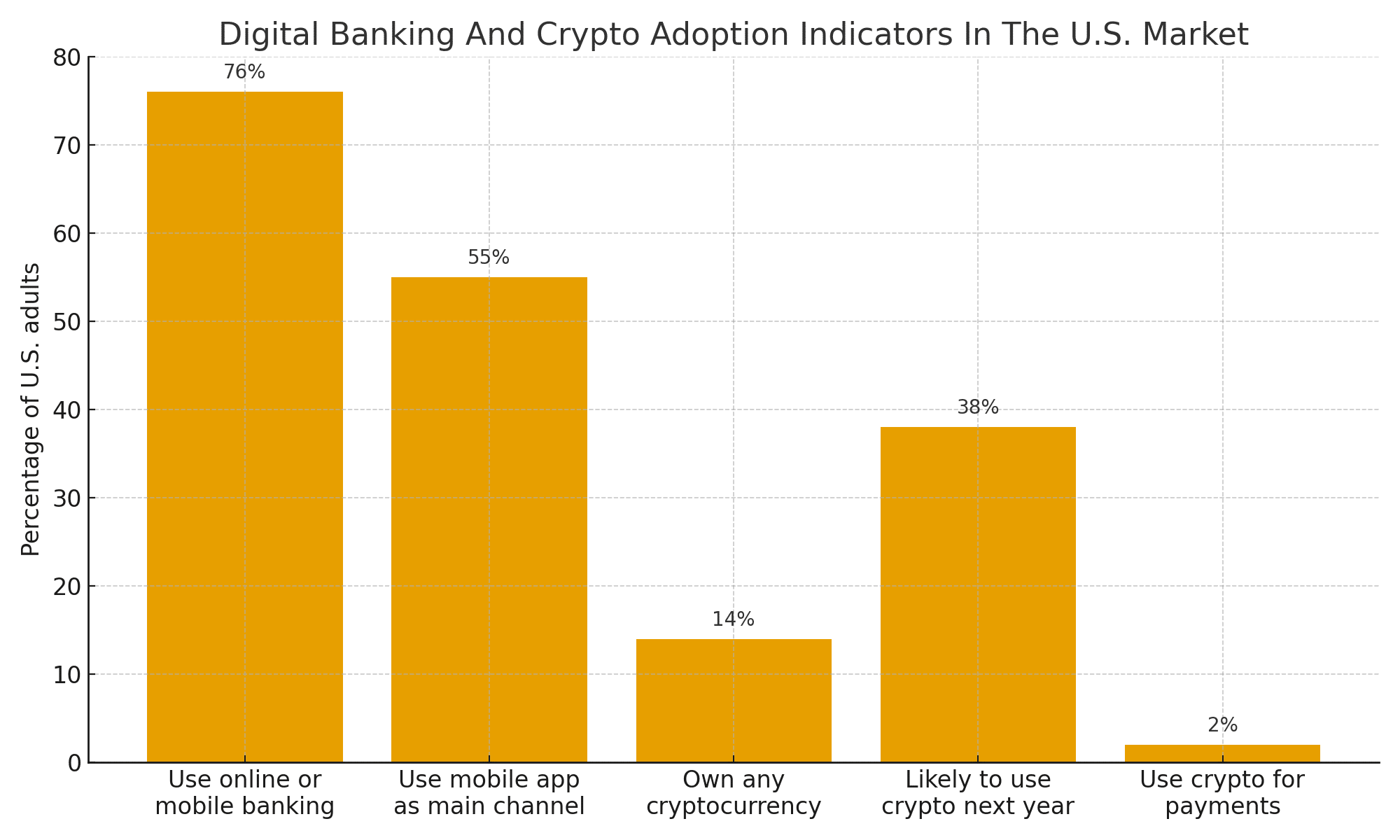
Digital banking is no longer a side channel. A national survey in 2024 found that 55 percent of U.S. bank customers now use mobile apps as their primary way to manage accounts, while 22 percent favor online banking on a computer and fewer than one in ten prefer branches.
Another study estimates that more than 76 percent of people in the United States use online or mobile banking at least once a month, which shows how deeply digital channels have penetrated daily life.
This shift matters for crypto because the smartphone has become the universal financial cockpit. The same device that holds a banking app can also hold a self-custody wallet, a stablecoin balance or a trading app. For younger segments, the divide between “banking app” and “crypto app” often feels like a difference in branding rather than a difference in function.
Crypto ownership grows, but trust gap remains wide
Crypto ownership in the United States remains meaningful but not universal. Recent polling shows that about 14 percent of U.S. adults hold bitcoin or other cryptocurrencies, roughly one in seven people. Younger men remain the most active group, but ownership cuts across age and income brackets.
At the same time, skepticism is still strong. A major 2024 survey found that 63 percent of Americans have little or no confidence that current ways to invest in, trade or use crypto are safe and reliable. Another research set suggests that only around 1.9 percent of respondents actually use crypto to pay for goods and services, with most holders treating it primarily as an investment.
This creates a split picture. Ownership is significant, and curiosity is rising. One longitudinal study reported that up to 38 percent of U.S. adults are at least somewhat likely to use cryptocurrency in the next 12 months, a notable jump from earlier in the year. Yet everyday payment behavior still leans heavily toward cards, bank transfers and digital wallets backed by bank accounts rather than on-chain settlement.
From apps to assets: how U.S. banks are testing crypto rails
As digital banking has matured, traditional institutions have started to experiment with crypto in measured ways. Several large custody and trust banks in the United States now offer secure storage of digital assets for institutional clients, including services tied to spot bitcoin exchange traded products.
A number of large universal banks are exploring or piloting limited crypto services such as custody partnerships, spot trading desks or in-house stablecoins for institutional payments. These banks are moving carefully, encouraged by more favorable signals from policymakers but still wary of compliance and anti money laundering obligations.
On the consumer side, digital only institutions are acting as important bridges. One leading U.S. digital bank does not offer native crypto trading inside its app but allows customers to link accounts easily to major exchanges and to buy regulated crypto investment products, such as exchange traded funds and trusts. This “gateway” model lets banks stay within familiar regulatory lines while acknowledging customer demand for direct exposure.
Stablecoins and tokenization bring crypto inside the system
If mobile banking is the front door, stablecoins and tokenized assets are the plumbing behind it. Dollar backed stablecoins are moving from niche trading tools into serious payment and settlement infrastructure. A 2025 policy shift saw the U.S. Senate approve a comprehensive stablecoin bill with rare bipartisan support, signaling that lawmakers are ready to treat these tokens as part of the regulated financial stack rather than as an outsider product.
At the same time, major financial institutions are piloting tokenization for traditional assets. Large global banks in the U.S. market are working on tokenized money market fund shares, allowing institutional clients to subscribe and redeem through private blockchains that mirror existing record keeping systems. The tokens in these pilots do not yet circulate freely on public networks, but they show how crypto style infrastructure can sit underneath familiar financial products.
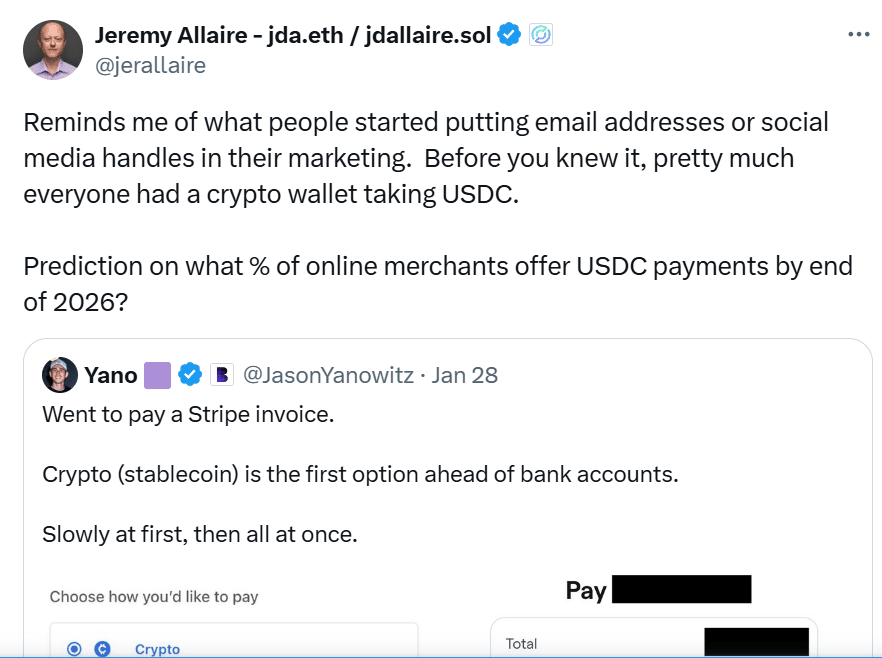
Voices inside the stablecoin industry see this as the start of a deeper integration between banks and chain based money. In one widely shared post on X, a stablecoin issuer chief executive wrote,
“Went to pay a Stripe invoice. Crypto (stablecoin) is the first option ahead of bank accounts. Slowly at first, then all at once.”
That small anecdote captures a larger shift, where stablecoin rails quietly become one of several standard payment choices rather than a novelty.
Key indicators that shape U.S. crypto adoption
Several quantitative signals help explain where the U.S. market stands today. To understand digital banking and crypto adoption, analysts tend to watch six indicators.
The first is digital banking penetration, where mobile and online usage above three-quarters of the population shows that technical barriers are low.
The second is crypto ownership, which sits in the mid-teens as a share of adults, with younger demographics overrepresented.
The third is active usage for payments, which remains very small at under 2 percent for everyday transactions.
The fourth is sentiment and trust. Confidence surveys demonstrate that a majority still worries about safety, even as curiosity about future usage grows.
The fifth indicator is the regulatory pipeline. The creation of a national strategic crypto reserve, bipartisan movement on stablecoins and new guidance that encourages banks to treat digital assets as a strategic opportunity rather than a reputational hazard all point toward a more structured environment.
The sixth is institutional participation. Custody services, tokenization pilots, and bank-backed stablecoin projects show that digital assets are shifting from speculative fringe instruments toward infrastructure components for settlement, liquidity, and collateral.
Together, these indicators tell a story of gradual integration rather than sudden replacement. Crypto is not taking over U.S. banking, but it is starting to rewire parts of it.
Human voices: optimism and caution in the same room
Industry leaders often frame crypto as a natural extension of digital banking. In one recent post, a major U.S. exchange chief executive argued that “many people will use crypto in the next ten years, and some will do so unknowingly,” pointing to wallets and apps that hide blockchain complexity behind familiar user interfaces.
From the policy side, a senior Federal Reserve official recently told a blockchain conference audience that regulators must “work with financial institutions to embrace and shape the evolving financial landscape instead of resisting change,” before warning that authorities who fail to adapt at this moment risk becoming irrelevant.
These remarks highlight the balance that now defines the U.S. discussion. Technology leaders see digital assets as a natural fit for mobile finance. Regulators accept that the genie is out of the bottle but want guardrails around consumer protection, anti-money laundering, and systemic risk. Banks stand between those forces, trying to innovate without stepping outside the supervision perimeter.
What comes next for U.S. digital banking and crypto
In practical terms, the most likely path is not a sudden flip to a crypto-only system. It is a layered structure where:
Bank apps remain the primary interface for most people.
Stablecoins and tokenized assets handle more of the behind-the-scenes movement of value.
Crypto remains a mix of investment product, speculative asset and alternative payment rail, with usage strongest among younger and more digitally confident groups.
Over time, if stablecoin legislation takes full effect and banks receive clearer guidance on custody, capital treatment, and on-chain risk management, more institutions are likely to plug into public or semi-public networks. At that point, consumers may not even notice whether a transaction rides on a traditional payment network or a blockchain-based rail, in the same way that most users today do not know which card network processes a tap-to-pay purchase.
Conclusion
Digital banking in the United States is already mainstream. The majority of consumers now treat mobile apps as the natural way to interact with their money. Crypto adoption, in contrast, is meaningful but still limited, with clear divides between age groups and a lingering trust gap.
However, the lines are starting to blur. Banks are piloting custody and tokenization, stablecoins are moving into regulated territory, and policymakers are slowly building a framework that treats digital assets as part of the financial system rather than as a separate world.
The next chapter of U.S. digital banking is likely to be less about replacing banks with blockchains and more about weaving crypto technology into the fabric of the existing infrastructure, piece by piece.
This article is for information only and does not represent investment, legal or tax advice. Readers should conduct their own research or consult a qualified professional before making financial decisions.


Frequently Asked Questions
Q1: How many Americans actually use digital banking today?
Recent surveys indicate that a clear majority of Americans use online or mobile banking, with over three-quarters accessing their accounts digitally and about 55 percent naming mobile apps as their primary method.
Q2: What share of U.S. adults owns cryptocurrency?
Polling suggests that roughly 14 percent of U.S. adults hold some form of cryptocurrency, such as bitcoin or other digital assets. Ownership is higher among younger adults, particularly men in the 18 to 49 age range.
Q3: Are Americans using crypto mainly for payments or for investment?
Most U.S. crypto users treat digital assets as investments. Studies show that only a small share, around 2 percent, use crypto regularly for everyday payments, while the majority buy or hold it for potential price appreciation.
Q4: How are traditional banks in the United States getting involved with crypto?
Banks are moving carefully. Some custodians now offer secure storage of crypto for institutional clients, others test tokenized funds or stablecoin projects, and several digital-focused banks act as bridges to crypto exchanges and regulated investment products.
Q5: What role do U.S. regulations play in crypto adoption?
Regulation is one of the key drivers. A national stablecoin bill, executive orders on strategic crypto reserves and updated guidance for banks are all helping to clarify rules, which can encourage more responsible innovation. At the same time, strict enforcement around fraud and compliance continues.
Glossary of key terms
Digital banking
Delivery of banking services through online and mobile channels, including balance checks, transfers, bill payments, account opening and sometimes lending, all without visiting a branch.
Tokenization
The process of turning traditional assets, such as money market fund shares or bonds, into digital tokens on a blockchain. These tokens mirror the underlying asset and can make settlement and record keeping more efficient.
Custody
A regulated service in which a financial institution safeguards digital assets on behalf of clients, managing private keys and providing security, reporting and sometimes additional services like staking or connectivity to exchanges.
On-chain payments
Transfers of value that settle directly on a blockchain network, such as sending stablecoins or cryptocurrencies between wallets, as opposed to bank transfers or card network transactions.
Digital wallet
A software application that stores payment information, such as card details or token balances. In crypto, a digital wallet also stores private keys that allow the owner to sign transactions on a blockchain.