This article was first published on TurkishNYR.
Crypto security has emerged as one of the most pressing topics in digital finance as 2026 starts. Billions of dollars were lost globally in the last year alone to wallet breaches, phishing, and intricate cyber hacks.


With more people holding onto crypto for payments, savings, and investment, attackers are also getting more clever, faster, and stealthier.
Meanwhile, crypto wallets are evolving. Hardware wallets now work with multiple blockchains, software wallets now incorporate security features, and new standards are coming on to save users from common mistakes.
But for all that progress, many losses still occur because people pick the wrong wallet or they misunderstand how modern crypto threats work.
Crypto Security Trends and Major Hacks in 2025–2026
The security outlook in 2026 is defined by the explosive hacks of 2025. According to fraud experts, crypto crime reached record levels last year and nation‑state groups (not lone hackers) scarfed down unexpected amounts.
For example, attacks linked to North Korea stole at least $2.02 billion in cryptocurrency in 2025. The largest of such attack involved an exploit of Bybit’s cold wallet ($1.5 billion was stolen).


Overall, Chainalysis tracked more than $3.4 billion stolen from January to early December 2025. Notably, this came from fewer incidents: There were about 200 security events related to crypto in 2025, roughly half as many as the year before but losses per breach on average more than doubled.
Put simply, attackers are honing in on deep liquidity targets like the larger exchanges and institutional wallets, rather than casting their net wide.
Even as large hacks dominated headlines, traditional scams and phishing are still deadly for typical users.
Research revealed that the amount lost to phishing and drain (a method where scammers convince users to drain their wallets themselves) was down 83% in 2025 at $83.9 million due to the mitigation of a downturn in the market for crypto.
But experts caution that as markets recover, hackers are expected to increase targeted phishing once again. Moreover, social engineering schemes are becoming more widespread. Scammers in 2025 posed as recruiters or security experts who tricked developers with fake coding tasks that had hidden trojans stealing keys.
Even hardware wallets are not safe: devices purchased from unauthorized resellers may have already been tampered with to include recovery phrases known by the attacker.
Criminals are weaponizing software supply chains: malware was discovered in popular open‑source repositories and browser extensions harvesting user data and wallet credentials while remaining undetected.
These trends, that is the major state-sponsored thefts and the evolution of scam tactics, tells that crypto security in 2026 demands institutional vigilance and personal paranoia. The stakes are shown by serious incidents such as the Bybit hack and North Korea’s record haul. Yet, even low-level errors can also leave retail users’ savings vanished.
January 2026 saw the hardware wallets maker Ledger confirm that they’d suffered a data breach from a third-party vendor.
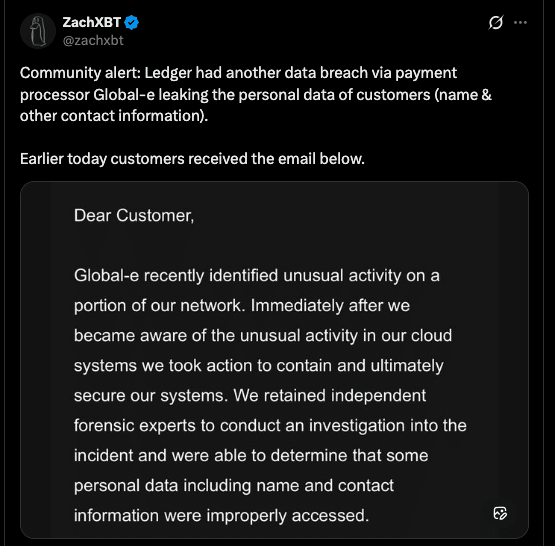
The leak revealed customer names and addresses, but no private keys or seed phrases were taken. Ledger highlighted that, importantly, no payment information had been leaked and crypto assets were safe, but its advice for customers included watching out for phishing efforts that might attempt to snatch recovery phrases.
Selecting a Secure Crypto Wallet
Selecting a wallet is the first line of defense in crypto security. Wallets come in many forms; hardware devices, software applications, browser extensions, offline or brain wallets, and each has trade-offs. It is suggested that users pick based on their security requirements and level of technical comfort.
As the U.S. Securities and Exchange Commission (SEC) details, hot wallets (online) are convenient but put crypto assets at risk to cyber threats, while cold wallets (offline devices such as USB hardware wallets or paper itself) are typically more secure from cyber threats. In essence, this equates to: keep vast amounts in cold storage; maintain only small spendable amounts (enough for operating) in hot wallets.
Cold Wallets (Hardware/Paper): These are made to be offline. Hardware wallets (e.g. Ledger, Trezor, or mobile secure-key devices) keep your private keys in a secure chip. They reduce exposure to internet attacks.
Paper or metal backups of seed phrases also qualify as forms of cold storage (with no electronic footprint). The disadvantage is that it offers less convenience. In order to spend cryptos, users would either have to plug the device (or type back the seed).
However, there’s a tangible risk, too. Devices can be lost, destroyed or stolen. An important tip too is : never to buy hardware wallets from anywhere but the manufacturer, or an authorized reseller as some scammers try to sell fake or tampered devices that let out users keys.
Hot Wallets (Software/Online): Software wallets can refer to mobile applications, desktop clients, or browser extensions such as MetaMask. They are user-friendly and provide an easy and fast way to transact, but they operate on internet-connected devices and thus are subject to malware, spyware, and fraudulent web pages.
For instance, in the latter part of 2025, a malicious update for the Trust Wallet Chrome extension secretly collected users’ decrypted mnemonic phrases and sent them to attackers.
Trust Wallet quickly put out a fix and reimbursed the victims, but the incident served as a reminder that even official wallet software can be backdoored via supply-chain attack.
Generally, hot wallets should be reserved for small/short-term amounts, users must keep the software up to date and verify all transactions.
Custodial vs Self-Custody: In self-custody, users control their private keys (through any of the wallets listed above) and are completely responsible for their safekeeping. This provides maximum autonomy and privacy, but also maximum risk. If users lose their keys or fall for a scam, there’s no bank to bail one out. Custodial wallets (such as exchange or institutional custody accounts), on the other hand, hold the keys for users.
This is more beginner-friendly and has some recovery options, but comes with counterparty risk. If the exchange is compromised or shuts down, users could lose funds . It is advised to always research custodians’ reputation and regulations, and ensure any custodial account uses strong security (like cold storage reserves and insurance)
The following table presents a brief overview of the main wallet types:
| Wallet Type | Description | Security Level | Best Use Case |
| Hardware Wallet | Physical device (USB), keys offline | Very High | Long-term storage of large assets |
| Software Wallet | Mobile/Desktop app, keys on device | Medium (vulnerable to malware/phishing) | Day-to-day transactions, small balances |
| Web/Browser Wallet | Browser extension (e.g. Metamask) | Low-Medium (target for malicious extensions) | Active trading, DeFi interactions |
| Custodial (Exchange) | Keys held by service (Binance, Coinbase, etc.) | Low (depends on provider) | Quick fiat ramps, beginners |
| Paper/Metal Backup | Printed or inscribed seed phrase | High (no electronic risk) | Emergency backup, ultra-long-term storage |
| Multi-Signature (M-of-N) | Requires multiple approvals | Very High (mitigates single point failure) | Organizational funds, maximal security |
Whichever wallet users opt for, these are the security guidelines to observe:
-Create a strong and unique password
-Enable two-factor authentication (2FA) on all accounts where available
-Review updates to firmware or software settings as they’re offered to users
-Back up seed phrases safely (offline) but never share them.
-Only download wallet software from an official source, and double-check the URL before entering any keys or passwords.
Standard Cyber Threats to Crypto Wallets
Cyber attackers continue to invent new tricks and users need to be kept abreast of the newest threats in crypto. Here are the top risks in 2026:
Phishing and Social Engineering: These remain the major threat for individual crypto holders. Scammers do so by sending fake emails, texts or social media messages that impersonate wallet providers, exchanges or even a hiring manager.
They may try to tempt users with a fake “wallet upgrade” site that will steal users’ keys, or solicit fake investment opportunities. Tactics such as fake job interviews where attackers pretend to want to hire developers, and get them to run malicious code that steals private keys.
Malicious Browser Extensions and Software: As demonstrated with Trust Wallet, threat actors have the capability to embed malicious software into wallet-themed apps. A backdoor in the official Trust Wallet Chrome extension (version 2.68) that stealthily prompted users, one-by-one, asking each to type out their mnemonic seeds (never trust a program that asks for your mnemonic seed), which were then promptly exfiltrated to an attacker’s server.
This $7M hack (quickly fixed) is a reminder that official channels can be compromised via stolen developer credentials.
Supply-Chain and Open-Source Attacks: Developers are prime victims. The Shai-Hulud incident is a case study in how simple it is for attackers to weaponize the software supply chain. In December 2025, hundreds of npm packages got implanted with Shai-Hulud malware which compromised up to 400k development credentials (tokens, keys etc.).
Any developer they compromise can then insert backdoors into widely used code, which in turn impacts a massive number of users. To cover oneself, keep to well-reviewed wallet stacks, and for developers, enforce good security in the build process. On the user side, always check the checksums of important wallet software when available.
Hardware and Device Attacks: Although hardware wallets are designed to be secure, there are risks. Beware of counterfeit or tampered devices from gray markets (some have had pre-configured keys known to attackers).
Only unbox and initialize new hardware in isolation to be certain the seed isn’t pre-loaded. Keep wallet firmware updated, because even hardware can have bugs. Additionally, attackers could try USB-based attacks or tinker with the supply chain, so only buy from trusted suppliers.
State-Sponsored and Organized Attacks: The largest thefts are frequently the handiwork of professional attackers. North Korean cyberthieves are said to infiltrate companies, hack exchanges and rob on a large scale. This means that even the biggest platforms should presume they can be attacked.
This is also a reminder for holders to diversify (not keep all coins at one service or platform) and not over-extend oneself to any one counterparty.
Malware and Computer Viruses: General-purpose malware can still drain wallets. There have been strains of malware, sometimes called “wallet stealers, that quietly skim a user’s browser or computer to obtain information about cryptocurrency wallets and private keys.
They could also intercept clipboard addresses so used send money to a hacker’s address. Regular antivirus measures and avoiding pirated software could help with this. In 2025, however, there were reports of SantaStealer malware that goes after browser-stored crypto information. Users need to be cautious with emailed attachments and downloading files.
Blockchain and DeFi Hacks: Besides personal wallets, vulnerabilities in smart contracts and decentralized finance protocols remain a threat. While this is not a direct wallet hack, breaking through a DeFi contract can effectively zero out funds that users put into it.
Stay updated about any known platform vulnerabilities and keep an eye out for connecting wallets with unknown dApps or signing complex transactions.
How to Keep Your Crypto Safe in 2026
With those threats in mind, here are a few central recommendations for securing crypto by 2026:
Employ Hardware for Savings: Store the bulk of your savings (non-spendable) storage on hardware wallet and practically keep keys off any network. Transfer money to hot wallets only when needed.
Turn on 2FA and Strong Authentication: For any kind of account (exchanges, wallets, email), require two-factor authentication (2FA) and strong unique passwords. Use hardware security keys (U2F) if available instead of SMS for increased security.
Stay informed and be vigilant: Update wallet software and hardware firmware on a regular basis. Look out for crypto news on security alerts about your wallet or exchange.
Verify everything: Verify URLs and domain names twice before visiting wallets or exchanges. Be wary of urgent messages in phishing emails. Avoid clicking unsolicited links that require one to log in or sign a transaction. When in doubt, visit the official site directly.
Secure Your Seed Phrases: Write your seed phrase down on metal or paper and lay it somewhere safe (like a home safe or safety deposit).
Limit Third Party Access: Give as little permission to platforms (and by extension, any third parties that platform is connected too) as possible. Revoke approvals for the old or unused contracts.
Monitor Addresses: For extra security, one can divide funds across multiple wallets. That means, even if one gets compromised, not everything is lost. There are also services that monitor users addresses and notify if anything nefarious occurs.
Be Cautious of New Tech: New wallet architectures (such as MPC wallets or social-recovery wallets) claim to offer more convenience. Always look up their record of security. It’s not always the case that new is safe, and proprietary systems may have hidden vulnerabilities.
With a combination of secure wallet options and heightened vigilance, users can greatly minimize your chances of getting roped in to crypto theft.
Crypto security is a moving target; whatever worked in 2020 probably won’t be good enough in 2026, so it is important to keep learning about new threats and defenses.
Conclusion
Crypto security in 2026 hinges on smart wallet selection and awareness of evolving threats. Last year’s massive hacks and scams prove that protecting one’s assets begins with knowing what wallet strategy to deploy and best practices like seed backup and 2FA.
At the same time, users can fall victim to sophisticated digital threats from supply-chain backdoors in wallet software to highly coordinated heists organized by nation‑state actors.
By staying informed, keeping defenses updated and not sharing private keys, users can at least try to negotiate this treacherous environment a little more safely.
Remember, no technical measure is pure foolproof; a combination of technical security (hardware wallets, encrypted backups) and common awareness(phishing awareness, vetted vendors) is the best overall approach to protecting crypto assets.
Glossary
Private Key: A secret code that allows a crypto wallet to be opened. Grant you something, just be sure that it does not get lost or all your funds will be gone.
Seed Phrase (Mnemonic): a backup of user’s private key that can be written down as easily-readable words, typically 12–24 words.
Hot Wallet: A wallet, (app or online) that’s connected to the internet.
Cold Wallet (Cold Storage): A wallet or backup not connected to the internet (hardware/paper).
Custodial Wallet: A wallet service (frequently an exchange or broker) where users do not control their private keys. More beginner-friendly, but requires some trust in the custodian.
Phishing: A type of social engineering attack in which a fraudster deceives you into disclosing valuable information (such as seed phrases), often by posing as trustworthy parties. Like fake wallet upgrade emails.
Multi-Signature (M-of-N): A wallet that needs N private keys to be signed (from different devices or individuals) in order to send a transaction.
Frequently Asked Questions About Crypto Security in 2026
What is the safest type of crypto wallet?
For long-term holding of the cryptocurrency, hardware wallets(cold storage) are the best. They store the private keys on secure hardware offline, so it’s nearly impossible to hack remotely. Also the multi-signature wallets (requiring multiple authorizations) provide very strong protection for big amounts.
How to secure a software/web wallet?
Use a security wallet app, keep it updated and use all the security features (passwords, 2FA). Install browser extensions only from the official store and keep browser up to date. Be careful of phishing links: Always check the domain name is correct before submitting keys or confirming transactions.
Is it impossible to steal/hack hardware wallets?
Hardware wallets dramatically lower that risk, though they are not infallible. One has to buy them from official sources to avoid tampering, boot them securely, update firmware. Safeguard the recovery seed offline, as well: If someone else gets hold of a user’s seed phrase, they can run off with their crypto without breaking into the device at all.
What is the safest way to store my seed phrase?
If a hardware wallet has not solved this problem, users need to write the seed phrase on paper or a metal backup and store it in an extremely secure location (e.g. home safe, bank vault). Do not keep a digital copy of it (cloud, email, picture).