
• Home
  • About Us
  • Terms and Conditions
  • Privacy Policy
  • Disclaimer
  • Contact
27 January Tuesday, 2026
  • tr Türkçe
  • en English
TurkishNY Radio
No Result
View All Result
  • Home
  • Cryptocurrency
  • Business
  • Economy
  • Home
  • Cryptocurrency
  • Business
  • Economy
No Result
View All Result
  • tr Türkçe
  • en English
TurkishNY Radio
No Result
View All Result
Bitcoin Bitcoin (BTC) $95,261.57 ↓ -0.05%
Ethereum Ethereum (ETH) $3,288.55 ↓ -0.06%
Tether USDt Tether USDt (USDT) $1.00 ↓ 0.00%
BNB BNB (BNB) $936.88 ↑ 0.81%
XRP XRP (XRP) $2.06 ↓ -0.16%
Solana Solana (SOL) $143.94 ↑ 1.52%
USDC USDC (USDC) $1.00 ↑ 0.01%
TRON TRON (TRX) $0.31 ↑ 0.69%
Dogecoin Dogecoin (DOGE) $0.14 ↓ -1.31%
Cardano Cardano (ADA) $0.40 ↑ 1.28%
Bitcoin Cash Bitcoin Cash (BCH) $592.58 ↑ 0.05%
Monero Monero (XMR) $626.65 ↓ -8.54%
Chainlink Chainlink (LINK) $13.72 ↑ 0.24%
UNUS SED LEO UNUS SED LEO (LEO) $9.06 ↑ 1.81%
Hyperliquid Hyperliquid (HYPE) $24.83 ↑ 0.87%
Stellar Stellar (XLM) $0.23 ↓ -0.45%
Sui Sui (SUI) $1.79 ↑ 1.00%
Zcash Zcash (ZEC) $405.35 ↑ 0.15%
Ethena USDe Ethena USDe (USDe) $1.00 ↑ 0.01%
Avalanche Avalanche (AVAX) $13.56 ↓ -1.36%
Litecoin Litecoin (LTC) $74.59 ↑ 3.87%
Dai Dai (DAI) $1.00 ↑ 0.01%
Hedera Hedera (HBAR) $0.12 ↑ 1.10%
Shiba Inu Shiba Inu (SHIB) $0.00 ↑ 1.59%
Canton Canton (CC) $0.13 ↓ -4.54%
World Liberty Financial World Liberty Financial (WLFI) $0.17 ↑ 1.92%
Toncoin Toncoin (TON) $1.71 ↓ -0.15%
Cronos Cronos (CRO) $0.10 ↑ 1.09%
PayPal USD PayPal USD (PYUSD) $1.00 ↓ -0.02%
Polkadot Polkadot (DOT) $2.13 ↑ 1.14%
World Liberty Financial USD World Liberty Financial USD (USD1) $1.00 ↓ -0.02%
Uniswap Uniswap (UNI) $5.35 ↑ 1.09%
Mantle Mantle (MNT) $0.95 ↑ 0.75%
Bittensor Bittensor (TAO) $275.98 ↓ -0.05%
Aave Aave (AAVE) $175.26 ↑ 2.58%
Bitget Token Bitget Token (BGB) $3.78 ↑ 0.56%
Pepe Pepe (PEPE) $0.00 ↑ 0.89%
OKB OKB (OKB) $114.57 ↑ 0.43%
Internet Computer Internet Computer (ICP) $4.12 ↓ -6.23%
NEAR Protocol NEAR Protocol (NEAR) $1.74 ↑ 1.23%
Ethereum Classic Ethereum Classic (ETC) $12.84 ↑ 2.02%
MemeCore MemeCore (M) $1.58 ↓ -3.37%
Tether Gold Tether Gold (XAUt) $4,594.44 ↑ 0.05%
Aster Aster (ASTER) $0.72 ↑ 1.46%
PAX Gold PAX Gold (PAXG) $4,608.64 ↓ -0.01%
Ethena Ethena (ENA) $0.22 ↓ -0.72%
Pi Pi (PI) $0.21 ↑ 0.51%
Global Dollar Global Dollar (USDG) $1.00 ↓ 0.00%
Polygon (prev. MATIC) Polygon (prev. MATIC) (POL) $0.15 ↓ -1.49%
Worldcoin Worldcoin (WLD) $0.56 ↓ -0.49%
KuCoin Token KuCoin Token (KCS) $11.43 ↓ -0.40%
Sky Sky (SKY) $0.06 ↑ 6.41%
Aptos Aptos (APT) $1.82 ↑ 1.68%
MYX Finance MYX Finance (MYX) $5.42 ↓ -1.28%
Ripple USD Ripple USD (RLUSD) $1.00 ↓ -0.03%
Cosmos Cosmos (ATOM) $2.53 ↑ 2.55%
Arbitrum Arbitrum (ARB) $0.21 ↑ 1.87%
Ondo Ondo (ONDO) $0.39 ↑ 2.39%
Kaspa Kaspa (KAS) $0.04 ↓ -1.67%
GateToken GateToken (GT) $10.39 ↑ 0.40%
Render Render (RENDER) $2.29 ↑ 4.64%
Algorand Algorand (ALGO) $0.13 ↑ 3.22%
Filecoin Filecoin (FIL) $1.52 ↓ -0.86%
OFFICIAL TRUMP OFFICIAL TRUMP (TRUMP) $5.38 ↑ 0.89%
Midnight Midnight (NIGHT) $0.06 ↓ -1.51%
Pump.fun Pump.fun (PUMP) $0.00 ↑ 2.40%
Dash Dash (DASH) $82.13 ↓ -12.23%
VeChain VeChain (VET) $0.01 ↑ 3.78%
Quant Quant (QNT) $80.61 ↑ 9.51%
USDD USDD (USDD) $1.00 ↓ -0.01%
Story Story (IP) $2.71 ↑ 8.86%
Bonk Bonk (BONK) $0.00 ↑ 1.69%
Flare Flare (FLR) $0.01 ↓ -0.44%
XDC Network XDC Network (XDC) $0.04 ↓ -0.86%
Sei Sei (SEI) $0.12 ↓ -0.18%
Pudgy Penguins Pudgy Penguins (PENGU) $0.01 ↑ 1.88%
PancakeSwap PancakeSwap (CAKE) $2.12 ↑ 4.44%
Jupiter Jupiter (JUP) $0.22 ↑ 2.98%
Stacks Stacks (STX) $0.37 ↑ 1.60%
Optimism Optimism (OP) $0.34 ↑ 1.48%
Tezos Tezos (XTZ) $0.62 ↑ 6.97%
Virtuals Protocol Virtuals Protocol (VIRTUAL) $0.98 ↓ -0.27%
Artificial Superintelligence Alliance Artificial Superintelligence Alliance (FET) $0.28 ↑ 2.33%
Nexo Nexo (NEXO) $0.99 ↑ 2.86%
Curve DAO Token Curve DAO Token (CRV) $0.44 ↑ 2.45%
Chiliz Chiliz (CHZ) $0.06 ↓ -1.33%
United Stables United Stables (U) $1.00 ↑ 0.01%
Immutable Immutable (IMX) $0.29 ↑ 7.58%
Injective Injective (INJ) $5.40 ↑ 4.75%
SPX6900 SPX6900 (SPX) $0.57 ↑ 1.57%
ether.fi ether.fi (ETHFI) $0.75 ↑ 1.08%
Lido DAO Lido DAO (LDO) $0.61 ↓ -0.98%
Aerodrome Finance Aerodrome Finance (AERO) $0.56 ↑ 0.70%
Celestia Celestia (TIA) $0.59 ↑ 5.79%
Morpho Morpho (MORPHO) $1.34 ↓ -2.60%
First Digital USD First Digital USD (FDUSD) $1.00 ↑ 0.04%
TrueUSD TrueUSD (TUSD) $1.00 ↓ -0.04%
FLOKI FLOKI (FLOKI) $0.00 ↑ 2.67%
DoubleZero DoubleZero (2Z) $0.14 ↑ 10.97%
The Graph The Graph (GRT) $0.04 ↑ 7.19%
Home Cryptocurrency

Could Greenland Become a U.S. Bitcoin Mining Hub? Trump Suggests 10,000 EH/s Potential

Victoria James by Victoria James
9 January 2026
in Cryptocurrency, Economy, News
Reading Time: 5 mins read
0
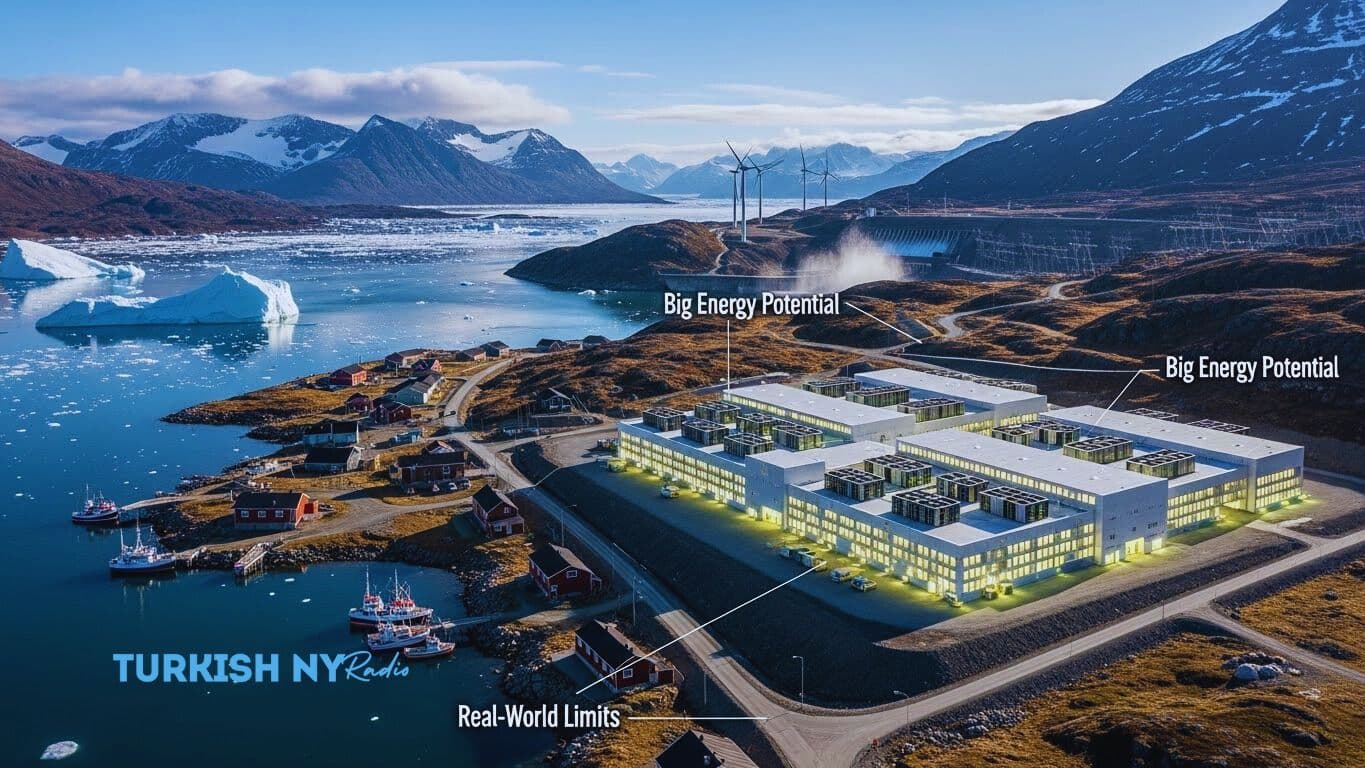
Bitcoin mining in Greenland

Bitcoin Mining in Greenland Faces Big Energy Potential and Real-World Limits

This article was first published on TurkishNY Radio.

Policy discussions in Washington involving Greenland have returned to public view, prompting renewed interest far beyond diplomacy.


Table of Contents

Toggle
    • YOU MAY BE INTERESTED
    • Russia Blacklists WhiteBIT: Why the Crypto Exchange Was Banned
    • Why Asset Tokenization Is Advancing Slowly but Strategically
  • Bitcoin Mining in Greenland Hinges on Hydropower Expansion
  • Grid Structure Limits Immediate Expansion
  • Expansion Near Nuuk Offers Mid-Scale Potential
  • Trump-Linked Mining Operations Highlight the Scale Question
  • Wind Energy Pushes the Discussion Into Theory
  • Practical Limits Still Matter More Than Political Headlines
    • Summary
  • Glossary of Key Terms
  • FAQs About Bitcoin mining in Greenland
    • What is the article about?
    • How do energy pricing and costs affect mining in Greenland?
    • What benefits could Bitcoin mining gain from Greenland?
    • What challenges or future updates should be expected?
      • References

YOU MAY BE INTERESTED

Russia bans WhiteBIT

Russia Blacklists WhiteBIT: Why the Crypto Exchange Was Banned

27 January 2026
Asset tokenization

Why Asset Tokenization Is Advancing Slowly but Strategically

27 January 2026

While political outcomes remain uncertain, the development that matters most to Bitcoin miners is already underway Greenland’s long-term energy planning.

A U.S. government spokesperson confirmed that Greenland-related discussions remain active at the federal level.

However, for the digital asset sector, attention is focused less on sovereignty debates and more on how Greenland plans to deploy its renewable energy resources over the next decade.

Bitcoin Mining in Greenland Hinges on Hydropower Expansion

Greenland’s government has formally stated that two major hydropower sites Tasersiaq and Tarsartuup Tasersua will be offered for industrial development through a public tender scheduled for the second half of 2026.

Official planning material indicates these sites could jointly produce more than 9,500 gigawatt-hours of electricity each year, equivalent to about 1.08 gigawatts of average power output.

When translated into Bitcoin mining terms using current ASIC efficiency standards, that level of power could support roughly 45 to 65 exahashes per second of hashing capacity.

At today’s network size, this would represent around 4–6% of global Bitcoin hashrate, assuming full utilization and uninterrupted access.

This figure represents a theoretical ceiling based on electricity supply alone. It does not assume priority allocation or exclusive use for mining operations.

Greenland renewable energy
Bitcoin Mining in Greenland Faces Big Energy Potential and Real-World Limits

Grid Structure Limits Immediate Expansion

Greenland’s electricity system operates through isolated regional grids rather than a single interconnected network. Public utility data shows total installed hydropower capacity currently remains under 100 megawatts, with pricing designed for residential and municipal demand.

This structure means that any early-stage mining deployment would likely depend on direct agreements with power producers or facilities built alongside generation assets.

Smaller installations in the 5–25 megawatt range could support trial-scale mining operations, but would not materially shift global Bitcoin network distribution.

Expansion Near Nuuk Offers Mid-Scale Potential

The Buksefjord hydropower station near Nuuk is scheduled for expansion from 45 megawatts to more than 120 megawatts, with construction expected to begin in 2026. Project timelines point to commissioning in the early 2030s.

If excess capacity were made available to industrial users, this expansion could support between 2 and 7 exahashes per second of mining activity.

However, planning documents emphasize urban growth and electrification needs, leaving mining access dependent on future policy decisions rather than firm commitments.

Trump-Linked Mining Operations Highlight the Scale Question

Mining companies connected to U.S. political capital are already operating at significant scale. Public disclosures show one such firm reached approximately 24 EH/s of installed capacity in 2025, requiring more than 400 megawatts of sustained electricity.


By comparison, Greenland’s proposed hydropower tender could theoretically power a mining fleet of similar size more than once over, provided infrastructure, transmission, and long-term contracts align. At present, these conditions remain unconfirmed.

Wind Energy Pushes the Discussion Into Theory

A peer-reviewed study indexed on ScienceDirect estimates Greenland’s onshore wind potential at over 300 gigawatts of nameplate capacity, producing nearly 1,500 terawatt-hours annually under conservative land-use assumptions.

If mining were treated as a flexible load rather than a continuous one, this output could exceed current Bitcoin network demand several times over.

However, this represents a physical energy limit, not a deployable blueprint. Transmission lines, storage systems, ports, weather conditions, and capital availability all impose real constraints.

Greenland hydropower projects
Bitcoin Mining in Greenland Faces Big Energy Potential and Real-World Limits

Practical Limits Still Matter More Than Political Headlines

Even under favorable policy conditions, large-scale renewable development in Greenland would require years of construction, Arctic-grade logistics, and stable international financing.

Competition from data centers serving artificial intelligence workloads further increases the opportunity cost of long-term renewable output.

Greenland’s 2026 hydropower tender will provide the first concrete signal of whether Bitcoin mining can secure sustained access to industrial-scale energy on the island.

Until then, the conversation remains rooted in energy mathematics rather than confirmed deployment.

ADVERTISEMENT

Summary

Bitcoin mining in Greenland is gaining attention as the island moves forward with major hydropower plans and evaluates its long-term wind resources.

A government tender expected in 2026 could open the door to industrial-scale energy use, but practical challenges remain.

Limited grid connections, infrastructure requirements, and competition for electricity all shape what is realistically possible, keeping the discussion focused on execution rather than political headlines.

Glossary of Key Terms

1. Bitcoin Mining

Bitcoin mining is how transactions are confirmed on the network. Specialized computers compete to solve calculations, helping secure Bitcoin while earning rewards for their work.

2. Hashrate

Hashrate describes the total computing power supporting the Bitcoin network. A higher hashrate means stronger security and more machines working to process transactions.

3. Hydropower

Hydropower is electricity produced using moving water. It is widely used for large operations because it provides steady output and does not rely on fossil fuels.

4. Stranded Energy

Stranded energy refers to electricity that cannot be easily used or sold due to location or grid limits. Bitcoin miners can use this power where traditional buyers cannot.

5. Power Purchase Agreement (PPA)

A power purchase agreement is a long-term deal where an energy producer sells electricity directly to a buyer at agreed terms, often used by large industrial consumers.

6. Energy Efficiency (Joules per Terahash)

This measure shows how much electricity a mining machine uses to generate computing power. Lower numbers mean the hardware produces more work using less energy.

7. Grid Fragmentation

Grid fragmentation happens when power systems operate separately instead of as one connected network, which can limit how much electricity large users can access.

8. Flexible Load

A flexible load is an energy user that can adjust power usage based on supply. Bitcoin mining fits this model by scaling operations when surplus electricity is available.

FAQs About Bitcoin mining in Greenland

What is the article about?

The article explains how Greenland’s hydropower and wind resources could support Bitcoin mining, while also outlining grid limits, infrastructure timelines, and competition from other large electricity users.

How do energy pricing and costs affect mining in Greenland?

Mining costs rely on negotiated industrial power deals rather than retail prices, with expenses shaped by infrastructure buildouts, cooling requirements, contract duration, and local energy availability.

What benefits could Bitcoin mining gain from Greenland?

Greenland provides renewable power, naturally cold conditions for cooling, and potential surplus energy, which can lower operating costs, improve efficiency, and reduce environmental exposure.

What challenges or future updates should be expected?

Projects must navigate regulations, secure permits, manage logistics, ensure reliable connectivity, and wait for outcomes from Greenland’s planned energy tenders and infrastructure expansions.


References

ScienceDirect

IEA

Minerstat

Tags: Bitcoin hashrate capacityBitcoin mining in GreenlandGreenland hydropower projectsGreenland renewable energy
Previous Post

12 Best Meme Coins to Invest in 2026: APEMARS ($APRZ) Presale Takes Centre Stage

Next Post

A New Pattern Is Forming in Best New Meme Coins as Apeing Breaks Out, Cheems and Pepe Consolidate, and XRP Dominates Japan

Victoria James

Victoria James

I offer insightful, well-researched, and engaging news coverage writing. Helping readers cut through the noise with ideas about market movements, blockchain technologies, regulatory developments, and more.

SIMILAR NEWS

Russia bans WhiteBIT
World

Russia Blacklists WhiteBIT: Why the Crypto Exchange Was Banned

27 January 2026
Asset tokenization
Cryptocurrency

Why Asset Tokenization Is Advancing Slowly but Strategically

27 January 2026
US Government Bitcoin Reserve Faces New Custody Questions
en

US Government Bitcoin Reserve Faces New Custody Questions

27 January 2026

Leave a Reply Cancel reply

Your email address will not be published. Required fields are marked *

Search

No Result
View All Result
DMCA
PROTECTED

Categories

  • Business
  • Cryptocurrency
  • Economy
  • en
  • News
  • Politics
  • World

Recent Posts

  • Russia Blacklists WhiteBIT: Why the Crypto Exchange Was Banned
  • Why Asset Tokenization Is Advancing Slowly but Strategically
  • US Government Bitcoin Reserve Faces New Custody Questions
  • FCA Consultation Signals Major Step Forward for UK Crypto Regulation
  • How to Buy Meme Coins? APEMARS Becomes the Next 100x Meme Coin – Free Crypto Model Draws Attention Away From $PI and $FLOKI

Site Navigation

  • Home
  • About Us
  • Terms and Conditions
  • Privacy Policy
  • Disclaimer
  • Contact

TurkishNY Radio

Banner 1
Banner 2
No Result
View All Result
  • Home
  • Cryptocurrency
  • Business
  • Economy
  • tr Türkçe
  • en English

  • English