



A New Era in Digital Finance
The most recent Citi tokenization forecast presents a vivid image of the financial markets of the future. By 2030, Citi expects stablecoins and tokenized securities to account for up to 10% of global post-trade volume.
The paper underlines the growing importance of generative artificial intelligence and blockchain-based tokenization in global market settlement, compliance, and liquidity.
This shift isn’t limited to cryptocurrency aficionados. It illustrates a fundamental shift in which financial institutions, governments, and investors rely on digital infrastructure to manage billions of dollars in worldwide transactions.
Stablecoins Emerge as Market Plumbing
The Citi tokenization forecast identifies stablecoins as the foundation of this transformation. Analysts predict that bank-issued stablecoins, rather than privately minted tokens, will dominate settlement systems.
This architecture ensures dependability, compliance, and regulatory trust, qualities that institutions require when billions of dollars are at risk.
According to forecasts, stablecoin market value might rise from the hundreds of billions it is currently to between $1.6 trillion and $3.7 trillion by 2030. “Stablecoins are no longer a niche product. They are poised to become financial plumbing for post-trade activities,” one market expert told X, emphasizing the trend toward general usage.
Generative AI Reshapes Market Workflows
Along with digital tokens, AI is changing the way trades are handled. According to Citi tokenization forecast, 86 percent of organizations are exploring generative AI for customer onboarding, while 57 percent use it in post-trade operations. By automating reconciliation, compliance, and settlement, AI lowers costs and speeds up transactions.
The industry is also pushing for T+1 settlement, which settles deals one day after execution. According to Citi’s poll, 76 percent of organizations are working on this project, which positions AI as the unseen power driving speedier and more efficient operations.
Multi-Chain Ecosystem and Custodian Role
The Citi tokenization forecast predicts a multi-chain financial environment by 2030. Approximately 63 percent of institutions plan to operate across several blockchains. Custodians will play a vital role as trusted operators, assuring network interoperability, security, and compliance.

As one custodial CEO stated on X, “The future of tokenization is multi-chain.” Institutions will rely on us to bridge the gap between fragmented ledgers. This indicates a big possibility for custodians to become the foundation of institutional blockchain use.
Regional Dynamics and Growth Potential
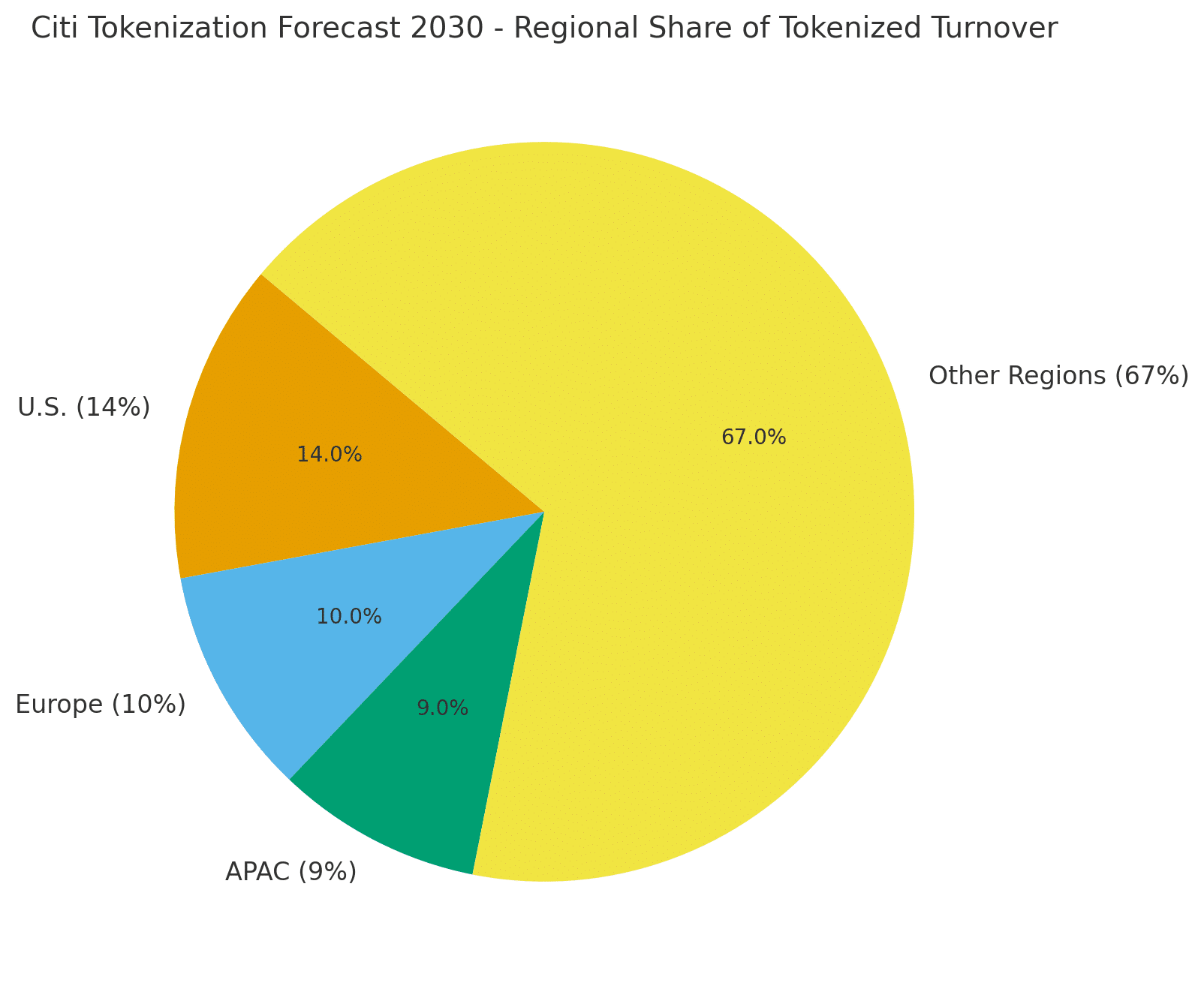
Regionally, the Citi tokenization forecast indicates varied levels of acceptance. By 2030, the United States is expected to dominate with 14% of tokenized turnover, followed by Europe at 10% and Asia-Pacific at 9%. These statistics reflect not just worldwide adoption, but also the regulatory and innovation battle among key financial hubs.
Experts believe that as central banks investigate tokenized finance and stablecoin frameworks, regional diversity will drive innovation. Stronger regulation in the United States and Europe may boost adoption, although Asia-Pacific’s fintech-driven economies will continue to push the envelope.
Conclusion
The Citi tokenization forecast emphasizes that the financial markets are on the verge of a digital revolution. Stablecoins, tokenized securities, and generative AI are no longer just theoretical notions; they are quickly becoming the foundation of global finance.
As institutions rush to modernize, the mix of legislation, innovation, and adoption will decide how smoothly the shift goes. For traders, students, and developers, the prognosis foreshadows a day when blockchain is no longer simply a component of the system, but the system itself.
Glossary
Tokenization: The process of converting real-world or financial assets into blockchain-based digital tokens.
Stablecoin: A digital currency pegged to traditional fiat, such as the U.S. dollar or euro.
Post-Trade: The processes occurring after a trade is executed, including clearing and settlement.
Generative AI: Artificial intelligence that creates and automates workflows such as compliance and onboarding.
Custodian: An institution that safeguards and manages financial assets on behalf of investors.
T+1 Settlement: A system where trades must be settled within one business day after execution.
FAQs for Citi tokenization forecast
What is the Citi tokenization forecast?
It is Citi’s projection that stablecoins and tokenized securities will handle 10 percent of global post-trade turnover by 2030.
How large will the stablecoin market be?
Citi estimates stablecoins could reach between $1.6 trillion and $3.7 trillion in market capitalization by 2030.
What role does AI play in this forecast?
AI will streamline compliance, onboarding, and settlement, making faster and more cost-efficient operations possible.
Which region is expected to lead tokenization?
The U.S. is projected to lead with 14 percent of tokenized turnover by 2030, ahead of Europe and Asia-Pacific.