
This article was first published on TurkishNY Radio.
The Circle vs BlackRock tokenized Treasury market is no longer a theoretical discussion. Verified data from RWA.xyz shows that tokenized U.S. Treasuries reached $15.07 billion by April 29, 2026, up from $13.53 billion earlier in the same month. The steady increase across April points to consistent demand rather than isolated inflows.


A few years ago, holding government debt through blockchain tokens felt experimental. Today, it is increasingly treated as a practical extension of fixed-income exposure within digital finance systems.
Circle vs BlackRock Tokenized Treasury Market Shift
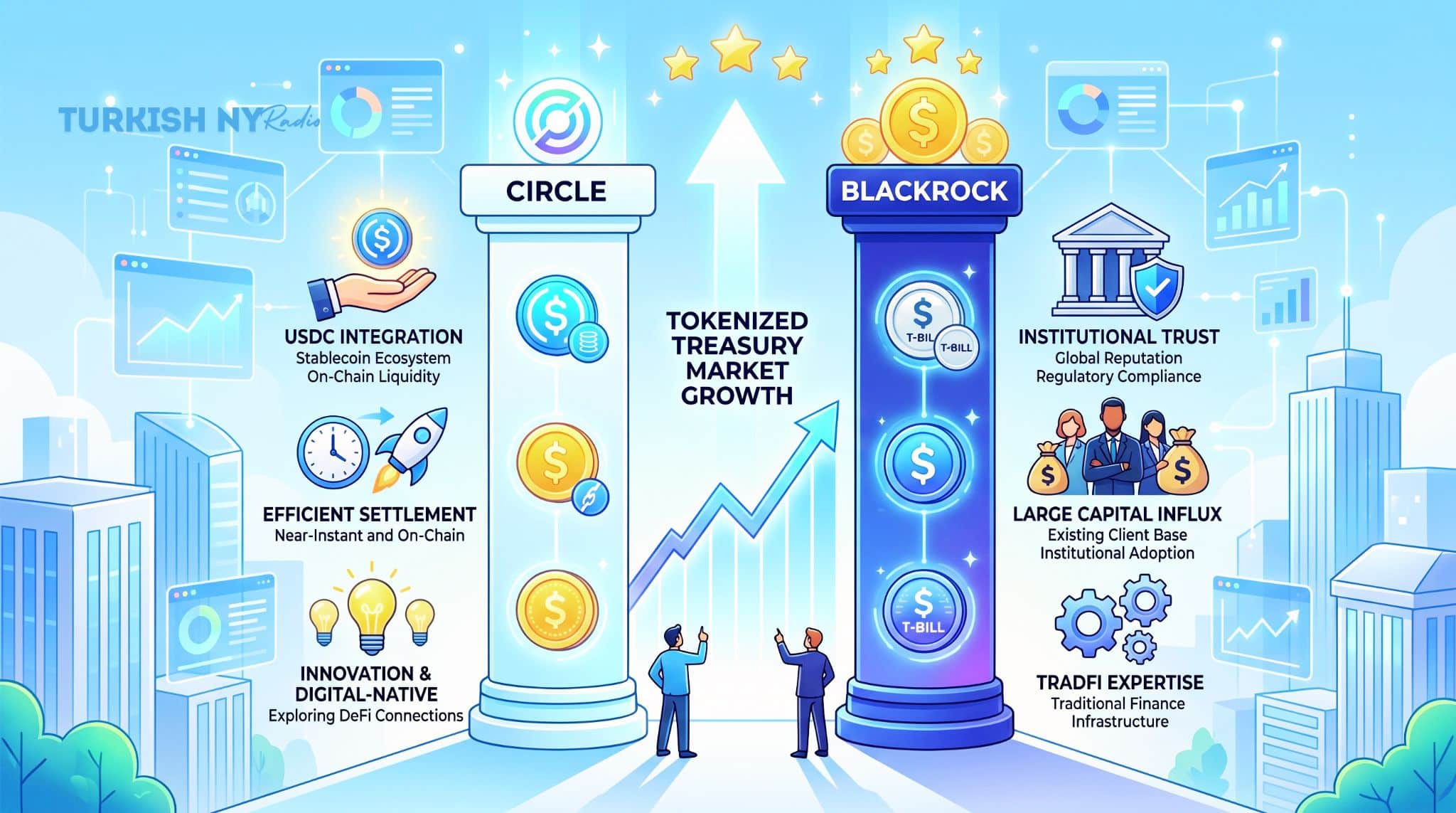
A notable change within the Circle vs BlackRock tokenized Treasury market is the shift in leadership. Circle’s USYC has taken the top position with roughly $2.9 billion in assets, while BlackRock’s BUIDL stands at around $2.58 billion, based on RWA.xyz data.
This shift does not diminish BlackRock’s role. Instead, it highlights how different strategies are shaping the same market.
BlackRock introduced an institutional benchmark, while Circle scaled through broader integration and utility. The Circle vs BlackRock tokenized Treasury market now reflects both approaches competing side by side.
Circle vs BlackRock Tokenized Treasury Market Demand
The appeal behind the Circle vs BlackRock tokenized Treasury market is straightforward. Tokenized Treasuries combine the stability of U.S. government debt with the flexibility of blockchain infrastructure.
They allow investors to:
- Earn yield from short-duration Treasuries
- Transfer assets faster than traditional settlement systems
- Keep capital within on-chain ecosystems
This positioning matters. In crypto markets, capital often sits idle in stablecoins or moves into higher-risk strategies. Tokenized Treasuries offer a middle ground, combining conservative yield with digital accessibility.
BUIDL Sets the Institutional Standard
BlackRock’s BUIDL continues to play a defining role in the Circle vs BlackRock tokenized Treasury market, even as it ranks second by assets. The fund holds Treasury bills, cash, and repo exposure, structured in a way that aligns with institutional expectations.
Data from Securitize confirms that BUIDL has delivered over $100 million in dividends since its March 2024 launch. This performance demonstrates that tokenized Treasury structures are not just operational but income-generating at scale.
The product’s $5 million minimum investment further signals its focus on institutional participants rather than retail users.
USYC Expands Through Real Utility
Circle’s USYC has gained momentum in the Circle vs BlackRock tokenized Treasury market through its integration into trading and collateral systems. A major growth driver has been its use on BNB Chain as collateral in derivatives markets.
Circle CEO Jeremy Allaire described this as “a major emerging use case.” The statement reflects a broader shift where tokenized Treasuries are not only yield instruments but also active components in trading infrastructure.
USYC’s ability to support continuous minting and redemption via USDC further strengthens its accessibility and operational efficiency.
Multi-Chain Access Expands Market Reach
Another factor shaping the Circle vs BlackRock tokenized Treasury market is multi-chain availability. BUIDL operates across several networks, including Ethereum and Solana, while USYC has established a strong presence on BNB Chain.
This cross-chain functionality improves usability. Institutions and platforms do not operate on a single blockchain, and products that can move across networks are easier to adopt and integrate.
Market Structure Shows Both Growth and Concentration
Despite rapid expansion, the Circle vs BlackRock tokenized Treasury market remains relatively concentrated. RWA.xyz data indicates that the top five products control nearly 68% of total market value.
Other contributors, such as Franklin Templeton’s BENJI and Ondo Finance’s USDY, are adding depth to the sector. Their presence supports competition while maintaining institutional standards.
A Structural Shift in On-Chain Capital
The Circle vs BlackRock tokenized Treasury market is influencing how capital behaves within crypto systems. Instead of exiting to traditional finance for lower-risk returns, investors can now access conservative yield without leaving blockchain environments.
This development introduces a more layered financial structure, where capital can shift between risk levels while remaining on-chain.

What Comes Next for the Market
The next phase of the Circle vs BlackRock tokenized Treasury market will depend on deeper integration into lending, settlement, and collateral frameworks.
Current data suggests that tokenized Treasuries are moving toward becoming a foundational layer within digital finance.
BlackRock provides institutional credibility, while Circle demonstrates how distribution and utility can drive scale. The long-term outcome may depend less on a single leader and more on how effectively these models converge.
Summary
- The Circle vs BlackRock tokenized Treasury market has crossed $15B, showing real growth as more capital looks for steady, on-chain returns.
- Circle’s USYC has moved ahead with $2.9B, just above BlackRock’s BUIDL at $2.58B.
- These products are no longer just about earning yield they’re now being used as collateral too.
- With multi-chain access and rising institutional interest, tokenized Treasuries are starting to feel like a core part of crypto finance.
Glossary of Key Terms
1. Tokenized Treasuries
These are U.S. government bonds turned into digital tokens. Instead of holding them through a bank, you can access them online, much like checking your balance in an app.
2. Blockchain
Think of this as a shared digital record book. Every transaction is written down and can’t easily be changed, which helps keep things transparent and secure.
3. Yield
This is the money you earn from your investment. It’s similar to the interest you get from a savings account, just through a different system.
4. Stablecoin (USDC)
A stablecoin is like digital cash that stays close to $1 in value. It’s commonly used to move money quickly within crypto platforms.
5. Collateral
Collateral is something valuable you use as a guarantee. In crypto, tokenized Treasuries can act like that safety deposit when making trades or borrowing funds.
6. DeFi (Decentralized Finance)
DeFi refers to financial services that run without banks. You can lend, borrow, or trade directly through apps instead of going through a traditional institution.
7. Multi-Chain
This means an asset can work across different blockchain networks. It’s a bit like using the same card across different banks or systems without restrictions.
8. Real World Assets (RWA)
These are physical or traditional investments, like bonds, brought onto blockchain. It’s simply a way of making familiar assets easier to use digitally.
FAQs About Circle vs BlackRock
1. What is the Circle vs BlackRock tokenized Treasury market?
It’s a space where firms like Circle and BlackRock offer blockchain-based access to U.S. Treasuries, letting investors earn steady yield without leaving digital asset platforms.
2. How do tokenized Treasuries pay returns and handle transactions?
They earn yield from government debt and distribute it on-chain. Investors can usually enter or exit using stablecoins like USDC, making access quicker and more flexible.
3. What makes tokenized Treasuries useful for investors?
They offer a balance between safety and utility providing stable returns while also working as collateral in trading, helping users keep capital active within crypto systems.
4. Are tokenized Treasuries safe, and what should users watch?
They rely on regulated structures, but risks like smart contract issues or regulatory changes remain. Adoption is growing, with more use expected across chains and institutions.