


For thousands of ambitious Indian students dreaming of studying abroad, Canada has long been the ultimate destination with world-class universities, multicultural life, and a promise of stability.
But in 2025, that dream is meeting a hard reality: a record-high Canada student visa rejection rate that’s left hopeful applicants heartbroken and universities scrambling.


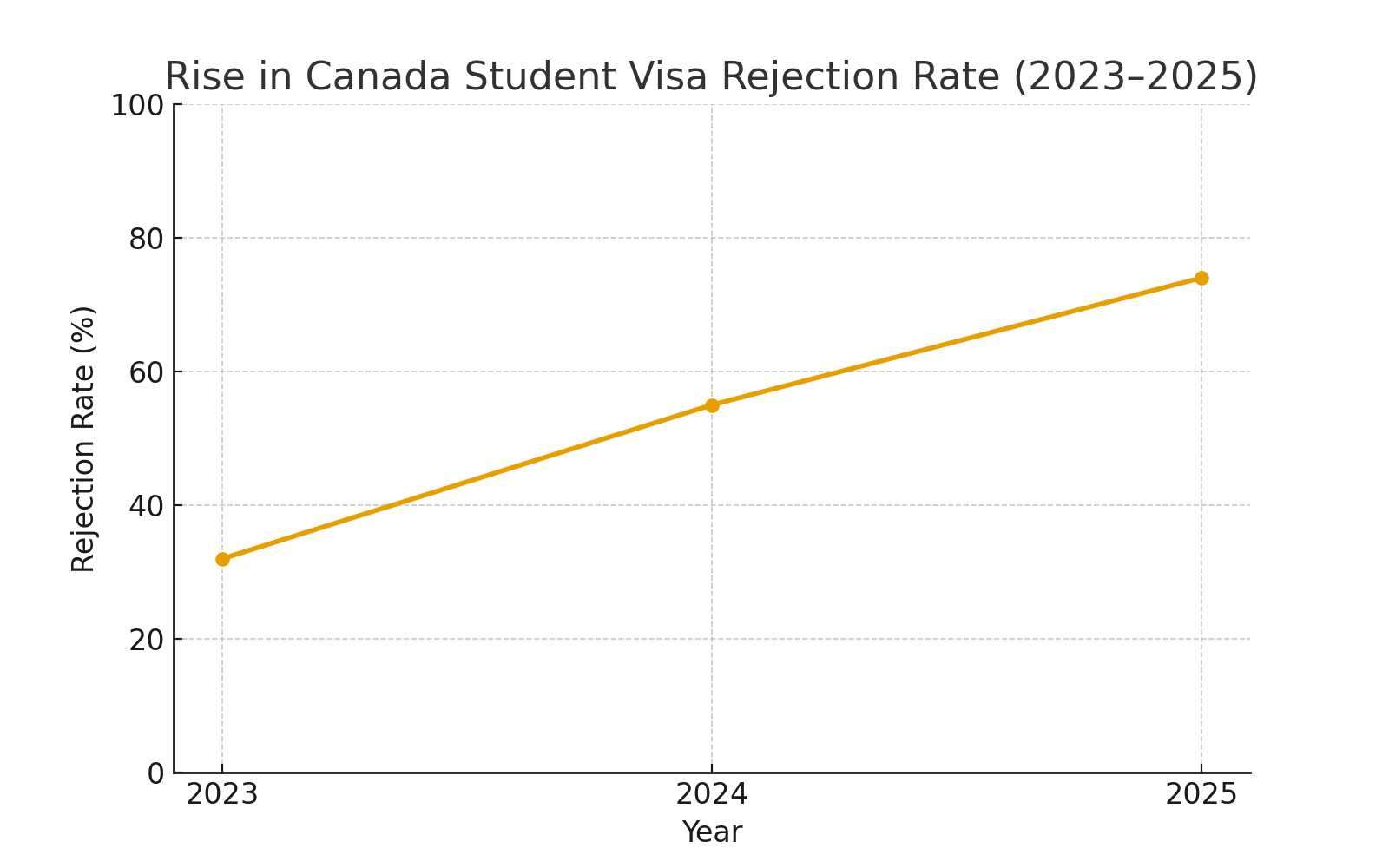
According to a Reuters report, nearly 74% of Indian student applications were rejected in August 2025 more than double the rate just two years ago.
The reason? Alleged fraudulent documentation, primarily fake college acceptance letters, has triggered a government crackdown that’s shaking the $22-billion international education sector.
Fraud Fears Fuel a Massive Policy Shift
Canadian authorities say they’re acting out of caution, not hostility. The Immigration, Refugees and Citizenship Canada (IRCC) stated that “rigorous verification is now mandatory for all foreign study permits, particularly from high-risk regions.”
The tightening follows a major 2023 scandal involving roughly 1,550 fake acceptance letters, most linked to agents in India.
That discovery prompted Ottawa to overhaul its student-visa screening and raise financial proof requirements steps that have led to today’s sky-high Canada student visa rejection rate.
Universities Feel the Chill
Canadian universities, many of which rely heavily on international tuition, are already feeling the pinch. The University of Waterloo, Regina, and Saskatchewan report double-digit drops in Indian enrollment.
“We’re concerned about the message this sends,” said Dr. Lisa Freeman, Provost of the University of Waterloo, in an interview with The Globe and Mail. “While fraud prevention is critical, genuine students are being caught in the crossfire.”
The Canada student visa rejection wave has forced institutions to shift recruitment to other regions like Nigeria and Vietnam, but the loss of Indian students who make up nearly 40% of all international enrollees is hard to replace.
A Political Undercurrent
Experts say this crisis can’t be separated from strained Canada-India relations. Diplomatic tensions, sparked by accusations and counter-accusations between both governments in 2023 and 2024, have cast a long shadow over migration and academic collaboration.
Indian education consultant Ravi Bhushan told The Times of India, “Students are being punished for politics they had no part in. Many who did everything right genuine documents, strong finances are still rejected.”
The term Canada student visa rejection has since trended across X (formerly Twitter), with hundreds of frustrated students sharing stories of sudden refusals.
One viral post read, “Applied thrice, got rejected thrice. My dream now feels like a fraud case I never committed.”
Bill C-12 and the Future of Student Mobility
Adding to the turbulence, Canada is pushing Bill C-12, which would give immigration officials new powers to cancel classes of temporary visas en masse if fraud is suspected. Supporters say it’s essential to protect the system’s integrity. Critics call it “collective punishment” for innocent applicants.
Analysts predict that unless the government balances security and opportunity, the Canada student visa rejection crisis could drive students toward alternative destinations such as Germany, Australia, and the U.K.
Conclusion
The sharp rise in Canada student visa rejection rates underscores a global truth international education must evolve to be both secure and accessible. Canada’s intent to safeguard integrity is valid, but fairness and transparency must remain at its core.
As one hopeful applicant from Mumbai wrote online, “All I wanted was a classroom, not a courtroom.” That sentiment captures the heart of the issue and a challenge Canada must address if it wants to remain a trusted global education leader.
For more news visit our flatform.


FAQs about Canada student visa rejection
1. Why is the Canada student visa rejection rate so high for Indians?
Due to rising fraud cases, especially fake acceptance letters, Canada has tightened its verification process.
2. What’s the current rejection percentage?
Roughly 74% of Indian study permit applications were denied in mid-2025.
3. Are Indian students banned from Canada?
No, but applications are under stricter review and financial proof requirements have increased.
4. What are the alternatives for Indian students?
Germany, Australia, and the U.K. are now popular choices due to clearer visa pathways and lower rejection rates.
Glossary
-
IRCC: Immigration, Refugees and Citizenship Canada — the department managing immigration and visas.
-
Study Permit: Authorization allowing foreign nationals to study in Canada.
-
Bill C-12: Proposed Canadian law granting visa cancellation powers for fraud prevention.
-
Acceptance Letter Scam: A 2023 fraud where fake letters were used to secure visas.