• Home
  • About Us
  • Terms and Conditions
  • Privacy Policy
  • Disclaimer
  • Contact
27 January Tuesday, 2026
  • tr Türkçe
  • en English
TurkishNY Radio
No Result
View All Result
  • Home
  • Cryptocurrency
  • Business
  • Economy
  • Home
  • Cryptocurrency
  • Business
  • Economy
No Result
View All Result
  • tr Türkçe
  • en English
TurkishNY Radio
No Result
View All Result
Bitcoin Bitcoin (BTC) $95,261.57 ↓ -0.05%
Ethereum Ethereum (ETH) $3,288.55 ↓ -0.06%
Tether USDt Tether USDt (USDT) $1.00 ↓ 0.00%
BNB BNB (BNB) $936.88 ↑ 0.81%
XRP XRP (XRP) $2.06 ↓ -0.16%
Solana Solana (SOL) $143.94 ↑ 1.52%
USDC USDC (USDC) $1.00 ↑ 0.01%
TRON TRON (TRX) $0.31 ↑ 0.69%
Dogecoin Dogecoin (DOGE) $0.14 ↓ -1.31%
Cardano Cardano (ADA) $0.40 ↑ 1.28%
Bitcoin Cash Bitcoin Cash (BCH) $592.58 ↑ 0.05%
Monero Monero (XMR) $626.65 ↓ -8.54%
Chainlink Chainlink (LINK) $13.72 ↑ 0.24%
UNUS SED LEO UNUS SED LEO (LEO) $9.06 ↑ 1.81%
Hyperliquid Hyperliquid (HYPE) $24.83 ↑ 0.87%
Stellar Stellar (XLM) $0.23 ↓ -0.45%
Sui Sui (SUI) $1.79 ↑ 1.00%
Zcash Zcash (ZEC) $405.35 ↑ 0.15%
Ethena USDe Ethena USDe (USDe) $1.00 ↑ 0.01%
Avalanche Avalanche (AVAX) $13.56 ↓ -1.36%
Litecoin Litecoin (LTC) $74.59 ↑ 3.87%
Dai Dai (DAI) $1.00 ↑ 0.01%
Hedera Hedera (HBAR) $0.12 ↑ 1.10%
Shiba Inu Shiba Inu (SHIB) $0.00 ↑ 1.59%
Canton Canton (CC) $0.13 ↓ -4.54%
World Liberty Financial World Liberty Financial (WLFI) $0.17 ↑ 1.92%
Toncoin Toncoin (TON) $1.71 ↓ -0.15%
Cronos Cronos (CRO) $0.10 ↑ 1.09%
PayPal USD PayPal USD (PYUSD) $1.00 ↓ -0.02%
Polkadot Polkadot (DOT) $2.13 ↑ 1.14%
World Liberty Financial USD World Liberty Financial USD (USD1) $1.00 ↓ -0.02%
Uniswap Uniswap (UNI) $5.35 ↑ 1.09%
Mantle Mantle (MNT) $0.95 ↑ 0.75%
Bittensor Bittensor (TAO) $275.98 ↓ -0.05%
Aave Aave (AAVE) $175.26 ↑ 2.58%
Bitget Token Bitget Token (BGB) $3.78 ↑ 0.56%
Pepe Pepe (PEPE) $0.00 ↑ 0.89%
OKB OKB (OKB) $114.57 ↑ 0.43%
Internet Computer Internet Computer (ICP) $4.12 ↓ -6.23%
NEAR Protocol NEAR Protocol (NEAR) $1.74 ↑ 1.23%
Ethereum Classic Ethereum Classic (ETC) $12.84 ↑ 2.02%
MemeCore MemeCore (M) $1.58 ↓ -3.37%
Tether Gold Tether Gold (XAUt) $4,594.44 ↑ 0.05%
Aster Aster (ASTER) $0.72 ↑ 1.46%
PAX Gold PAX Gold (PAXG) $4,608.64 ↓ -0.01%
Ethena Ethena (ENA) $0.22 ↓ -0.72%
Pi Pi (PI) $0.21 ↑ 0.51%
Global Dollar Global Dollar (USDG) $1.00 ↓ 0.00%
Polygon (prev. MATIC) Polygon (prev. MATIC) (POL) $0.15 ↓ -1.49%
Worldcoin Worldcoin (WLD) $0.56 ↓ -0.49%
KuCoin Token KuCoin Token (KCS) $11.43 ↓ -0.40%
Sky Sky (SKY) $0.06 ↑ 6.41%
Aptos Aptos (APT) $1.82 ↑ 1.68%
MYX Finance MYX Finance (MYX) $5.42 ↓ -1.28%
Ripple USD Ripple USD (RLUSD) $1.00 ↓ -0.03%
Cosmos Cosmos (ATOM) $2.53 ↑ 2.55%
Arbitrum Arbitrum (ARB) $0.21 ↑ 1.87%
Ondo Ondo (ONDO) $0.39 ↑ 2.39%
Kaspa Kaspa (KAS) $0.04 ↓ -1.67%
GateToken GateToken (GT) $10.39 ↑ 0.40%
Render Render (RENDER) $2.29 ↑ 4.64%
Algorand Algorand (ALGO) $0.13 ↑ 3.22%
Filecoin Filecoin (FIL) $1.52 ↓ -0.86%
OFFICIAL TRUMP OFFICIAL TRUMP (TRUMP) $5.38 ↑ 0.89%
Midnight Midnight (NIGHT) $0.06 ↓ -1.51%
Pump.fun Pump.fun (PUMP) $0.00 ↑ 2.40%
Dash Dash (DASH) $82.13 ↓ -12.23%
VeChain VeChain (VET) $0.01 ↑ 3.78%
Quant Quant (QNT) $80.61 ↑ 9.51%
USDD USDD (USDD) $1.00 ↓ -0.01%
Story Story (IP) $2.71 ↑ 8.86%
Bonk Bonk (BONK) $0.00 ↑ 1.69%
Flare Flare (FLR) $0.01 ↓ -0.44%
XDC Network XDC Network (XDC) $0.04 ↓ -0.86%
Sei Sei (SEI) $0.12 ↓ -0.18%
Pudgy Penguins Pudgy Penguins (PENGU) $0.01 ↑ 1.88%
PancakeSwap PancakeSwap (CAKE) $2.12 ↑ 4.44%
Jupiter Jupiter (JUP) $0.22 ↑ 2.98%
Stacks Stacks (STX) $0.37 ↑ 1.60%
Optimism Optimism (OP) $0.34 ↑ 1.48%
Tezos Tezos (XTZ) $0.62 ↑ 6.97%
Virtuals Protocol Virtuals Protocol (VIRTUAL) $0.98 ↓ -0.27%
Artificial Superintelligence Alliance Artificial Superintelligence Alliance (FET) $0.28 ↑ 2.33%
Nexo Nexo (NEXO) $0.99 ↑ 2.86%
Curve DAO Token Curve DAO Token (CRV) $0.44 ↑ 2.45%
Chiliz Chiliz (CHZ) $0.06 ↓ -1.33%
United Stables United Stables (U) $1.00 ↑ 0.01%
Immutable Immutable (IMX) $0.29 ↑ 7.58%
Injective Injective (INJ) $5.40 ↑ 4.75%
SPX6900 SPX6900 (SPX) $0.57 ↑ 1.57%
ether.fi ether.fi (ETHFI) $0.75 ↑ 1.08%
Lido DAO Lido DAO (LDO) $0.61 ↓ -0.98%
Aerodrome Finance Aerodrome Finance (AERO) $0.56 ↑ 0.70%
Celestia Celestia (TIA) $0.59 ↑ 5.79%
Morpho Morpho (MORPHO) $1.34 ↓ -2.60%
First Digital USD First Digital USD (FDUSD) $1.00 ↑ 0.04%
TrueUSD TrueUSD (TUSD) $1.00 ↓ -0.04%
FLOKI FLOKI (FLOKI) $0.00 ↑ 2.67%
DoubleZero DoubleZero (2Z) $0.14 ↑ 10.97%
The Graph The Graph (GRT) $0.04 ↑ 7.19%
Home Cryptocurrency

Can the EU Dump U.S. Treasurys? What the Data Really Shows

Victoria James by Victoria James
22 January 2026
in Cryptocurrency, Economy, News
Reading Time: 5 mins read
0
U.S. Treasurys”

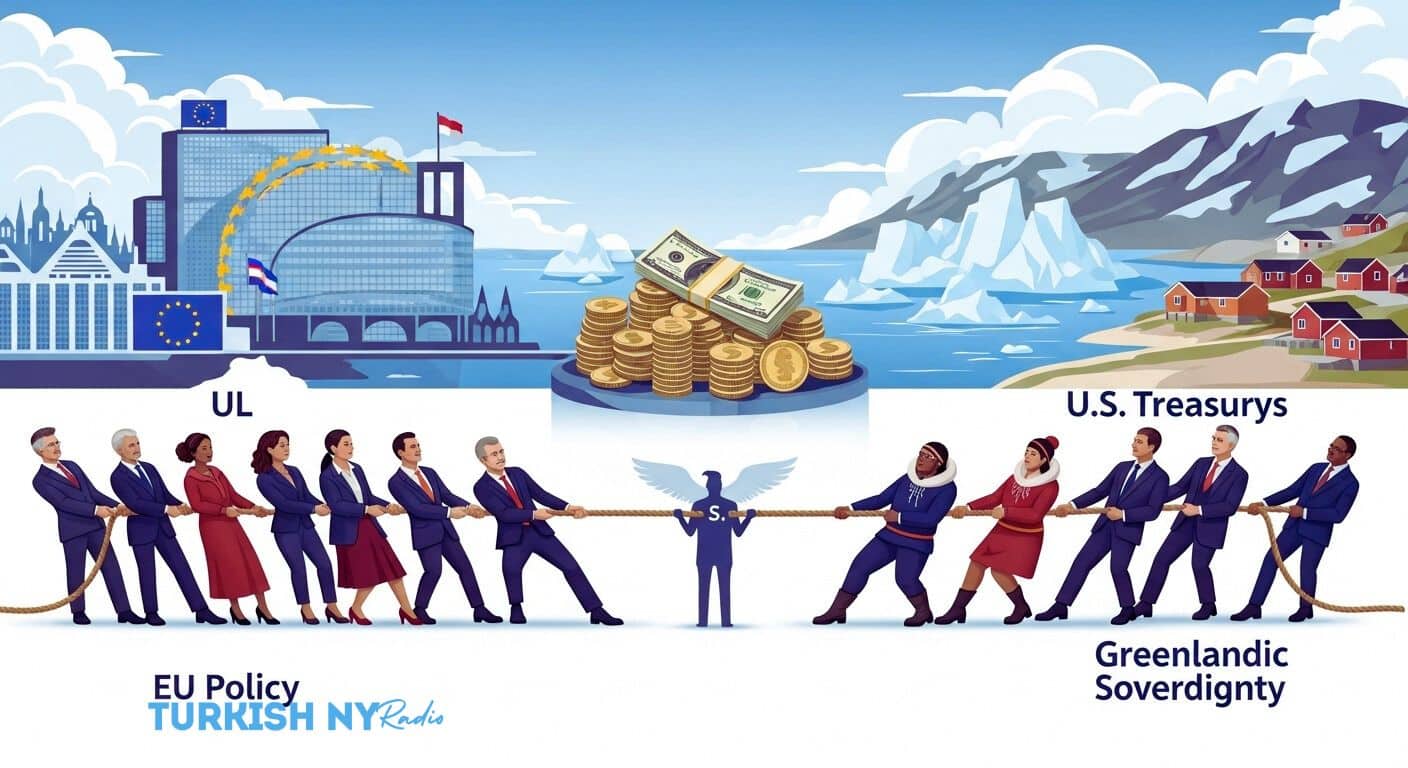
Can U.S. Treasurys Become Political Leverage in the EU–Greenland Standoff?

This article was first published on TurkishNY Radio.

A geopolitical disagreement over Greenland has reopened a question that financial markets rarely confront directly: what happens if close allies begin treating U.S. government debt as a bargaining tool?


Table of Contents

Toggle
    • YOU MAY BE INTERESTED
    • How Ripple’s Saudi Bank Partnership Supports Vision 2030
    • Russia Blacklists WhiteBIT: Why the Crypto Exchange Was Banned
  • EU Dumping U.S. Treasurys: Big Numbers, Bigger Misreads
  • Where the $1.7 Trillion Figure Comes From
  • How a Policy Shift Would Likely Unfold
  • Why Speed Matters More than Intent
  • The Broader Consequences Reach Beyond Bonds
  • A Slow Shift, Unless Markets Force the Issue
    • Summary
  • Glossary of Key Terms
  • FAQs  About U.S. Treasurys
    • What does “EU dumping U.S. Treasurys” really mean?
    • Could this impact everyday costs or borrowing?
    • How might this influence Bitcoin and crypto markets?
    • Is this already happening or just a possibility?
      • References

YOU MAY BE INTERESTED

How Ripple’s Saudi Bank Partnership Supports Vision 2030

How Ripple’s Saudi Bank Partnership Supports Vision 2030

27 January 2026
Russia bans WhiteBIT

Russia Blacklists WhiteBIT: Why the Crypto Exchange Was Banned

27 January 2026

Recent reporting by the Financial Times has raised the possibility that European policymakers could consider U.S. Treasurys when weighing responses to growing friction with Washington.

That idea alone has been enough to unsettle bond markets not because a mass sell-off is guaranteed, but because of how sensitive the system is to timing.

The risk is not a dramatic announcement. It is whether any shift happens quietly and gradually, or suddenly and at scale.

EU Dumping U.S. Treasurys: Big Numbers, Bigger Misreads

Official U.S. Treasury data show that foreign investors held $9.35 trillion in U.S. Treasurys as of November 2025. Roughly $3.92 trillion of that total is classified as foreign official holdings, meaning central banks and similar public institutions.

Those figures are real. What is often misunderstood is what they represent.

The Treasury itself warns that its reporting relies heavily on U.S.-based custodians. Bonds held through overseas custody accounts may not be attributed to their true owners.

As a result, the data cannot precisely identify how much any single country or political bloc actually controls.

This distinction matters. It limits how much influence policymakers can exert directly, especially over privately held bonds.

U.S. Treasury holdings
Can U.S. Treasurys Become Political Leverage in the EU–Greenland Standoff?

Where the $1.7 Trillion Figure Comes From

Some estimates point to about $1.73 trillion in Treasurys linked to major European custody and reporting hubs, including Belgium, Luxembourg, France, Ireland, and Germany.

That number is best understood as an upper-bound reference, not a verified total of EU-owned debt. It reflects where bonds are reported or held, not who ultimately owns them.

In short, Europe cannot simply “press a button” and liquidate that amount overnight.

How a Policy Shift Would Likely Unfold

If Treasurys were ever used as leverage, it would almost certainly happen in stages.

First would come political signaling statements, policy discussions, and changes in tone that frame Treasurys as part of broader risk management. That phase could last months.

Next could come guidance changes, such as shortening portfolio duration or slowing reinvestment of maturing bonds. These steps do not require open confrontation and can be framed as routine reserve management.

Only after that would markets feel the impact, either through passive runoff over time or active selling that compresses into weeks if volatility rises and private investors react defensively.

The difference between those paths is the difference between mild repricing and a sharp yield shock.

Why Speed Matters More than Intent

Historical Federal Reserve research suggests that a sudden $100 billion reduction in foreign official Treasury buying within a single month could lift five-year yields by as much as 40–60 basis points in the short term.

That research predates today’s market structure, but it highlights a key point markets react to flow, not politics.

ADVERTISEMENT

Even a plan designed to unfold slowly can turn disruptive if private investors hedge aggressively or reduce exposure at the same time.

The Broader Consequences Reach Beyond Bonds

Any sustained rise in Treasury yields would ripple across the U.S. economy, where total federal debt now exceeds $38 trillion. Higher benchmark rates feed directly into mortgages, corporate borrowing costs, and equity valuations.

Foreign investors also hold large positions across U.S. equities and credit markets, amplifying spillover effects if confidence weakens.

For crypto markets, the initial transmission would come through tighter dollar liquidity and higher global discount rates. Bitcoin’s longer-term role as a neutral alternative would depend on whether politicization becomes persistent, not episodic.

TIC
Can U.S. Treasurys Become Political Leverage in the EU–Greenland Standoff?

A Slow Shift, Unless Markets Force the Issue

Global reserve data show that the dollar still accounts for nearly 57% of disclosed reserves, with changes typically occurring in steps rather than breaks.

That suggests de-dollarisation remains gradual. However, if the Greenland dispute evolves into sustained financial brinkmanship, markets will focus less on rhetoric and more on one key variable:

Does Treasury exposure decline as a slow runoff or as a sudden shock?

That answer will shape yields, liquidity, and risk sentiment long before any official statement does.

Summary

The article explains why fears around the European Union “dumping” U.S. Treasurys are often overstated. While headline figures sound alarming, ownership data is complex and easily misread.

What truly matters is how fast any reduction happens. A sudden move could push yields higher and tighten liquidity, while a slow runoff would likely be absorbed.

Bitcoin would feel the impact mainly through interest rates and dollar conditions, not politics alone.


Glossary of Key Terms

1. U.S. Treasurys

U.S. Treasurys are basically money people lend to the U.S. government. In return, the government pays interest, much like a very reliable savings plan.

2. EU Dumping U.S. Treasurys

This phrase means European institutions might reduce or sell some of their U.S. government bonds. Think of a major customer slowly or suddenly closing accounts at a bank.

3. Yield

Yield is the income you earn from a bond. When bond prices drop, yields go up similar to buying a rental property cheaper but collecting the same monthly rent.

4. Yield Shock

A yield shock happens when interest rates rise very fast. It’s like your rent doubling overnight instead of increasing gradually over time.

5. Custody Data

Custody data shows where financial assets are held, not who really owns them. It’s like knowing where a car is parked, not whose name is on the title.

6. Foreign Official Holdings

These are investments owned by governments or central banks, not everyday people. Think of them as national savings accounts managed by policymakers.

7. Dollar Liquidity

Dollar liquidity describes how easily dollars move through the financial system. When liquidity tightens, borrowing and spending slow down like a sudden cash shortage.

8. Runoff

Runoff means letting bonds mature and expire without replacing them. It’s similar to letting a fixed deposit end and choosing not to renew it.

FAQs  About U.S. Treasurys

What does “EU dumping U.S. Treasurys” really mean?

It means Europe could slowly cut back or quickly reduce its exposure to U.S. government bonds as part of a policy response, which may affect yields and liquidity.

Could this impact everyday costs or borrowing?

Yes. If Treasury yields rise, mortgages, business loans, and financing costs can increase, making credit more expensive for households and companies.

How might this influence Bitcoin and crypto markets?

Crypto would likely feel the impact through tighter dollar liquidity and higher interest rates first, before any longer-term shift in investor behavior appears.

Is this already happening or just a possibility?

For now, it’s a possibility. Markets are watching policy signals and data to see whether any changes happen gradually or all at once.


References

FINANCIAL TIMES

U.S Department of the Treasury

The Federel Reserve Board

Tags: Greenland U.S.–EU disputeTICU.S. Treasury holdingsU.S. Treasurys
Previous Post

Solana Mobile SKR Airdrop: Eligibility, Supply, and Claim Rules

Next Post

ARK Invest Maps a Path to a $28 Trillion Crypto Market by 2030

Victoria James

Victoria James

I offer insightful, well-researched, and engaging news coverage writing. Helping readers cut through the noise with ideas about market movements, blockchain technologies, regulatory developments, and more.

SIMILAR NEWS

How Ripple’s Saudi Bank Partnership Supports Vision 2030
Cryptocurrency

How Ripple’s Saudi Bank Partnership Supports Vision 2030

27 January 2026
Russia bans WhiteBIT
World

Russia Blacklists WhiteBIT: Why the Crypto Exchange Was Banned

27 January 2026
Asset tokenization
Cryptocurrency

Why Asset Tokenization Is Advancing Slowly but Strategically

27 January 2026

Leave a Reply Cancel reply

Your email address will not be published. Required fields are marked *

Search

No Result
View All Result
DMCA
PROTECTED

Categories

  • Business
  • Cryptocurrency
  • Economy
  • en
  • News
  • Politics
  • World

Recent Posts

  • How Ripple’s Saudi Bank Partnership Supports Vision 2030
  • Russia Blacklists WhiteBIT: Why the Crypto Exchange Was Banned
  • Why Asset Tokenization Is Advancing Slowly but Strategically
  • US Government Bitcoin Reserve Faces New Custody Questions
  • FCA Consultation Signals Major Step Forward for UK Crypto Regulation

Site Navigation

  • Home
  • About Us
  • Terms and Conditions
  • Privacy Policy
  • Disclaimer
  • Contact

TurkishNY Radio

Banner 1
Banner 2
No Result
View All Result
  • Home
  • Cryptocurrency
  • Business
  • Economy
  • tr Türkçe
  • en English

  • English