
This article was first published on TurkishNY Radio.
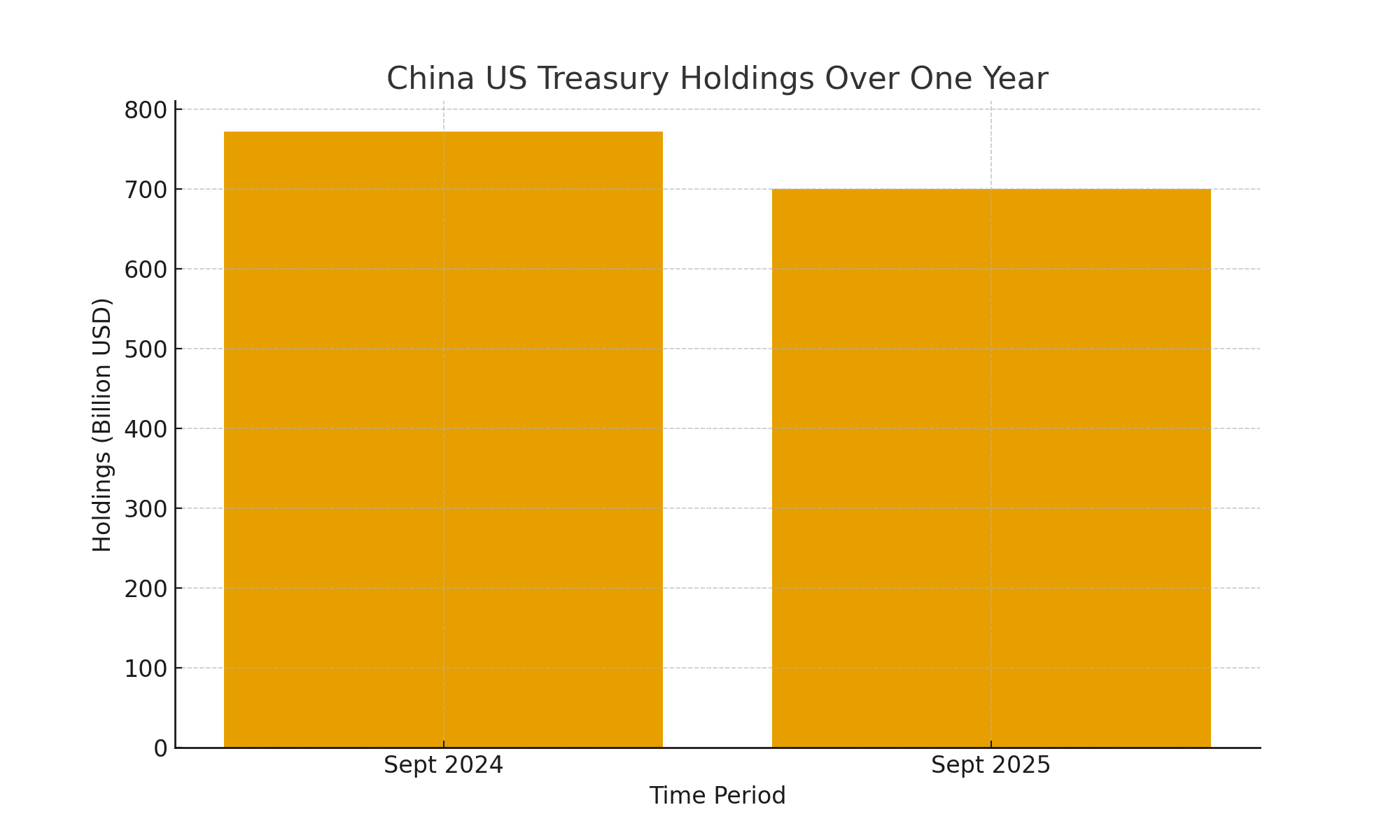
Over the past year, China has quietly reduced its exposure to United States Treasuries about $71.5 billion. This move, is now reaching far beyond the bond market and becoming more than a little worrisome for the cryptocurrency investor crowd.


At least for crypto investors, this shift gives a sharp edge to a big question that has been lurking in the background for years: will the move away from dollar assets by central banks really put money into Bitcoin? Or will it still be gold and traditional reserve instruments that hold center stage?
The latest data show that China’s holdings of US Treasury securities fell from roughly $772 billion in September 2024 to about $700.5 billion in September 2025, meaning a significant reduction among one of the world’s largest official holders. Several other BRICS members, including India, Brazil, and Saudi Arabia, have also trimmed their positions, contributing to a broad story of diversifying away from US debt.
However, the broader picture is more subtle. Over the same period foreign holdings of US Treasuries actually increased, climbing from about $8.77 trillion to nearly $9.25 trillion as private investors and other institutions stepped in to take up what some central banks were selling. With this evidence, human beings rely on U.S. debt at all but a reorder in who holds the paper and why.
Central Banks Adjust, The Dollar System Endures
Bitcoin’s supporters often claim that each reduction in US Treasury exposure is a small but inevitable step toward breaking up the dollar-based world order. In reality, however, the picture looks less dramatic: The dollar still accounts for about 56 to 58 percent of disclosed global foreign exchange reserves, well ahead of the euro, yen or pound.
This decline has also been the subject of studies at various international institutions. One of these has pointed out that declines in the dollar’s share have recently been driven more by currency movements than by large-scale coordinated sales.
Meanwhile, when we look at inflation-adjusted figures, the dollar’s reserve base is only down marginally. This suggests that central banks are not making a sudden exodus from using greenbacks, but simply adjusting their positions slightly.
In other words, although China’s reduction of its enormous pile of Treasuries is important, it is still not yet a major departure from the dollar system. The core structure of global reserves remains undisturbed, even as its players move around.
Gold still held Its place as an official hedging tool for the central banks
The real winner in this story of rebalancing is not, at least so far, Bitcoin. Central banks have been buying up gold at a pace that appears to be without precedent. Official sector data show that last year, central banks added over 1,000 tons, and the same occurred again for 2023. Gold demand reached a record near 4,974 tonnes in 2024, with central bank buying and new interest from exchange-traded products the key drivers.
Gold has many of the things that central bank reserve managers prize. High liquidity, a long track record from wars and crises line the pockets on either side of rival global blocks. So far in 2025, while stocks have likewise set records and bulls worry about a possible dual bubble-type blowout, the metal has climbed some more.
Brexit and Legacy Gold offers few financial markets in the world that rival those three attributes. Gold represents both darkness and light, a metal that has been used as money since the dawn of civilization. It’s easy to pile up in reserve, yet hard for any confiscating force outside its immediate vicinity to lay hands on.
Bitcoin’s narrative meets reserve reality
In this environment, it is understandable that the asset can reach record highs in the region of $397-507 million. Liquidity also migrates into new forms such as exchange traded funds and corporate treasuries, which removes the visible supply from exchange and helps compress long term volatility.
At the same time, central banks judge assets by standards that are different from those of retail traders or hedge funds. Volatility remains far above major currencies or gold and the market is still heavily influenced by sentiment swings, leverage cycles, and regulatory news.
In recent years, several central bank officials have explicitly rejected holding Bitcoin in reserves. They cite concerns over liquidity during stress episodes and lack empirical evidence about how the asset would fare in a severe macro shock.
The result is stark. Crypto investors see every Treasury sale as evidence that the era of the dollar is winding down and in its wing a non sovereign asset which has thus far been hard capped awaits. Central banks, however, are still voting with their balance sheets for gold and highly rated bonds from a diversified mixture of fiat currencies
What Crypto Market Indicators Are Saying
For crytpo traders and Long term investors, several key indicators frame the way this reserve story feeds into actual market conditions.
Bitcoin dominance holds firm: as capital concentrates in the major and liquid assets and smaller tokens lag behind. This consolidation reflects how institutional players, including ETF issuers and corporate treasuries, prefer assets that can handle large orders with minimal slippage.
At the same time, on-chain data shows a shrinking exchange float as more coins sit in long-term wallets or structured products. This reduces immediate sale pressure but concentrates risk in fewer hands.
Real returns on US Treasurys also matter. When inflation-adjusted yields are high, yield-bearing safe assets look more attractive, which can, in turn, suppress non-yielding assets such as bitcoins. When real returns fall or turn negative, Bitcoin’s narrative of scarcity and hedge appeal tends to regain strength.
Analysts following liquidity flows say that changes in central bank balance sheets and short-term funding operations are sometimes louder indicators than headline policy rate moves for where Bitcoin prices are likely heading next.
What This Means For Bitcoin Over The Next Cycle
China ‘s $71 billion Treasury reduction is not an unimportant event in the current world of finance. The signal that major emerging market players agree to adjust their exposure to US debt, particularly in a world with increasing geopolitical rivalry and changing trade patterns and designs also makes clear that the dollar-based system has the flexibility for private and institutional investors as well as buyers to soak up the supply without a sharp rise in yields.
For Bitcoin, the episode stands as a kind of stress test for one of the most popular narratives. The asset is obviously maturing, with regulated products, deepening derivatives markets and an increasing role in institutional portfolios. But at the same time it has not crossed over into that space which would make it a serious contender for most central banks as a core reserve asset.
Conclusion
The story of China’s firing off Treasuries is an easing rather than a dramatic break from the dollar : a cautious reshaping of reserves in a world that feels more risky and multipolar. Bitcoin surely benefits from the larger quest for alternatives, both among private investors and institutions which seek diversification and asymmetric upside.
But the bridge from Bitcoin’s story to the central bank reality remains fenced with barbed wire. Official reserve managers continue to favor assets that deliver enduring liquidity, historical performance, and political acceptability. This explains the boom in gold holdings and the dollar at the center of the system, as it is.
To crypto investors, this signal is loud and clear—Bitcoin could still flourish if central banks are slow to adopt it, but its performance will depend heavily on conditions of liquidity, real yields, and global market risk appetite, rather than just a simple anti-dollar story alone.
Frequently Asked Questions
Q1. Did China completely dump its US Treasuries?
No. China cut its holdings by $71.5 billion in a year, but did not dump US Treasuries as completely as that. But as one of the largest foreign creditors in the United States itself still has roughly $700 billion worth, this shows how difficult it is for little countries to get rid of those who owe them money.
Q2. Does this move prove that the dollar is losing its reserve status?
The dollar’s share of global reserves has been dropping over time, and now accounts for just over half of disclosed holdings.
Q3. Are central banks buying Bitcoin instead of Treasuries?
There is very little evidence to suggest that central banks in size are shift significant allocations into Bitcoin. Most reserve diversification still favors gold and, next to that, other major fiat currencies rather than crypto assets.
Glossary Of Key Terms
US Treasures
Debt securities issued by the United States government. They are widely accepted as the reserve assets that central banks will use in case of need because of their liquidity and perceived safety.
Foreign Exchange Reserves
Holdings of foreign currencies and related assets that central banks maintain in order to manage their own currency, intervene in markets and have a buffer during crises.
Real yield
The yield of a bond after adjusting for inflation. Real yields affect the relative attractiveness of non-yielding assets such as Bitcoin and gold compared to bonds
BRICS
A geopolitical and economic bloc comprising Brazil, Russia, India, China, and South Africa, and other similar entities in later years. Its policies and reserves are important signals to de-dollarization.