

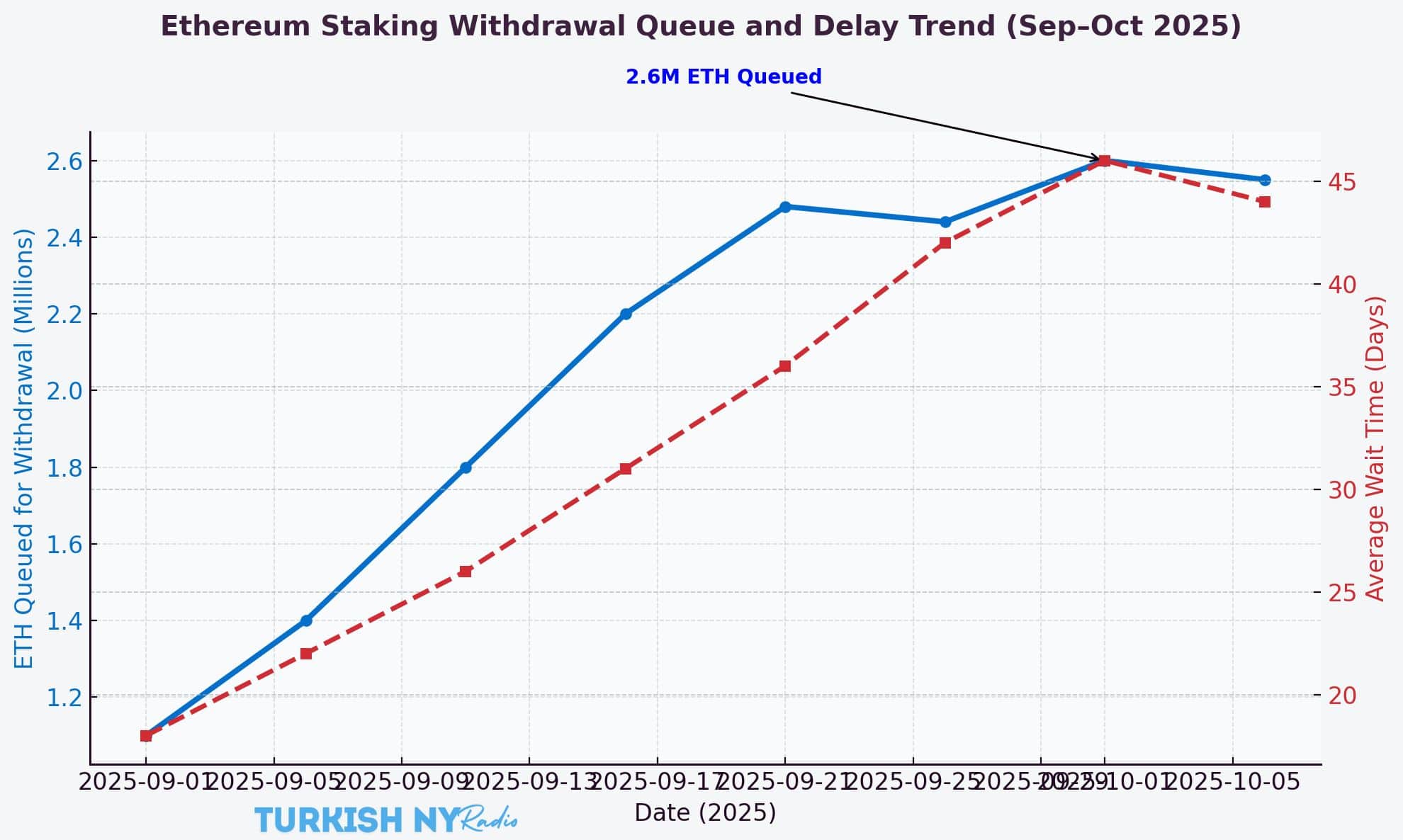
Ethereum’s validator exit queue has topped 2.5 million ETH (around $11.25 billion) as of the end of October 2025, prolonging the average withdrawal time to almost 46 days, one of the longest in history.
This increasing ETH withdrawal delay is stretching liquidity systems to the brink and revealing a flaw in Ethereum’s DeFi underpinnings. The line is created by how many validators are allowed to leave the network each epoch via Ethereum’s staking exit delay.


This defense has been designed to preserve the integrity of consensus but is becoming a growing burden on LSTs and complicating the redemption cycle on leading DeFi lending/collateral markets.
ETH Withdrawal Delay Tests Price Recovery Resilience
The Ethereum price is around $4,434 USD in recent CoinGecko data.
Other sources, meanwhile, list ETH as being priced between $3,900 and $4,000 with slight disparities between exchanges.
That said, Ethereum continues to face significant volatility pressure from macro gyrations and exit queue worries.
Also Read: SEC Acknowledges Grayscale’s HBAR ETF—What Investors Should Know

Why Exit Delays Worsen DeFi Fragility
That extended staking exit delay is significant because LSTs such as stETH are highly used for collateral in lending protocols. An ETH withdrawal lag essentially turns liquid staking tokens into illiquid assets for weeks.
When exit days lengthen, discount rates increase, and the peg between stETH and ETH regularly breaks down to produce deficiencies of capital efficiency.
Another analyst dubbed the backlog a “time bomb,” noting that if the quality of collateral does fall, it may result in forced deleveraging across DeFi markets as users cash out their debt positions during a time when no ETH is accessible from Maker’s decentralized credit facility.
Now, with billions in TVL at stETH’s back, any shock to the system could ripple through Aave, Maker, Curve, and other infrastructure contracts.
Leveraged staking strategies only add to that risk, indeed. Studies have revealed that LSTDs exacerbate liquidation risk in the presence of shock when there is a deviation between LST and ETH.
So the ETH withdrawal lag is not just irritating; it changes the effective value of collateral.
Ethereum’s Design Defense
Ethereum co-creator Vitalik Buterin and the core devs always say that staking exit delay is intentional, not a bug. Buterin compares exit pacing to discipline for network participation, disincentivizing speculative “exit hunts.”
A planned protocol paper reveals queued exits to be enforceable epoch-wise with inner withdrawal staging. This helps to protect against consensus instability, though one can still wonder if the operator queue has now exceeded tolerable limits.
There are those who suggest increasing exit throughput capacity to ease systemic stress; this could be coupled with changes in queuing rules and still maintain security.
ETH Price Forecast Stress Scenarios & Projections
The following table frames possible Ethereum price paths under pressure from the ETH withdrawal delay and broader market forces:
| Horizon | Bear Case | Base Case | Bull Case | Key Influencers |
| 1–3 months | $3,300 – $3,800 | $3,800 – $4,300 | $4,300 – $5,000 | Exit queue sentiment, ETF flows, macro risk |
| 6 months | $3,500 – $4,200 | $4,200 – $5,200 | $5,200 – $6,000 | DeFi stability, institutional inflows |
| Year-end 2025 | $3,800 – $4,500 | $4,500–$5,800 | $5,800–$7,200 | Adoption, protocol upgrades, collateral health |
These ranges assume the ETH withdrawal delay remains a central friction. In a stress scenario, the bear case could intrude toward $3,300, while the bull case requires sustained demand and peg recovery.
Structural Risks & Strategic Responses
Risk managers should treat all ETH withdrawal delays as a form of implied duration risk. Discount curves referenced to exit days should be included in the collateral models.
Proposals to loosen LTVs or modifications of liquidation based on queue length are under discussion in governance forums. On the protocol side, exit throughput upgrades or even optional “fast exit” lanes with a premium fee are being considered.
There might be mechanisms that pop up on EIPs down the road in Ethereum’s roadmap (or changes to these) that set standards for how to not have big slowdowns and how to not throw away consensus security.
Also Read: Eric Trump Says, ‘Buy the Dip Bitcoin Ethereum’: Here is What Experts Say
Final Thought
The ETH withdrawal delay is past “technical nuance”; it now resides at the intersection of consensus mechanics and financial soundness. As bugout lines grow, the relationship amidst staked as well as collateral quality and market valuation of ETH gets more tangled.
In walking that tightrope, Ethereum’s creators will have to calibrate security against liquidity, while the markets themselves must ultimately judge whether delayed exits are seen as sensible architecture or an unforeseen weakness that leads to a rush for the doors.
More crypto news on ETH withdrawal delay, expert analysis, and price forecasts is available now on our crypto news platform
Summary
Ethereum has continued to see rising pressure as more than 2.5M ETH ($11B) are stuck in withdrawal, while exit times reach an average of 46 days.
The ETH withdrawal delay, a security measure intended to reduce opportunities for a validator’s exit, has prompted liquidity worries throughout DeFi markets.
They say long queuing times could destabilize liquid staking derivatives such as stETH, expand peg gaps, and raise system risk, in a rallying cry for faster exit throughput to protect Ethereum’s financial and networking health.
Glossary of Key Terms
1. Ethereum (ETH)
A digital network and money system that allows individuals to create and administer smart contracts, self-executing computer code that works like a program, without the need for a middleman or bank.
2. Validator
A person or computer that processes Ethereum transactions, like a referee in a game of football.
3. Staking
Staking ETH to secure the network’s operations and receive rewards, similar to placing money in a savings account so it can accrue interest.
4. ETH Withdrawal Delay
The amount of time staked ETH must wait before it can be withdrawn. You might think of it as a line at a busy bank, in which withdrawals are made slowly so the line remains orderly.
5. Liquid Staking Derivatives (LSTs)


Tokens such as stETH, which are the equivalent of staked ETH, can be traded and used in DeFi operations; imagine a piece of paper that proves you own money in a time deposit.
6. DeFi (Decentralized Finance)
A type of financial system based on blockchain that allows people to lend, borrow, and trade without banks a bit like a peer-to-peer version of finance agreements made digital.
7. Liquidity
The speed and ease with which an asset can be bought or sold. High liquidity refers to something that can be sold quickly and easily, like cash; low liquidity means it’s more difficult to sell.
8. Smart Contract
A code contract that processes commands when they are ready to be executed, like a vending machine dispensing something after money is dropped in.
Frequently Asked Questions About ETH withdrawal delay
1. Why is there such a delay right now with withdrawing ETH?
The reason there is a delay for ETH withdrawals is because when too many validators exit the network at the same time, it would be dangerous for network stability, so withdrawal requests stack up.
2. What is the effect of lagging ETH withdrawals on all aspects of ETH price & liquidity?
Couple longer wait times and liquidity reduction for stakers, with potentially larger pegs gaps in liquid staking assets like stETH; this can indirectly affect market confidence surrounding Ethereum.
3. Staking For how long can I leave my funds staked?
Yes, your staked ETH is safe with the Ethereum protocol. The delay is not part of a fund-loss or compromise risk.
4. What are some proposed solutions for the delay in ETH withdrawal?
Developers are considering increasing exit throughput, implementing queue optimizations, and making staking limits changes to combine liquidity improvement with preserving Ethereum’s network security.