
This article was first published on TurkishNY Radio.
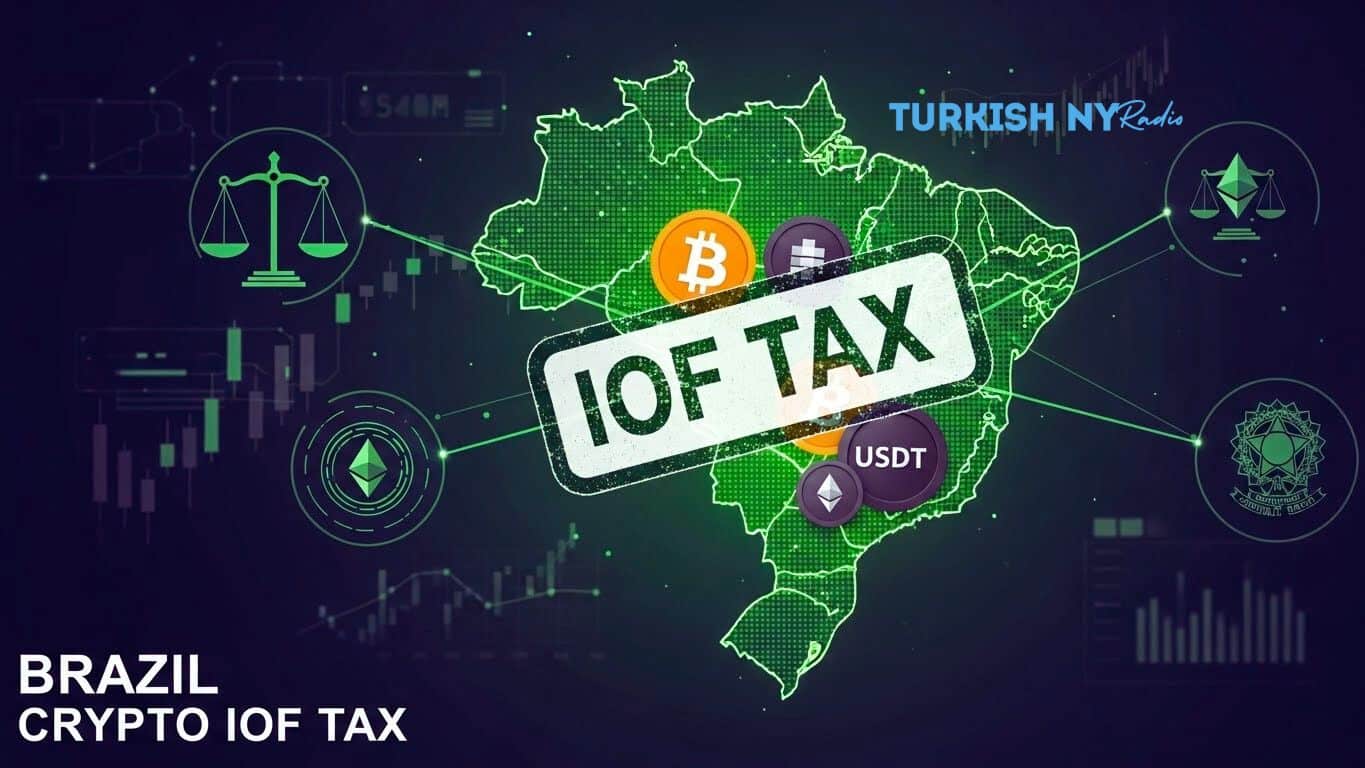
The IOF (Tax on Financial Operations) has finally been extended to cryptocurrency transfers by the Brazilian government. That is especially the case for transactions with stablecoins and other crypto assets that many now consider to be foreign-exchange tools.


The reform puts to rest years of uncertainty as to whether digital-asset transfers were covered by traditional tax rules, while granting authorities a legal basis on which to impose IOF on a wider range of crypto transactions.
Officials said the move seeks to ensure compliance and to close a loophole that had allowed some people to avoid paying FX taxes by using crypto for cross-border payments or remittances.
The change in tax is due to be introduced via regulations in February 2026.
Brazil’s Crypto IOF Tax Reshapes Stablecoin Dominance
This is according to data from Chainalysis, which reveals that Brazil reached an average of approximately $318.8 billion in crypto transactions between July 2024 and June 2025, ranking the country as Latin America’s biggest cryptocurrency economy.
More than 90% of that came from stablecoins, or digital assets pegged to fiat currencies, employed for payments, remittances, and cross-border transfers.
That number reflects the magnitude, and rapid pace, of crypto adoption in the region. Brazil has recently risen to 5th in the world on the 2025 Global Crypto Adoption Index as institutional adoption and retail consumption grow strong.
With crypto volumes already approaching approximately one-third of all transactions in Latin America, the increased IOF tax may lead to a reshaping of payment flows and user behavior across the nation.

New Bill Ties Stablecoin to FX, Closing Tax Loopholes
The regulatory pivot is based on a defining resolution of the Central Bank of Brazil, which has recently determined that fiat-pegged virtual assets, among them most stablecoins, will be treated as foreign-exchange operations.
Under these rules, transfers, purchases, and settlements with stablecoins will be considered by the central bank as FX (foreign exchange) transactions, which means they’ll fall under the obligation to pay IOF, the same tax that applies to traditional currency exchanges.
Officials describe the shift as important to thwart “regulatory arbitrage,” where stablecoins were being used as backdoor replacements for traditional FX transfers, particularly when it comes to cross-border payments and remittances.
Here’s What the Israeli “IOF Taxation” Means for Crypto Users and Companies
With stablecoin now attached to FX norms, some transactions that were previously tax-free will be subject to IOF duty. Although the specific rate has not been detailed, previous IOF bands on FX transactions in Brazil have varied between 0.38% and 6.38%, depending upon the type of movement.
The tax is expected to affect cross-border payments, remittances, and the more recently burgeoning import-related stablecoin flows.
The crypto capital gains rules are unaffected, but with the extra layer of transaction tax, how stablecoins are utilized in the future might well depend on if that pushes trades more toward fiat-based transfers or compels compliance through regulated exchanges.

Confidence in Institutions Grows Despite Tightened Rules
The country has seen the biggest global crypto firms as well as local fintech platforms expanding despite tightening regulations.
However, the certainty around how crypto-FX is being classified and taxed in some regions has apparently given large institutions more confidence; they simply view the massive scale of the market and its transparent rules to justify what might be perceived as a high (reasonable) compliance cost.
As crypto adoption is now well-entrenched, stablecoins and digital assets are considered fundamental infrastructure within the BRA financial system.
The IOF tax extension could change flows, but it also portrays a market that is growing fonder of how to include crypto under traditional financial oversight.
Summary
Brazil has enacted the Brazil Crypto IOF Tax (CRYPTOLAWIOF), implementing its country’s standard financial operations tax on cryptocurrency transfers, in particular stablecoin transfers that were defined as foreign exchange operations.
It comes after crypto usage has continued to surge, with more than $300B in transfers all fueled by stablecoins. New reporting systems such as DeCripto will increase transparency and reduce tax evasion.
Even with stricter scrutiny, international exchanges and domestic fintech companies are still growing in Brazil for as long as the regulatory clarity exists that builds the long-term market confidence.
Glossary of Key Terms
IOF (Imposto sobre Operações Financeiras)
A tax Brazil imposes on financial transactions. Call it, if you will, a little surcharge when trading money or paying some bills.
Stablecoins
“Stablecoins,” currencies that will not lose or gain value over time and are loosely pegged to the price of more common currency like the U.S. dollar, can be thought of as digital cash.
Foreign-Exchange (FX)
Trading one currency for another. You don’t define using reais to buy dollars as FX, OK, so now a handful of crypto transfers fit the bill.
DeCripto System
A new government reporting tool in Brazil is making it easier for the authorities to monitor cryptocurrency activity, akin to the way banks report financial transactions.
Cryptocurrency Transfers
Transmitting digital money from one wallet to another, akin to sending a payment on a mobile app but with crypto instead of dollars.


Tax Reporting
Telling the government about money that was earned or uses of money so it can assess how much tax to collect.
Regulatory Compliance
Adhering to similar guidelines as those governing financial services. It keeps systems safe, legal, and monitored.
Cross-Border Payments
Transferring money to someone in a different country. Many people use stablecoins to do this more quickly and cheaply than they can through regular banks.
FAQs About Brazil’s Crypto IOF Tax
What is the Brazil Crypto IOF Tax?
The Brazil Crypto IOF Tax would extend the country’s financial operations tax to cryptocurrency transfers, including payments made in stablecoins, to categorize digital assets as foreign exchange transactions.
Will the IOF tax raise stablecoin transfer costs?
Yes. Cross-border and FX-type stablecoin transfers could also be subject to additional IOF charges, making it more expensive for users or businesses using international crypto payments and remittances.
How will Brazil watch out for taxing cryptocurrencies via IOF?
Via the DeCripto reporting mechanism and international data-sharing conventions for extra scrutiny of digital-asset flows and slashing tax evasion on crypto platforms.
What will be needed for compliance updates by those who use, or operate with, crypto?
Yes. New reporting requirements for platforms processing stablecoins. Users need to ‘cross-check’ tax rates, accurately trace transactions, and conduct their operations in line with Brazil’s regulatory steps.