
This article was first published on TurkishNY Radio.
A quiet financial change is quietly occurring in China and it’s beginning with a question. ‘Can Bitcoin now protect long-term value better than high-end property?’ This might come as unexpected news from the country’s top. But for decades, high-end homes have been synonymous as the ultimate symbol of stability.


It shaped how success was measured and how wealth was preserved across generations. Yet new conversations on social platforms reveal a surprising trend. Investors are comparing multimillion-yuan homes with a digital asset once viewed as risky and unproven.
The contrast raises a more profound curiosity about what people value most during uncertain economic cycles. As markets change and mobility becomes a priority, the search for a reliable store of value is pushing Bitcoin into discussions once dominated by real estate, opening the door to a significant rethinking of wealth strategy.
Why Luxury Property Once Ruled the Wealth Landscape
Luxury property held an unmatched influence in the financial mindset across China for many years. Limited access to global markets and strict capital controls steered households toward real estate. A home did more than generate returns. It carried emotional weight and cultural meaning. It marked success, security, and continuity.
Investors accepted long debt cycles because homes symbolized generational achievement. Even when liquidity was low, the sense of stability outweighed the risks. This perception shaped financial choices for families across the country.
The Sudden Question: Is Property Still a Safe Store of Value?
Recent discussions on Weibo and Xiaohongshu show a clear change. Wealthy users were comparing luxury homes and Bitcoin, Nvidia stock, BNB, all assets priced for long-term value, as evidenced by nearly two-thirds of all internet votes up to those times.
Some people think that property markets are changing and will no longer be the same as before. According to official data, average residential building sale prices in 70 large and medium-sized cities have declined for years. In the major markets of Beijing, Shenzhen and elsewhere, high property values have continued to soften as 2017 comes to a close.
At the same time of increasing money supply and falling interest rates, these conversations point to a changed reason to buy property. No longer does a feeling of security come from bricks and mortar that cannot easily be taken away.

The Liquidity Divide: Why Speed Matters More Than Ever
Liquidity plays a key role in this shift. High-value homes take time to sell. Buyers shrink during downturns. Policy rules slow the sale process. Large transactions can draw regulatory attention. These factors reduce financial flexibility at moments when speed matters most. In contrast, assets such as Bitcoin, foreign equities, and global funds settle in near real time.
Analysts note that crypto markets never sleep, allowing investors to exit or rebalance at any time. Research from an independent blockchain analytics platform shows that global digital asset activity spikes during periods of uncertainty, driven by this constant liquidity.
Investors with large portfolios value speed, especially when markets turn unpredictable. This contrast shapes how stores of value are now judged.
Bitcoin Gains Appeal as a Portable Reserve
Many investors now view Bitcoin less as a speculative asset and more as a movable reserve of value. Its appeal lies in its mobility. It can cross borders without relying on local systems. It can be divided into smaller units. It can be sold at any moment. That is what makes Bitcoin at least strategically for preserving options.
Even when market skidded a few hundred points, the best digital analysts found that big-wallet Bitcoin portfolios continued steadily to swell.
There’s a shift of perspective in these data. Investors are beginning to look at Bitcoin as their hedge against straitjacketed systems, rather than as just another way to amass quick profits. This pattern is increasingly visible worldwide, because digital assets increasingly come across as alternative storage places for valuable things.
The Weight of Visibility: Why High-End Property Raises Concerns
Luxury homes carry hidden costs beyond mortgages. Large property transactions can invite audits or more thorough regulatory scrutiny. High-value real estate is easy to track. It creates long-term records that remain visible across financial systems.
During periods of heightened oversight, this visibility can feel risky. Investors may hesitate to adjust portfolios due to procedural delays. In contrast, digital assets allow quiet, flexible rebalancing.
Guidance published by international financial task groups highlights that oversight frameworks evolve, yet digital assets still offer wider operational freedom. This difference in visibility shapes the evolving mindset among wealthy investors.
Younger Generations Reject the Old Wealth Formula
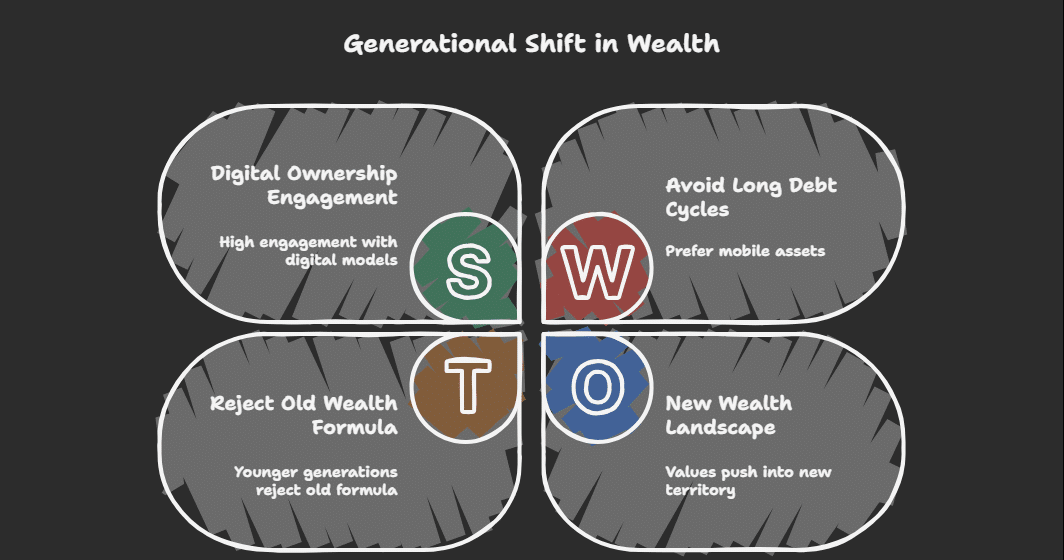
Age shapes how people respond to property trends. Older generations experienced decades of rising home values, so they still trust property as the safest asset. For them, homes represent family stability. Younger investors grew up with fast global markets and digital wealth systems.
Many work in international sectors, travel often, and engage with borderless technologies. Their exposure to crypto, Web3, and global markets influences their choices. They avoid long debt cycles and prefer mobile assets.
Developers note that younger users show high engagement with digital ownership models, from tokens to digital identities. This group sees Bitcoin and other assets as tools for mobility, not symbols of status. Their values push the wealth landscape into new territory.
Social Media Sparks a Cultural Rethink of Wealth Identity
More and more people locate information via social media. Wealthy users openly commiserate on the hardship of maintaining properties they’ve bought when house prices fall. Some express fear of owning assets they cannot quickly sell. Others tell stories about touring high-end apartments and worrying about future price crashes.
A growing number of users compare liquidity charts, Bitcoin pricing tools, and real estate data side by side. These comparisons fuel a new cultural lens.
By now wealth is not only defined in terms of what a household owns, but rather in how easily the household can turn that wealth into something else. This cultural shift throws up new questions about what it means to be economically safe in a global economy.
How Analysts Compare Bitcoin and Real Estate Performance
Research firms often compare real estate cycles with Bitcoin’s long-term supply model. Bitcoin’s uniform 21 million coins ensures predictability in scarcity of supply; property markets, however, are dependent upon the economy or government policy changes.
Material from market data providers suggests that rather than following domestic cycles and trends on a long-term basis, Bitcoin is more closely bound up with the world’s total supply of liquidity. This behavior appeals to investors who want assets tied to worldwide flows.
Real estate, on the other hand, remains tied to local rules and buyer sentiment. Analysts also discuss Solana’s rising role in digital asset markets, noting how its fast network and active communities spark price analysis on social media. These discussions strengthen the idea that global blockchain systems now compete with traditional stores of value.
The Role of Capital Controls in Rising Bitcoin Interest
Capital controls influence how investors view mobility, and official guidelines confirm that restrictions limit the amount of capital that can cross borders each year, as set by the country’s central monetary authority. Real estate magnifies this issue because property ties wealth to one location. During periods of tighter policy, this creates anxiety. Bitcoin offers an alternative that functions across borders.
Academic research shows that digital assets often serve as safe channels during periods of restriction, especially in regions with changing financial rules. Developers and policy experts emphasize that blockchain systems offer transparency while enabling users to maintain financial autonomy. This autonomy aligns with the needs of wealthy investors who seek security and freedom in a single asset.
The Bigger Picture: A New Definition of a Store of Value
The debate is not about replacing property. Homes still have cultural and emotional importance. Instead, the shift reflects a broader change in financial logic. Wealth preservation now depends on liquidity, mobility, and diversification. Investors want assets that work in fast markets.
They want protection from slow procedures and sudden rule changes. Bitcoin fills this need by offering global pricing and constant liquidity. The result is a new definition of a store of value. It is no longer tied solely to physical assets. It is tied to freedom of movement and access to global systems.
Conclusion
The growing interest in Bitcoin among wealthy investors in China reveals a deeper transformation. It reflects new priorities shaped by liquidity, flexibility, and visibility. Property still matters, but it no longer stands alone.
Digital assets now shape how people think about long-term stability. This change will shape the flow of capital, market behavior, and cultural identity for the year to come.
Finance, blockchain, and economics, although not everyone may be interested in all of these topics, those reading this article will respond positively. And as global systems keep on evolving, it is only natural that there will be more impetus to help speed up these trends further.
This article is for informational purposes only and does not constitute financial advice. Readers should conduct their own research before making investment decisions.
Glossary
Bitcoin: A digital asset with 21 million coins in fixed supply.
Liquidity: The speed at which an asset can be sold off.
Capital Controls: Rules that restrict cross-border money flows.
Store of Value: Something that holds its worth well over time.
Blockchain: A decentralized ledger of transactions, built on a peer-to-peer network.
FAQs
What makes Bitcoin attractive to high-net-worth investors?
It offers liquidity, mobility, and global pricing. These features help investors manage risk during uncertainty.
Why is luxury property losing its appeal?
Markets face slower sales, falling prices, and more oversight. This reduces confidence in long-term stability.
Does this shift mean property will no longer matter?
Property still holds cultural value. It will remain important, but other assets now compete to serve as wealth storage.
How will this trend influence global markets?
It may increase digital asset movement and reshape investment strategies for wealthy individuals.