
The debate over Bitcoin vs Gold has never been more intense. For years, investors and analysts have argued about which asset represents the truest form of safe-haven protection.
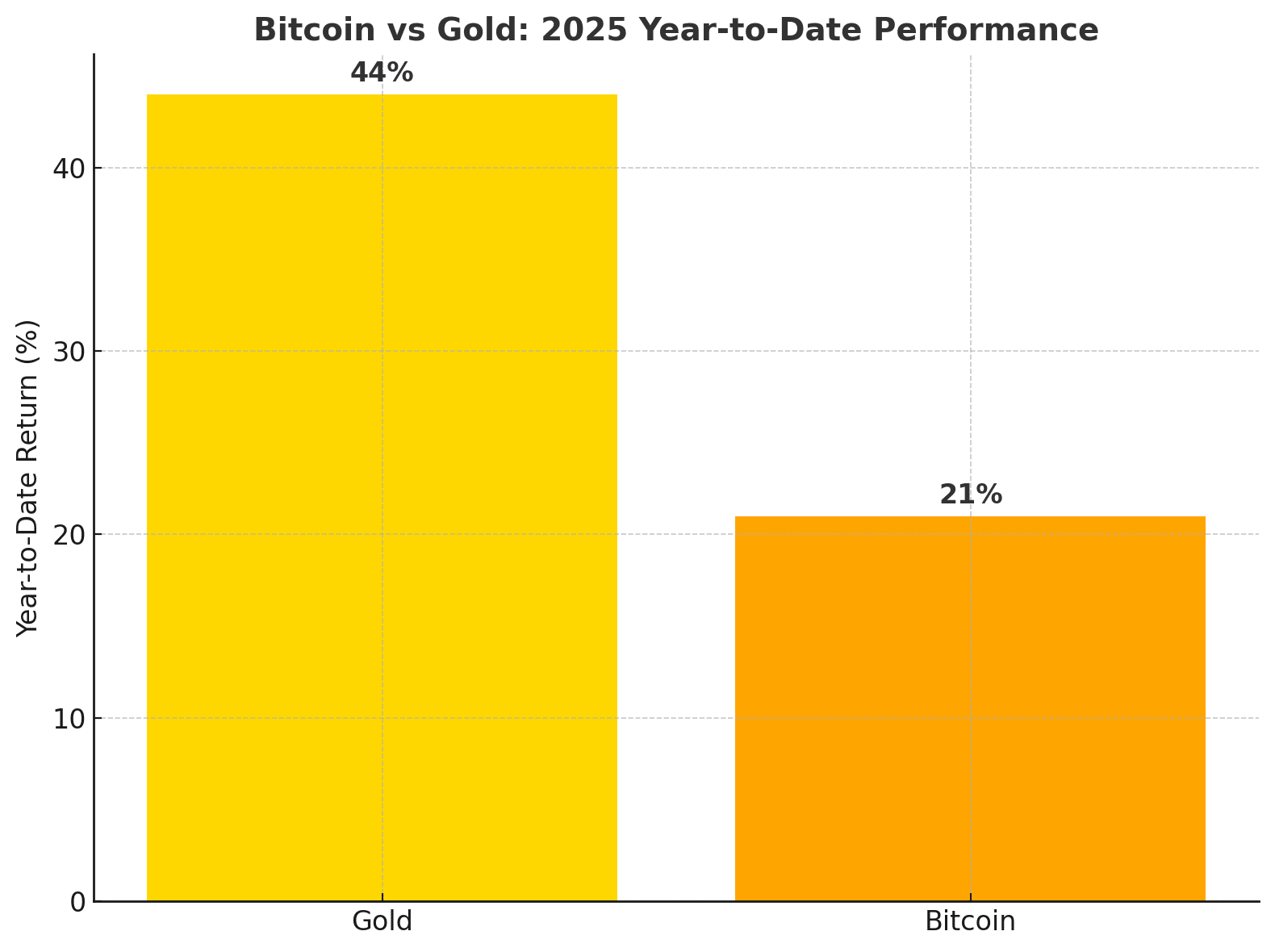
This September, gold smashed to a new all-time high near $3,791 per ounce, climbing more than 40% year-to-date. In contrast, Bitcoin, despite institutional inflows and wider acceptance, has risen just over 20% in the same period.


The divergence has triggered global conversations about whether Bitcoin’s “digital gold” narrative is losing momentum at the very moment traditional gold shines brightest.
Gold’s Record-Breaking Run
The precious metal’s surge comes against the backdrop of heightened economic uncertainty, persistent inflationary fears, and a strengthening U.S. dollar.
Historically, gold has thrived in such environments. Its tangible form, centuries-long track record, and global liquidity make it a safe-haven magnet during turbulent times.
The current rally highlights how traditional markets still lean toward physical gold when the stakes rise. Analysts argue that institutional players, who were once seen as pivoting toward Bitcoin, are instead doubling down on the metal they know.
This discrepancy has cast the Bitcoin vs Gold narrative in a new light. While gold proves its resilience, Bitcoin’s volatility and relatively short history are cited as barriers to its acceptance as a crisis hedge.
Bitcoin Struggles to Keep Pace
While gold ascends, Bitcoin has faltered in its safe-haven role. Exchange reserves show only modest outflows, signaling that institutional conviction remains cautious.
Market data reveals BTC’s correlation to risk assets like tech stocks has risen, undercutting its reputation as a hedge.
Farzam Ehsani, CEO of VALR, captured the mood when he noted on X, “Recent crypto market performance and liquidity events created a short-term rotation to tangible havens like gold.”
His comments underscore how capital flight toward traditional assets has left Bitcoin lagging in the Bitcoin vs Gold debate.
Despite this, Bitcoin’s advocates remain undeterred. They argue that macro stress and regulatory overhangs temporarily suppress BTC’s price, but the structural drivers, such as ETF approvals and scarcity, remain intact. Proponents see the digital asset as an eventual winner, even if gold dominates the present cycle.
The Role of the U.S. Dollar
Adding complexity to the Bitcoin vs Gold contest is the U.S. dollar’s rebound. A stronger dollar often cools demand for both assets, but the impact has been uneven. Gold’s climb paused briefly when the dollar index ticked higher, yet its upward trajectory quickly resumed.
Bitcoin, by contrast, showed sharper vulnerability to dollar strength, falling more aggressively in parallel with equity markets.
Analysts believe this divergence further highlights how investors perceive risk. Gold retains its immunity to currency shocks, while Bitcoin, despite being outside the fiat system, is increasingly traded like a risk-on asset.
As one strategist posted on X, “Bitcoin is behaving less like digital gold and more like tech beta.” That perception complicates its claim as a hedge, even as advocates continue pushing the Bitcoin vs Gold equivalence.
Shifting Narratives and Investor Sentiment
The heart of the Bitcoin vs Gold discussion lies not only in price performance but in narrative strength. Gold’s story is well-established: it has preserved value across empires, currencies, and crises. Bitcoin, however, is still writing its narrative.
While it has survived multiple crashes, regulatory battles, and skepticism, its relatively short 15-year history leaves open questions about resilience.
Retail traders, particularly in emerging markets, continue to see Bitcoin as a hedge against local currency collapse.
Yet global institutions, pension funds, insurers, and sovereign wealth funds still prefer the stability of gold. This gap in perception is central to understanding why Bitcoin has lagged in 2025’s safe-haven race.
Nevertheless, some argue that this very underperformance may create an opportunity. If Bitcoin consolidates and regains momentum, the upside could be significant, especially if catalysts like further ETF inflows or regulatory clarity arrive.
In this way, the Bitcoin vs Gold debate remains open-ended, with cycles favoring each asset at different times.
Conclusion
The clash of Bitcoin vs Gold is more than a contest of price charts; it is a battle for trust, history, and narrative control.
Gold’s surge to record highs reinforces its role as the world’s safe-haven of choice. Bitcoin’s lag reminds investors that its path to mainstream acceptance remains bumpy, defined by volatility and perception challenges.


Yet dismissing Bitcoin entirely would be shortsighted. Its scarcity, portability, and growing institutional interest ensure it remains part of the conversation. In the end, Bitcoin vs Gold may not be about one replacing the other, but about coexistence in portfolios shaped by a mix of tradition and innovation.
FAQs
Q1: Why is gold outperforming Bitcoin now?
Gold has benefited from macro uncertainty, inflationary fears, and institutional trust built over centuries, pushing it to new record highs.
Q2: Does Bitcoin still qualify as “digital gold”?
While some critics argue its performance undermines the label, Bitcoin’s scarcity and adoption suggest its long-term “digital gold” case remains.
Q3: How does the U.S. dollar affect Bitcoin vs Gold?
A stronger dollar typically weighs on both assets, but gold shows greater resilience while Bitcoin tends to mirror risk assets like tech stocks.
Q4: Should investors choose gold or Bitcoin?
Investors often diversify. Gold offers stability, while Bitcoin provides asymmetric upside potential. Both can serve different hedging purposes.
Glossary
All-Time High (ATH): The highest recorded price of an asset.
Safe-Haven Asset: An investment expected to retain or increase value during times of market stress.
ETF (Exchange-Traded Fund): A regulated investment fund that trades like a stock and can hold assets like Bitcoin or gold.
Volatility: The degree of variation in an asset’s trading price, often linked with risk.
Liquidity: The ease with which an asset can be bought or sold without affecting its price.
Correlation: A measure of how closely the price movement of one asset tracks another.