



Bitcoin recovery rally strengthened on Monday as positive macroeconomic indicators pushed more investors to the world’s leading decentralized digital currency. Bitcoin advanced more than 3.7% over the past 24 hours to trade above $111,000 (It had fallen to $103,600 last week).
The upward move came in the wake of record highs for Japanese stocks and stronger-than-expected G.D.P. data from China. The news helped strengthen sentiment for risk assets.


The upturn in Bitcoin prices spurred a more general rebound across the cryptomarket, with large tokens including Ether, Solana, XRP, BNB and Dogecoin rising 3 to 5 percent.
Analysts said the new optimism was a combination of positive global conditions. Strong technical gauges also suggest that Bitcoin’s ascent is far from over.
Economic Boost from Asia
Japan’s Nikkei index climbed to a record 49,000 points, up 25% year to date. The rally followed news of reports that Sanae Takaichi, a proponent of Abenomics, was poised to become Japan’s new prime minister.
Also Read: Bitcoin Price Falters Amid Renewed U.S.–China Trade Strain and Risk-Off Mood
The economic approach, emphasizing low interest rates and fiscal spending, has been a re-assuring signal for investors that Japan will stay the course with its pro-growth agenda. This optimism had contributed towards a stronger Bitcoin recovery rally.
Meanwhile, third-quarter GDP in China was up 4.8 percent from a year earlier, slightly above the expected 4.7 percent. The outcome reinforced confidence among investors and lifted Chinese stocks by nearly 1%.
Dollar Weakness Supports Crypto
The dollar index was down to 98.40, a minuscule retreat that appeared to help prop up dollar-denominated assets like Bitcoin. A weaker dollar often benefits cryptocurrencies since it makes global purchasing power stronger.
Gold, meanwhile, was flat at around $4,250 an ounce with a lack of upside momentum apparent. Some analysts say that investors could be moving away from traditional safe havens and toward digital assets.
On-Chain Indicators Turn Bullish
On-chain data continued to show strength behind the Bitcoin recovery rally. The RVT ratio, which compares Bitcoin’s realized capitalization to its on-chain transaction value, has declined in recent days.
| Month | Minimum Price | Average Price | Maximum Price | Potential ROI |
|---|---|---|---|---|
| October | $108,194.61 | $116,084.95 | $123,975.29 |
14.6%
|
| November | $111,250.55 | $115,870.38 | $120,490.20 |
11.4%
|
| December | $111,412.68 | $113,369.75 | $115,326.82 |
6.6%
|
Crypto analytics platforms reported that a decline in the RVT ratio reflects active transfers and accumulation across wallets, not passive holding. This growing network activity strengthens the foundation of the Bitcoin recovery rally.
Institutional and Retail Confidence
Institutional investors have also contributed to the rebound. Michael Saylor, executive chairman of Strategy, suggested on Twitter that his company might raise its Bitcoin exposure.
These kinds of moves can build trust among retail traders, giving individual investors more confidence about entering the market. Crypto analyst Austin Arnold of Altcoin Daily drew parallels with 2020, when Bitcoin went on to rally by more than 500% after gold printed its top.
Analysts concurred that the Bitcoin recovery rally is more than just a short-term response. Bitcoin still consolidates as its long-term holders buy. The trend points to an increasing dem
Technical Structure Remains Strong
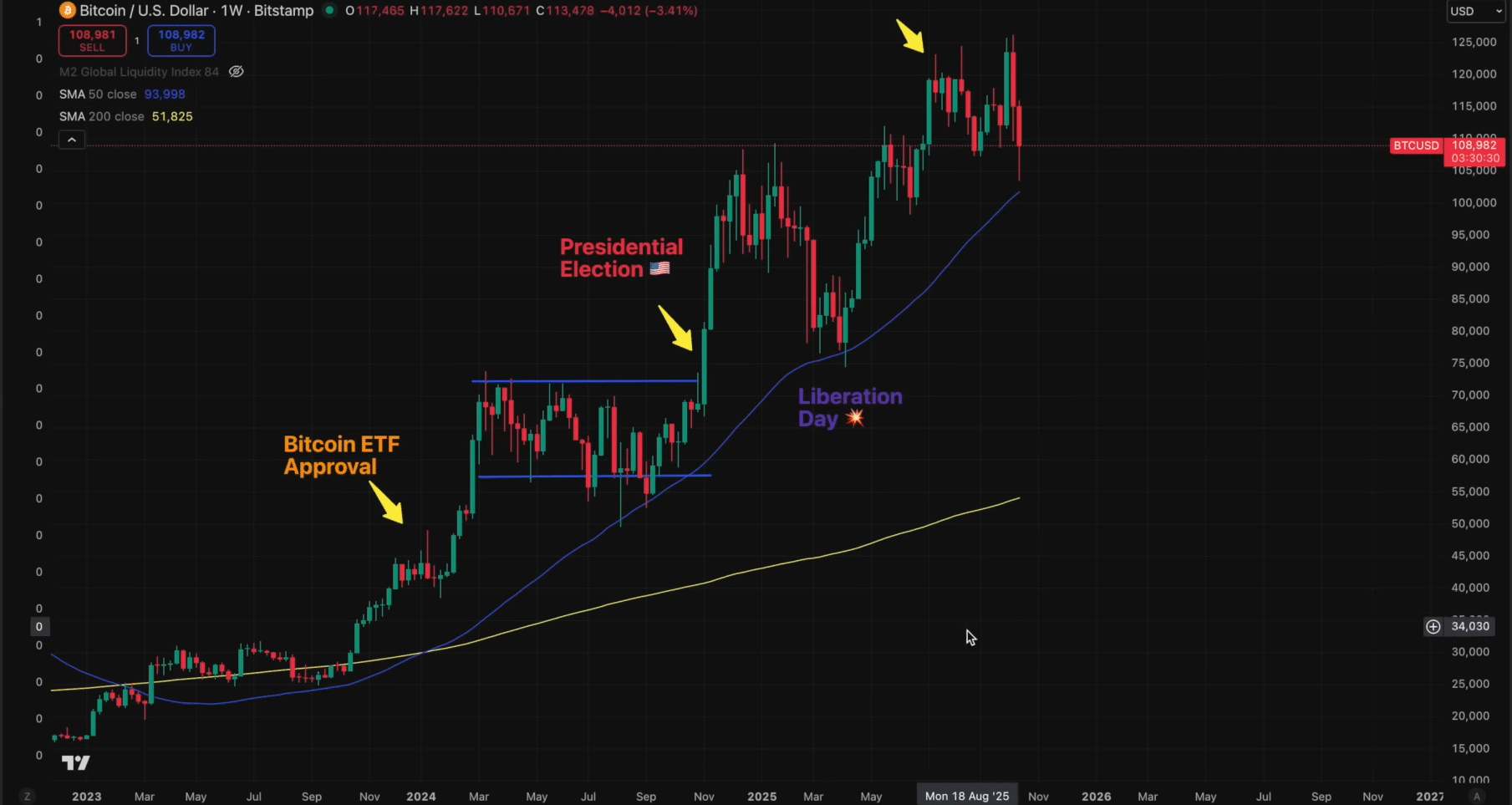
On a technical basis, Bitcoin’s price is still far above its 200-day moving average, which essentially separates bull and bear trends. Strong support is seen in the 50-week moving average.
Analysts observe that Bitcoin has been bouncing off these levels time and time again during corrections, confirming buyer power. This technical formation compounds the prospects for a Bitcoin recovery rally.


Outlook and Risks Ahead
If global liquidity is maintained, the Bitcoin recovery rally will likely see further continuation. Expected U.S. Federal Reserve rate cuts later in the year could drive money into risk assets, further supporting sentiment.
Analysts note BTC must hold $108,000 to establish momentum. A daily close above $111,000 would be strong and hint at the next leg higher in the recovery rally from Bitcoin that could continue into next quarter.
Conclusion
The ongoing Bitcoin recovery rally is a testament to the increasing faith people have in digital currencies despite a relatively improving global situation. Bubble-Case Strong economic indicators out of Asia, a weaker dollar, and positive on-chain data have all fueled Bitcoin’s move higher.
Short-term volatility is probably still in the cards but the tone is indicating investors are positioning for lasting growth. If BTC is able to maintain key support levels, the ongoing momentum may extend into Q2 as a possible turning point for the macro crypto market.
Also Read: Bitcoin Leads $1B Crypto Market Liquidation as Risk Assets Sell Off Globally
Appendix: Glossary of Key Terms
Bitcoin Recovery Rally: The bounce back in Bitcoin price after a period of decline, indicating a rebound of investor confidence and global liquidity.
RVT Ratio: A blockchain metric that measures the ratio of Bitcoin’s realized capitalization and on-chain transaction value; a lower RVT Ratio tends to indicate that there is active accumulation underway.
Moving Average (MA): A technical indicator that measures Bitcoin’s average price over time to help spot long-term market trends.
Risk Assets: Investments with a higher risk, but also more potential upside, work better here, such as stocks or cryptos.
Dollar Index (DXY): The value of the U.S. dollar versus major global currencies; Bitcoin and other digital assets often gain when it weakens.
Institutional Investors: Financial institutions, and big companies whose actions do affect the direction of the Bitcoin market.
Frequently Asked Questions About Bitcoin recovery rally
1- What is the Bitcoin recovery rally?
It refers to Bitcoin’s rebound above $111,000 after recent lows, signaling renewed investor confidence and market strength.
2- Why are Asian markets important for Bitcoin?
Strong performance in Japan and China boosts global risk appetite, which often translates into higher crypto demand.
3- How does the dollar affect Bitcoin?
A weaker dollar increases global investment in Bitcoin as traders look for better returns in alternative assets.
4- What technical levels should investors watch?
Analysts are monitoring support around $108,000 and resistance near $111,000 to gauge short-term market direction.