
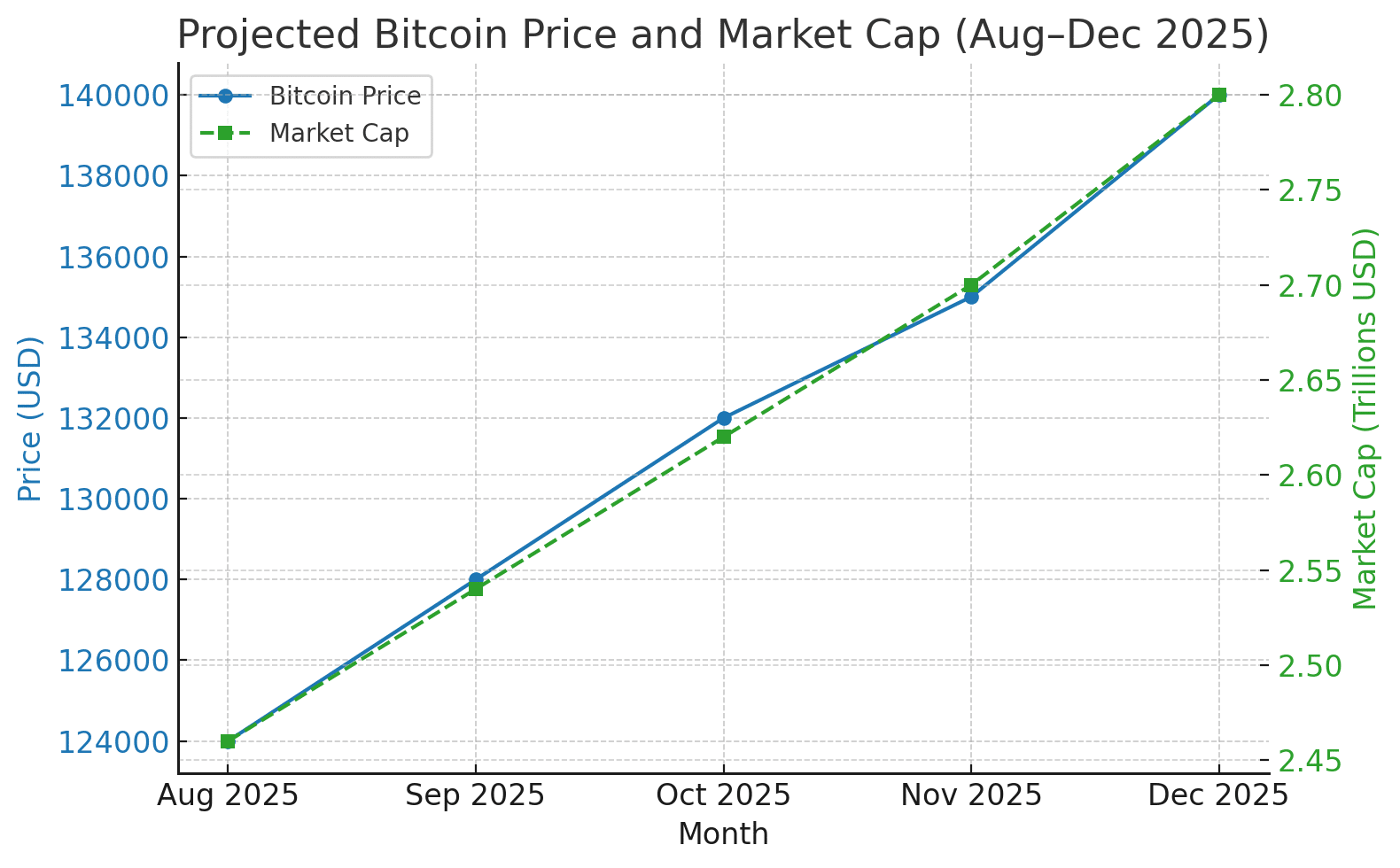
Bitcoin has achieved another milestone, overtaking Google to become the world’s fifth-largest asset by value. This feat, with a Bitcoin market cap of over $2.46 trillion, comes as the cryptocurrency trades near record highs above $124,000, fueled by macroeconomic tailwinds and rising institutional demand.
The Increasing Power of Bitcoin Market Cap
The most recent increase in Bitcoin market cap is being driven by a mix of positive economic conditions and increased investor demand for alternative assets.


With the US dollar falling on predictions of a September Federal Reserve rate drop, traders and institutions alike are turning to risky assets, with Bitcoin emerging as the primary beneficiary. According to one prominent market expert,


“Bitcoin’s rise isn’t just about speculation anymore, it’s about its evolving role as a recognized, global store of value.”
Institutional Flows and ETF Expansion
Institutional capital continues to flow into the market, aided by the growth of spot Bitcoin ETFs and the new approval to include digital assets in 401(k) retirement portfolios.
This move has made Bitcoin more accessible to mainstream investors and given it a new layer of respectability in global finance. Large corporate treasuries are also playing a role, with numerous corporations raising shares in expectation of additional increases in Bitcoin market cap in the coming quarters.
Macro tailwinds power the rally
The macroeconomic background has played an important role in Bitcoin’s ascent. A sinking US dollar, dovish central bank signals, and buoyant stock markets have all combined to create an ideal climate for digital assets to flourish.
Such circumstances have historically supported long-term bull cycles, and the current situation seems to be no exception. As one expert stated, “The correlation between monetary easing expectations and Bitcoin strength is as clear as ever.” For many traders, the expanding Bitcoin market cap is a reflection of both economic policy and cryptocurrency usage.
Bitcoin Price Targets and Market Outlook
Technically, Bitcoin’s supremacy shows no indications of diminishing. Analysts are eyeing the $125,000 level as a potential breakout trigger, with upside estimates ranging from $135,000 to $140,000 in the coming months.
A prolonged rise may bring Bitcoin market cap close to $3 trillion, putting it in direct rivalry with silver and Saudi Aramco on the global asset leaderboard. However, the way forward is not without hazards, with unexpected policy changes or global economic shocks capable of quickly changing attitude.
Conclusion
Bitcoin’s market capitalization surpassing that of Google is more than just a symbolic success; it represents a fundamental shift in how the world sees digital assets. The increase in Bitcoin market cap shows cryptocurrency’s rising integration into mainstream finance, which is driven by institutional acceptance, macroeconomic alignment, and retail excitement.
While volatility remains a feature of the market, Bitcoin’s momentum shows that it is solidifying its position as a key component of the global financial system.
FAQs
What is current Bitcoin market cap?
It is approximately $2.46 trillion, making Bitcoin the fifth-largest global asset.
Why did Bitcoin surpass Google in value?
A combination of ETF inflows, institutional accumulation, and macroeconomic factors pushed Bitcoin market cap higher than Google’s.
What could drive Bitcoin’s price higher from here?
Breaking the $125,000 level, sustained institutional buying, and favorable economic policies could push prices toward $140,000.
Is Bitcoin’s growth sustainable?
While long-term fundamentals are strong, market volatility means sharp fluctuations remain possible.
Glossary
Bitcoin market cap – The total value of all mined Bitcoin, calculated by multiplying price by circulating supply.
ETF (Exchange-Traded Fund) – A fund that trades on stock exchanges, giving investors exposure to assets without direct ownership.
401(k) retirement portfolio – A U.S. tax-advantaged retirement savings plan that can now include digital assets in some cases.
Monetary easing – Economic policy that lowers interest rates to stimulate growth, often boosting risk assets.
Volatility – The degree of variation in trading prices over time, common in cryptocurrency markets.
Asset leaderboard – Ranking of global assets by market capitalization.