




This article was first published on TurkishNY Radio.
Institutional crypto banking in Hong Kong has reached a new milestone as Swiss-based AMINA Bank secures a significant license uplift for its local subsidiary. The fresh approval from the city’s securities regulator allows AMINA Hong Kong to provide regulated crypto trading and custody to professional investors at a time when local digital asset volumes are rising.


For institutions that waited on the sidelines, the signal is that crypto in the city is moving into a more mature, supervised phase.
A New Type 1 License For Institutional Crypto
The upgraded Type 1 license permits the firm to deal in crypto related securities and to execute spot trades in a curated list of digital assets. AMINA Hong Kong already holds permissions to advise on securities and to manage assets, so the firm now acts as a bridge between traditional finance and the crypto economy.
For treasurers, wealth managers, and family offices, that mix of banking background and visible supervision serves as a practical test of credibility and risk management strength.
Secure Access To Thirteen Major Cryptocurrencies
Under the new framework, the platform can trade and safeguard thirteen leading cryptocurrencies, including large cap coins such as Bitcoin and Ether, major stablecoins, and selected decentralized finance tokens. Client assets sit inside institutional-grade control systems that feature segregation, independent audits, and strict checks designed to limit the risk of loss or misuse.
Services are restricted to organizations, corporates, and high net worth individuals that qualify as professional investors under Hong Kong rules, which keeps the focus squarely on sophisticated capital.
Market Volumes And Key Crypto Health Indicators
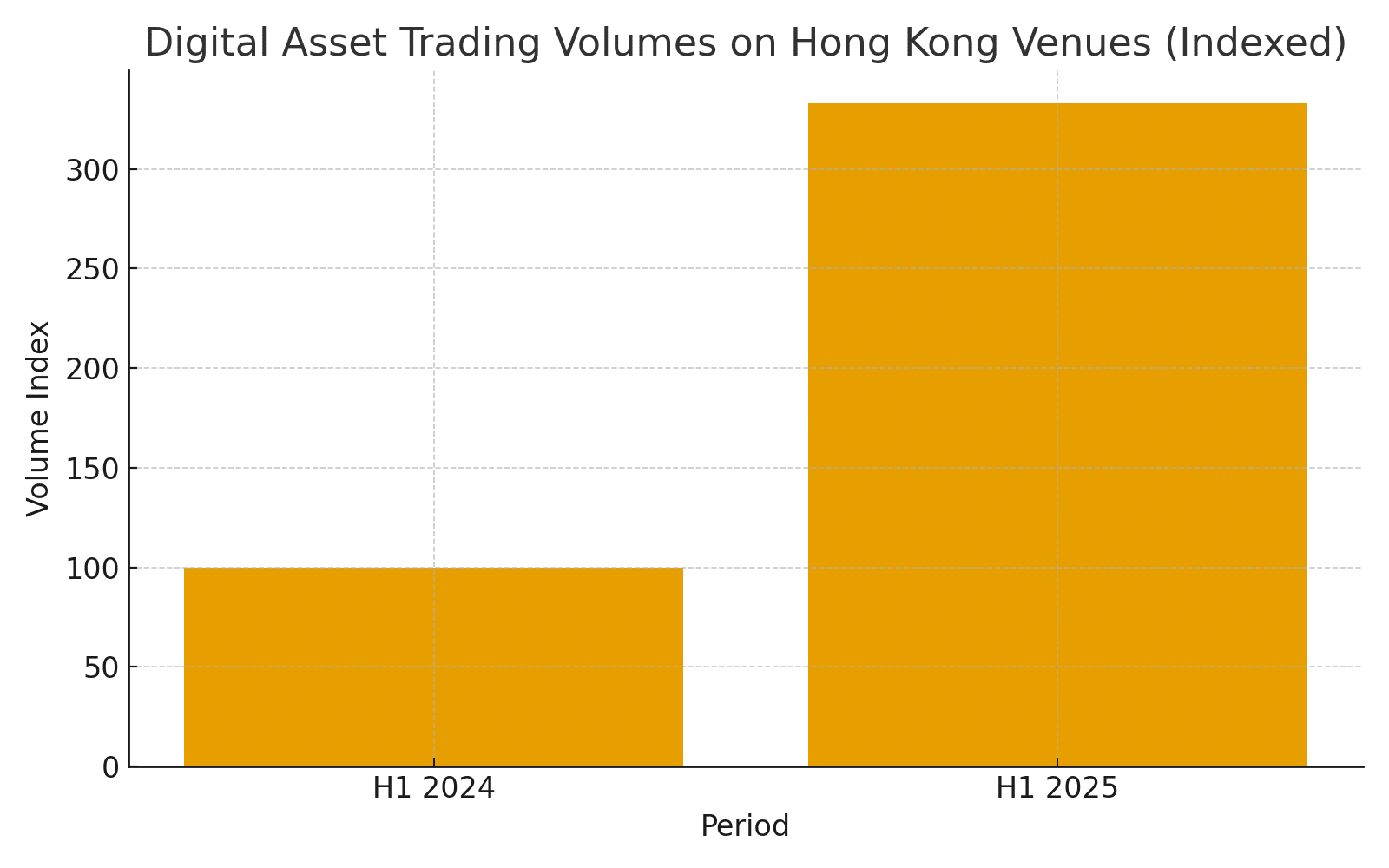
The timing of the decision reflects a clear shift in local activity. Market figures highlighted by the bank point to a 233 percent jump in digital asset volumes on Hong Kong venues in the first half of 2025 compared with the same period in 2024. Analysts read this through three indicators that often guide institutional allocation decisions, namely liquidity, participation, and regulatory clarity.
Liquidity appears in deeper order books and tighter spreads. Participation shows up in larger average trades and more stable flows from funds. Regulatory clarity becomes visible when the number of licensed entities rises and more trading moves from offshore platforms to fully supervised local venues.
Beyond Spot Trading Toward Structured Digital Products
AMINA Hong Kong plans to use this momentum with a product shelf that reaches beyond simple spot exposure. The institution already offers dual currency certificates, capital protected notes, and index linked strategies that reference crypto markets, while signalling interest in tokenized real world assets and structured portfolios.
These tools create different combinations of risk and return, from income oriented coupons to momentum based baskets, and they keep those strategies inside a framework that subjects them to ongoing oversight and risk controls.

Hong Kong’s Race To Lead In Regulated Digital Assets
The development aligns with a broader push by the city to attract digital asset businesses while maintaining strong investor safeguards. Policymakers have built regimes for stablecoins, custody, and virtual asset trading platforms, and they continue to remind the public that licensed providers should be the first choice.
At the same time, Hong Kong competes with other hubs that are refining rules of their own, including centres in the Middle East, Europe, and North America. In that contest, entries from international banking groups are often viewed as a sign that rules are predictable enough for long term planning and serious capital.
What The License Means For The Wider Crypto Market
For the global crypto market, the arrival of a fully licensed institutional bank in Hong Kong does not guarantee higher prices, but it does strengthen the channels through which capital can move in and out of digital assets. Stronger custody can help reduce counterparty risk, while transparent onshore trading can support better price discovery and cleaner benchmarks.
If volumes continue to grow and more institutions route activity through regulated venues, indicators such as turnover, open interest tied to onshore flows, and the share of trading on supervised platforms may play a larger role in how global investors judge the health of the sector.
Institutional Crypto Moves From Experiment To Infrastructure
The next chapter will show whether demand from asset managers, corporate treasuries, and private wealth desks is strong enough to use this new channel at scale. Sentiment may rise or fall, yet the license structure itself has become part of the long term rail system that supports digital assets in Asia.
For now, the message is clear. Institutional crypto in Hong Kong is moving from experiment to infrastructure, and firms that secure a regulatory foothold at this stage are likely to shape how that structure matures over time.


Frequently Asked Questions
What does AMINA’s new license actually allow
The new approval allows AMINA Hong Kong to provide regulated spot trading and custody for a defined list of major cryptocurrencies to professional investors, alongside existing permissions in securities advisory and asset management.
Who can access AMINA Hong Kong’s crypto services
The platform targets organizations, corporates, and high net worth individuals that meet the local definition of professional investor, rather than the broad retail market.
Why is the 233 percent volume increase important
The increase signals stronger liquidity and growing institutional participation, two key indicators that large investors follow when they consider whether a market is deep and mature enough for meaningful exposure.
How does this affect global crypto prices
The license itself does not set prices, but it improves market structure by adding safer custody, clearer regulation, and additional institutional channels, which can support more stable and transparent price formation over time.
Which crypto indicators matter most for institutions in this context
Institutions typically track liquidity, trading volumes, volatility, derivatives open interest, onchain activity, and the share of flows that run through regulated venues when they assess the risk profile of digital assets.
Glossary Of Key Terms
Type 1 license
A regulatory category in Hong Kong that covers dealing in securities and, in this case, certain crypto related activities such as execution of spot trades for qualified clients.
Professional investor
A regulated client category that includes institutions, corporates, and individuals with large financial portfolios, subject to specific net worth and experience thresholds.
Custody
The secure holding of client assets, including private keys for cryptocurrencies, under controlled procedures such as segregation, audits, and strict operational checks.
Stablecoin
A digital token that aims to keep a stable value, often linked to a fiat currency, and widely used as a medium of exchange and settlement instrument in crypto markets.
Tokenized real world asset
A traditional asset, such as bonds or real estate, that is represented on a blockchain as a digital token so that it can be traded and settled on digital infrastructure.