![Sun [New]](https://s2.coinmarketcap.com/static/img/coins/64x64/10529.png)


![BitTorrent [New]](https://s2.coinmarketcap.com/static/img/coins/64x64/16086.png)


This article was first published on TurkishNY Radio.
The crypto market has been moving like a crowded exit, with traders prioritizing liquidity and reducing leverage after a sharp risk-off turn. Bitcoin briefly tested $60,008.52 before bouncing toward $64,153.24, while Ether dipped to $1,751.94 and later recovered near $1,891.27, reflecting a market that is still trying to find its footing.


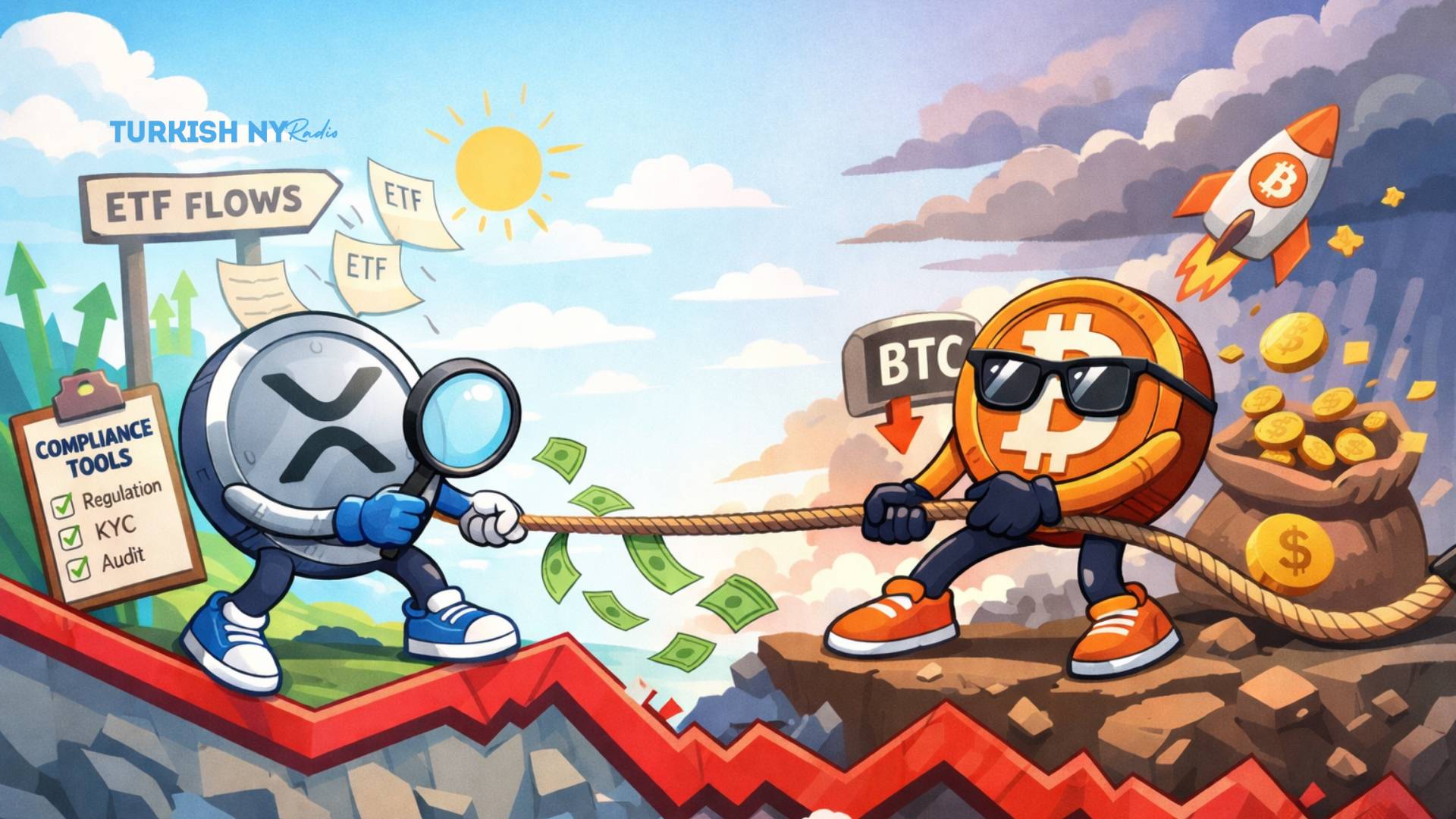
In that environment, XRP has drawn a different kind of scrutiny. Rather than treating it purely as a high-beta proxy, market participants are increasingly viewing XRP through the lens of access, compliance tooling, and where regulated capital may rotate next.
That shift is a big reason XRP price prediction conversations are leaning less on vibes and more on measurable signals like flows, derivatives positioning, and product rails that make it easier for institutions to participate.
XRP price prediction: the signals traders are actually watching
One of the most revealing indicators in a nervous market is where money goes when investors have multiple ways to express the same view. Recent flow commentary around U.S.-listed spot Bitcoin ETFs has highlighted sustained outflows during the drawdown, reinforcing the idea that some allocators have been de-risking rather than buying weakness.
That matters for a simple reason: ETF wrappers sit close to portfolio rules, committee oversight, and risk budgets. When volatility rises, the easiest position to cut is often the one that offers daily liquidity and a clean reporting trail.
It helps explain why Bitcoin can sell off hard even when long-term narratives remain intact, because the short-term market is driven by behavior, not beliefs. A recent market update also noted that the broader crypto market has shed roughly $2 trillion since peaking in October 2024, with more than $1 trillion lost in the past month, a backdrop that tends to accelerate risk reduction.

Against that backdrop, XRP price prediction is being shaped by a different question: not only whether XRP can outperform on a chart, but whether it is gaining incremental demand through routes that look institution-friendly.
Why compliance rails are becoming part of the XRP narrative
XRP’s current narrative is not only about price. It is also about infrastructure that can satisfy the constraints institutional players live with, such as credentialing, counterparty policy, and controlled market access.
A key development is the expansion of a prime brokerage platform that added support for Hyperliquid, positioning the integration as institutional access to on-chain liquidity and derivatives in a more familiar operating model.
On the protocol side, the XRP Ledger’s “Permissioned Domains” framework has been documented as a way to restrict certain activity to accounts holding accepted credentials, effectively creating controlled environments on top of a public network. The documentation describes how a domain can define a list of accepted credentials and how credential holders can gain access automatically.
For readers tracking XRP price prediction, this matters because new participation is often gated by compliance realities. A market can have liquidity, but if large allocators cannot touch it under policy, that liquidity does not translate into sustained demand. Credential-based access is a direct attempt to bridge that gap.
The legal overhang has eased, and markets price that in
Regulatory uncertainty has been a long-running weight on XRP, so any credible reduction in that uncertainty tends to change how investors think about worst-case scenarios.
The SEC announced a joint stipulation to dismiss appeals that resolved the civil enforcement action against Ripple and two executives. A separate legal update also described the case as officially ended, with Ripple agreeing to a $125 million fine, with appeals dropped.
Markets do not hand out “all clear” labels, but they do reprice probabilities. With a major enforcement chapter closed, XRP price prediction models naturally tilt toward market structure factors again: access, flows, and risk appetite.

How traders interpret the current tape
In drawdowns like this, short-term price action is often a story about positioning. Liquidations, margin calls, and forced deleveraging can overwhelm fundamentals. A recent report put crypto liquidations at $2.56 billion over recent days, underscoring how quickly leverage can unwind when volatility spikes.
That matters for XRP as well, because relative stability is sometimes less about “strength” and more about who is still forced to sell. When the market shifts from speculative enthusiasm to capital preservation, the coins that remain “tradable” inside more controlled channels can hold attention longer than expected.
In practical terms, the indicators that tend to influence XRP price prediction in this type of market are straightforward: whether ETF and regulated-product demand persists, whether derivatives leverage continues to cool, and whether institutional rails keep expanding in ways that translate into real flow, not just headlines.
Conclusion
XRP is not immune to macro-driven selloffs, and nobody should pretend a few narrative tailwinds erase market risk. Still, the current cycle shows why XRP can trade differently from Bitcoin during stress.
ETF flow dynamics are reshaping how investors express exposure, leverage unwinds are amplifying volatility across majors, and XRP’s ecosystem has been pushing toward credentialed access and institutional-grade liquidity routes.


For XRP price prediction, the takeaway is less about calling a precise top or bottom and more about tracking the variables that move capital: access, compliance readiness, and whether regulated participation keeps growing even while the broader market is shaky.
Frequently Asked Questions
What is the biggest driver behind current XRP price prediction narratives?
Right now, the strongest inputs are capital-flow signals and market structure. When investors can buy exposure through regulated channels, demand can behave differently than in spot-only cycles.
Why do liquidations matter even for long-term investors?
Liquidations can force selling at the worst moments, pushing prices below levels that fundamentals alone would justify. That is why the market can look irrational during stress, especially when billions in leverage unwind quickly.
How do Permissioned Domains change the XRP story?
They introduce credential-based access control, which can make participation easier for entities that need compliance-friendly environments.
Glossary of Key Terms
ETF flows: Net buying or selling in exchange-traded funds, often used as a proxy for regulated investor demand.
Liquidations: Forced closing of leveraged positions when margin requirements are not met, often accelerating price moves.
Prime brokerage: A service layer that can provide trading access, financing, and risk tools for professional clients across venues.
Permissioned Domains: A framework on the XRP Ledger that restricts access to certain features based on accepted credentials.
Credential: A proof issued on-ledger that can grant access rights inside permissioned environments.
Sources