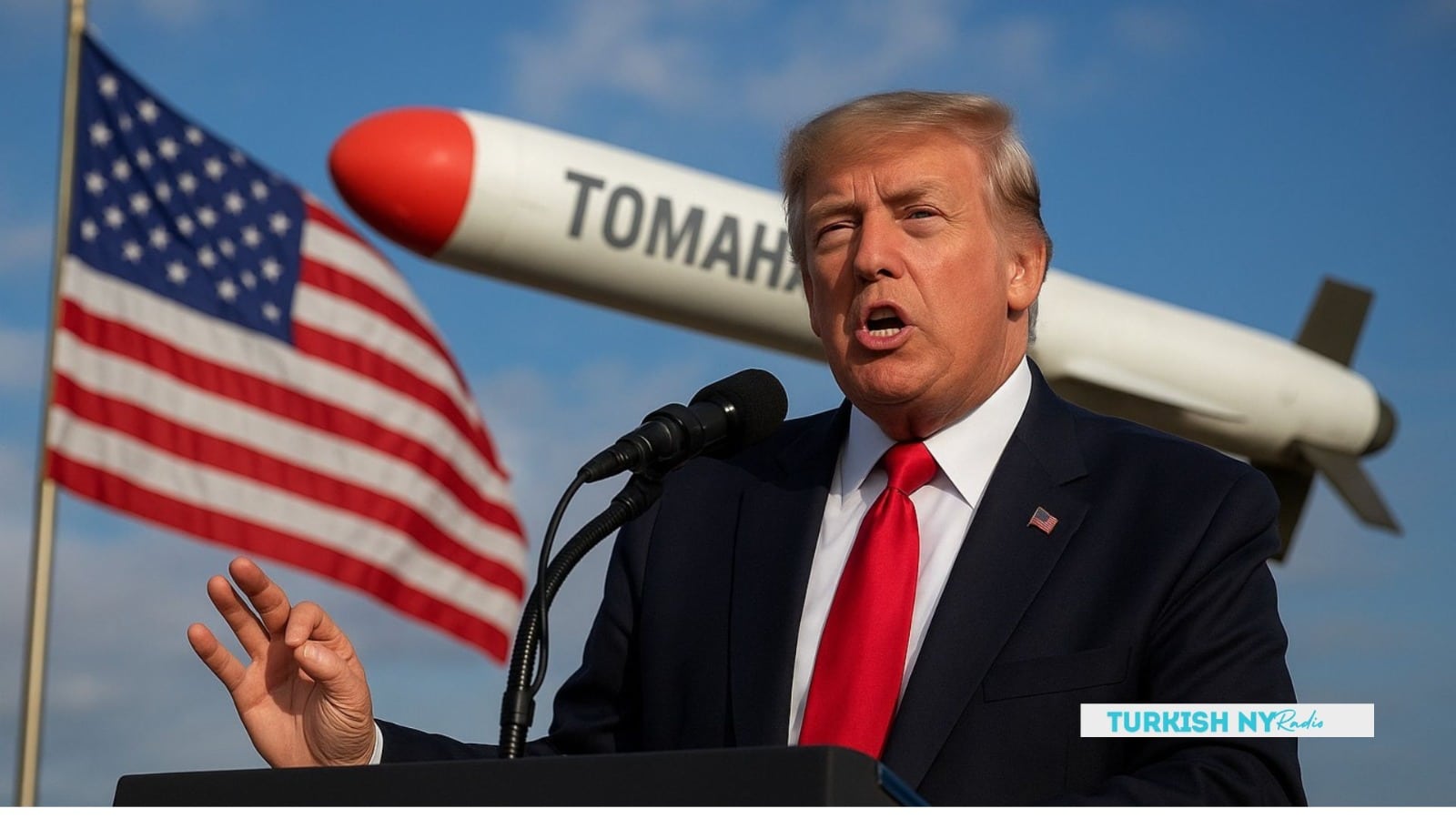
President Donald Trump declared on Monday that he is “not currently considering” sending Tomahawks for Ukraine at least for now.
His choice of words, especially the pause-inducing “for now,” has ignited a fresh round of debate among diplomats, defense experts, and political analysts about what exactly the U.S. strategy in Eastern Europe looks like under his administration.


The announcement, made aboard Air Force One while en route from Palm Beach, Florida, wasn’t a fiery rejection rather, it was a careful dance between caution and calculated leverage.
For Ukraine, the hesitation means another moment of waiting, while for Russia, it’s a signal that Washington’s red lines are still fluid.
Trump’s “For Now” Stance Leaves Doors Open
Speaking to reporters, Trump said, “I’m not really considering that option things can change, but at this moment, I’m not.” His remarks followed weeks of speculation that the White House was reviewing whether to transfer long-range Tomahawk cruise missiles, capable of striking deep inside Russian territory.
According to Reuters, discussions about supplying Tomahawks for Ukraine had intensified after NATO Secretary-General Mark Rutte’s visit to the White House in late October.
Rutte confirmed that the matter was “under review,” while emphasizing that the final call rested with the United States.
Analysts see Trump’s response as a strategic balancing act signaling deterrence without escalation. It’s consistent with his “America First” doctrine, where military aid is filtered through a domestic cost-benefit lens.
A War of Words and Warnings
Just weeks ago, AP News reported Trump privately warned Russia that he might consider supplying Tomahawks for Ukraine if Moscow failed to show progress toward ending the war. But his latest remarks suggest that line may have shifted again.
Russia, unsurprisingly, has been vocal. Kremlin spokesperson Dmitry Peskov called any transfer of Tomahawks for Ukraine a “red line” that would mark a “qualitatively new stage of escalation.”
Meanwhile, Ukrainian officials have expressed disappointment but held out hope. “We understand the complexity of U.S. decisions,” said an aide to President Volodymyr Zelenskyy in an interview with The Kyiv Independent. “But every delay has a cost measured in lives.”
The Stakes Behind the Missiles
Tomahawk missiles first deployed in the Gulf War are precision-guided, long-range weapons capable of hitting targets over 1,000 miles away.
Granting Tomahawks for Ukraine would allow Kyiv to target Russian logistics, command centers, and even strategic facilities far beyond the front lines.
Pentagon officials reportedly believe there’s enough inventory to share without compromising U.S. defense readiness.
Yet Trump’s caution isn’t unfounded: such a move could dramatically escalate the conflict and complicate already fragile peace channels.
A Policy in Motion
Observers note that Trump’s careful phrasing suggests the door remains open. In Washington, foreign-policy watchers have seen this pattern before Trump floats, freezes, and re-floats ideas as geopolitical conditions shift.
The Guardian points out that Trump’s reluctance stems partly from concerns about U.S. stockpiles and partly from a belief that restraint could coax Russia toward negotiation.
“For Trump, ambiguity is leverage,” one former diplomat told the paper.


For now, the world waits to see if “no” eventually becomes “yes.”
Conclusion
Trump’s decision to withhold Tomahawks for Ukraine may be viewed as pragmatic caution or, to critics, as strategic hesitation. Either way, it underscores his transactional approach to foreign aid and his desire to project control over global conflicts.
As winter looms and battlefield dynamics shift, the question remains: will restraint bring negotiation or embolden aggression? For now, the answer seems as uncertain as the phrase itself “not right now.”
For more news, visit our platform.
FAQs about Tomahawks for Ukraine
1. What are Tomahawk missiles?
Long-range, precision cruise missiles designed for deep-strike capability, used extensively by the U.S. Navy.
2. Why did Trump refuse to send Tomahawks for Ukraine?
He cited concerns about escalation and keeping options open for future negotiations.
3. Could this decision change later?
Yes. Trump emphasized “for now,” suggesting a temporary stance that could evolve.
4. How has Ukraine responded?
Ukrainian officials have expressed disappointment but said they remain hopeful for continued U.S. support.
Glossary of Key Terms
-
Tomahawk Missile: U.S. long-range cruise missile capable of precision strikes.
-
Escalation: The process of intensifying a military conflict.
-
NATO: North Atlantic Treaty Organization, a U.S.-led defense alliance.
-
Stockpile: Reserve quantities of weapons or military resources.