



This article was first published on TurkishNY Radio.
For more than a decade, United States crypto firms operated in a fog of overlapping rules. One agency treated a token like a commodity, another treated it as a security, and a third focused only on money laundering.


The revised 2025 regulatory plan of the Securities and Exchange Commission (SEC) sits right in the middle of that messy history and tries to turn enforcement-driven chaos into a structured framework for digital assets.
The new roadmap does not simply promise more rules. It ties the SEC impact agenda to a broader policy reset in Washington, a shift in leadership at the agency, and a coordinated push known as Project Crypto. Together, these pieces aim to give token issuers, exchanges, custodians, and investors something they have rarely had in the United States: clear, forward looking expectations.
A new 2025 roadmap after years of regulatory fog
The Spring 2025 Regulatory Flexibility Agenda places crypto assets near the top of the near term rulemaking list. The agenda describes potential rules on the offer and sale of crypto assets, crypto market structure, custody, transfer agents, and broker dealer responsibilities.
The stated goal is simple to read, but hard to execute in practice. The SEC wants clear rules for issuance, trading, and safekeeping of digital assets, while it continues to discourage fraud and market abuse.
Legal analyses of the agenda point out that this is not just about adding new restrictions. The plan also aims to trim or delay several legacy items from the prior administration and to reduce unnecessary disclosure burdens for public companies.
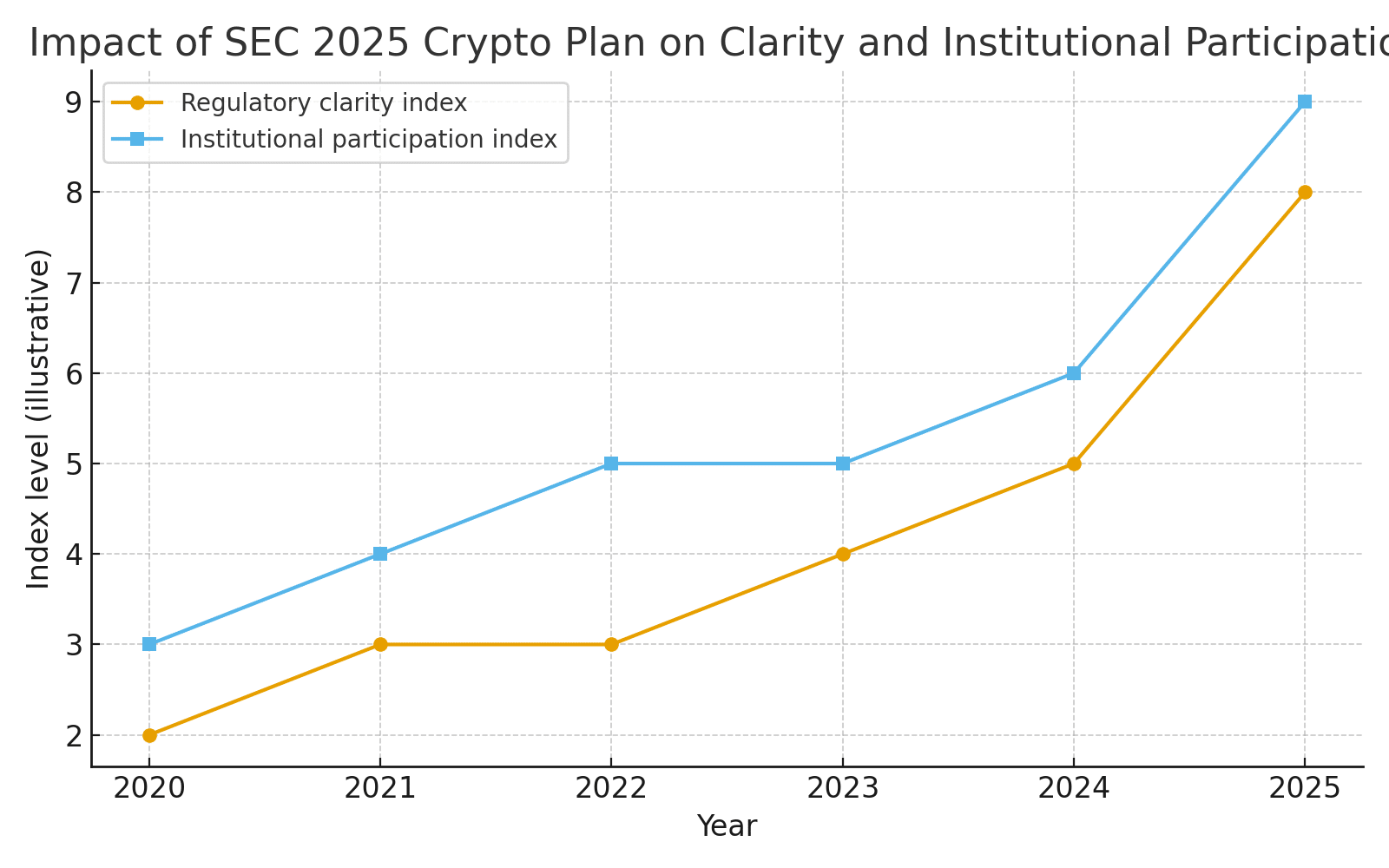
That includes companies that hold crypto on the balance sheet or that build token-based products. In other words, there’s a visible tilt toward capital formation and market efficiency, not only toward punishment.
Recent steps support that narrative. Early in 2025, the SEC impact revoked a controversial accounting bulletin that forced custodians of digital assets to show those assets as liabilities. Banks and trust companies argued that the bulletin made it too costly to serve crypto clients. Its removal signaled that the new leadership was prepared to revisit past decisions that had chilled institutional custody.
Inside Project Crypto and the Crypto Task Force
Alongside the formal agenda, Project Crypto has become the public face of the new regulatory philosophy. In recent speeches, the SEC chair described Project Crypto as a multi-year effort to apply federal securities laws based on how tokens actually function, rather than on labels or fear-driven narratives.
The SEC Crypto Task Force, which predates the current chair but has gained fresh authority, focuses on several core jobs. It works on drawing a sharper line between securities and non securities, designing tailored disclosures for token projects, and mapping realistic paths to registration for both assets and intermediaries. It also helps ensure that enforcement resources go after real misconduct rather than technical violations that arise from uncertainty.
Commentary from regulatory specialists notes that Project Crypto is tightly linked to a broader harmonization push with the Commodity Futures Trading Commission.
The CFTC, for its part, has moved toward allowing listed spot crypto trading on registered futures exchanges, coordinated with the SEC impact so that firms are not crushed between conflicting standards. This coordination is essential if the market is going to support tokenized products that sit across securities and commodities lines.
What the 2025 plan means for exchanges, brokers, and custodians
For trading venues, the 2025 agenda could be transformative. The SEC is considering crypto market structure amendments that would clarify how national securities exchanges and alternative trading systems may handle crypto asset securities and, potentially, some non security tokens on the same regulated platforms.
Today, a large share of spot volume still runs through offshore or lightly supervised venues. Shifting more activity into regulated environments with surveillance and reporting rules borrowed from equities would change the risk profile for the entire market.
Broker dealers and custodians sit at the center of this shift. Draft policy ideas include updated custody rules that explicitly cover digital assets, clearer criteria for what counts as a qualified custodian, and revamped financial responsibility rules that reflect how token settlement and wallet technology work in practice.
Legal observers expect the SEC to recognize a wider set of bank and trust models as eligible custodians, which would open the door for more traditional institutions to serve crypto clients at scale.
For decentralized projects, questions remain. If a protocol handles order routing, price discovery, or automated market making, at what point does it become an exchange or an alternative trading system under securities law.
The agenda indicates that those issues will be addressed with more explicit guidance, rather than case-by-case enforcement alone. That guidance will matter for how far DeFi platforms can go while remaining accessible to United States users.
How the plan could change market behavior
If the SEC impact delivers on the roadmap, the practical impact could be significant. Token teams may gain well-defined offering paths, including exemptions and safe harbor models that allow early innovation while still protecting buyers. Asset managers may receive clearer permission to hold spot crypto and tokenized instruments inside funds that serve retail investors. Large institutions may finally feel comfortable moving from pilot projects to full product lines.
This does not mean that risk disappears. Projects that ignore disclosure rules or mislead investors are still likely to face enforcement. However, the balance shifts from guessing at the rules to planning around them.
Over time, that tends to lower the cost of capital for credible projects and to push weaker projects either to improve or to exit. For a market that has lived through repeated boom and bust cycles, a more predictable policy environment can be as valuable as a single bullish headline.
Key crypto indicators that matter even more under the new rules
Regulation does not replace market fundamentals. Under a clearer 2025 framework, several indicators become even more important for analysts and long term participants.
Trading volume and liquidity sit near the top of that list. Deep order books on regulated venues signal that institutions are comfortable with both the asset and the rulebook around it. Thin liquidity, especially when paired with heavy promotional activity, remains a classic red flag.
Volatility is another key measure. Crypto will probably remain more volatile than most traditional asset classes, but the pattern of volatility matters. A market that reacts sharply to every regulatory headline is a market that still lacks clarity. As the new rules take shape, sustained spikes on routine policy news may gradually give way to calmer reactions.
On chain flows and stablecoin activity also offer clues. Rising stablecoin supply and active on chain transfer volumes can signal growing use of crypto rails for payments, collateral, and settlement. In a world with formal custody and market structure rules, these flows may increasingly connect to regulated institutions rather than to purely offshore activity.
Market dominance and rotation tell a parallel story. Shifts in the share of total market value held by the largest assets often track risk appetite. If clear regulation draws more conservative capital into the market, dominance measures for established assets may rise relative to thin, speculative tokens.
None of these indicators stands alone, but together they help illustrate whether the new regulatory framework is attracting patient capital or simply fueling the next short term bubble.
The global picture and competitive pressure
The United States is not designing its crypto regime in isolation. Other jurisdictions already have full frameworks in place for digital assets and tokenization. The European Union has its comprehensive rules, several Asian centers run licensing systems that cover exchanges, custodians, and token issuers, and a number of Gulf and offshore hubs compete to attract high growth projects.
If the SEC manages to finalize a coherent 2025 rulebook, the country can compete more directly for high quality firms that want both innovation and legal certainty. If the process stalls, talent and capital may continue to flow to regions where rules are already written down. For global investors, the shape of the United States regime matters because it influences where the deepest, most transparent markets will live in the next cycle.


Conclusion
The revised 2025 plan of the SEC impact, combined with Project Crypto and a more cooperative stance with other regulators, represents a meaningful inflection point for digital asset oversight in the United States. The transition from enforcement first to rulemaking first is still in progress, and key details remain open for public debate.
However, the direction is clear. The agency is moving toward a world in which token classification, custody, trading, and disclosure are governed by explicit rules rather than by hints in courtroom filings. For a market that depends on trust, liquidity, and long term capital, that shift may prove as important as any short term price move.
Frequently asked questions
What is the main goal of the SEC 2025 crypto plan
The main goal is to create a consistent framework for issuing, trading, and safeguarding crypto assets, so that firms and investors can rely on written rules instead of case by case enforcement.
What is Project Crypto
Project Crypto is a multi year initiative inside the SEC that focuses on digital assets. It coordinates policy work on token classification, disclosures, custody, and market structure, and it works with other agencies to reduce overlapping or conflicting rules.
How could the new rules affect crypto exchanges
The agenda signals that regulated exchanges and alternative trading systems may receive clearer permission to list crypto asset securities and possibly some non security tokens, with stricter surveillance and reporting standards. This could shift more volume from offshore venues to regulated platforms.
Will DeFi platforms be covered by the plan
DeFi platforms are not excluded. The SEC intends to address when protocol based trading functions cross the line into regulated exchange or broker activity. Exact rules are not final yet, but guidance is expected as part of the 2025 agenda.
Glossary of key terms
Crypto asset
A digital token that can represent a payment asset, a utility feature, a right to cash flows, or other economic interests on a blockchain network.
Custody
The service of holding assets on behalf of clients. In crypto, custody often involves secure key management, wallet infrastructure, and compliance controls.
DeFi
Short for decentralized finance. A set of applications that use smart contracts instead of intermediaries to provide services such as trading, lending, and derivatives.
Market structure
The legal and technical architecture of a market, including exchanges, brokers, custodians, clearing systems, and the rules that connect them.
Project Crypto
An SEC initiative that focuses on how federal securities laws apply to digital assets, with a goal of providing clarity on token classification, disclosure, and market oversight.
Regulatory agenda
A formal public list of rules that an agency expects to propose or finalize over a given period, often used as a roadmap by businesses and investors.
Stablecoin
A digital asset that aims to maintain a stable value, often by being backed by reserves or linked to a fiat currency such as the United States dollar.
Volatility
The degree of price change over time. Higher volatility means prices move more sharply, which can signal elevated risk or intense speculation.